The vast and unforgiving landscape of the Central Asian steppe presents a stark canvas where human history and ancient wildlife migrations have intersected for millennia. Skidding off the primary paved routes onto unpaved, mud-slicked tracks maintained only by seasonal tire ruts, researchers and conservationists navigate a terrain that feels largely untouched by contemporary civilization. Flanking these primitive trails are parallel pathways, carved into the earth by nomadic herds, which fork, merge, and crisscross the expanse. In the distance, howling Siberian winds drive the silhouettes of thousands of saiga antelopes—a critically resilient species whose lineage predates the retreat of the last ice age.
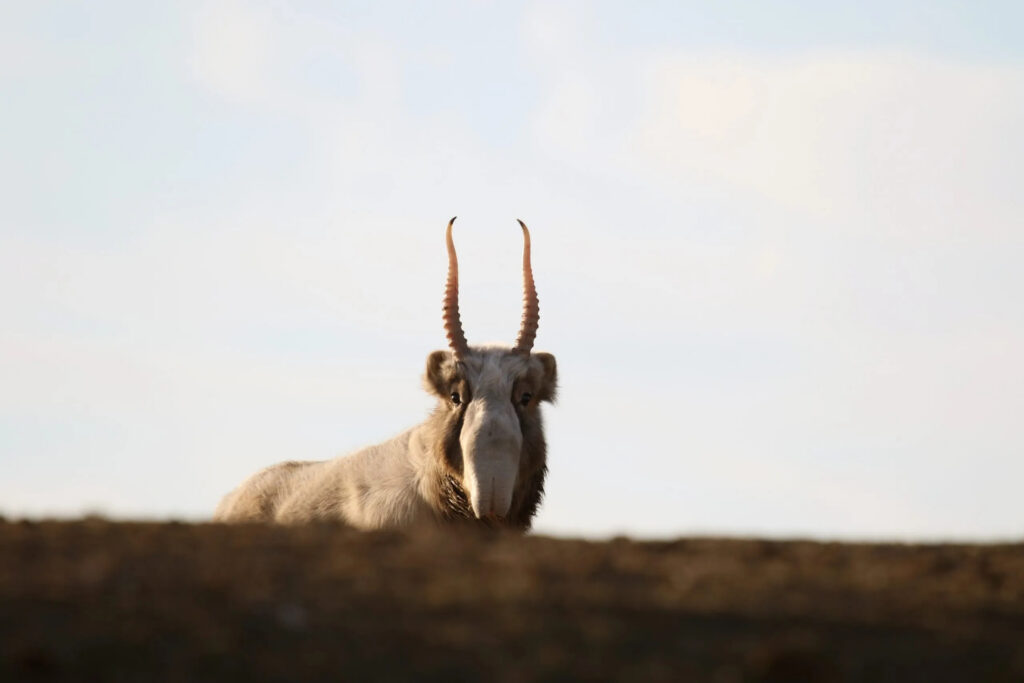
Through binoculars, this scene unfolds as an ancient tableau. Hundreds of saigas, distinguished by their unique, bulbous snouts, sprint across the treeless plain. These physiological features are evolutionary marvels: their floppy, elongated noses function as natural filtration systems to block out dense dust during arid periods, while simultaneously warming the frigid, sub-zero winter air before it reaches their lungs. Observing these animals charge through the bleak horizon highlights an enduring truth of the region: the saiga is an inherently migratory species, bound to a continuous cycle of movement across national borders.
Deep Evolutionary Roots and the Nomadic Heritage
Since time immemorial, the saiga antelope has blazed trails across Central Asia, outliving a menagerie of Pleistocene megafauna that included woolly mammoths, saber-toothed cats, and giant deer with twelve-foot antlers. When early human caravans first attempted to traverse this harsh terrain, indigenous populations often relied on saiga migration routes to locate water sources and passable terrain.
This deep connection to movement is mirrored in human history. The very term "Kazakh" is widely believed to derive from the Turkic word qaz, meaning "wanderer" or "vagabond." For millennia, small human groups migrated seasonally, moving to higher altitudes during scorching summers where melting snow provided hydration and greenery, before retreating to sheltered valleys ahead of winter storms. These ancient transit corridors ultimately helped pave the way for the development of the Silk Road—an intricate web of pathways linking transcontinental trade hubs. The fertile banks of the Ural River, serving as the natural geographical boundary between Europe and Asia, emerged as a vital crossroads where East met West.
However, the twentieth century brought profound disruption to this timeless rhythm. Following the rise of the Soviet Union, mandatory sedentarization policies forced nomadic human populations into agricultural settlements, extinguishing a mobile culture that had persisted for generations. While this shift was framed as modernization, it fundamentally conflicted with the ecology of the region, much of whose soil proved unsuitable for intensive crop cultivation. While human populations adapted to stationary urban centers, the saiga antelope maintained its ancient migratory imperatives, setting the stage for a modern conflict between wildlife preservation and infrastructure development.
The Rutting Season and Contemporary Field Audits
To better understand and protect these fragile populations, field researchers from organizations such as the Association for the Conservation of Biodiversity of Kazakhstan (ACBK) conduct regular seasonal audits. Participating in these field expeditions requires confronting extreme environmental conditions. Seasonal rains frequently transform grasslands into treacherous sludge, turning vehicular transit into a test of endurance and controlled hydroplaning.
Field audits are strategically timed to coincide with the saiga rutting season—a critical biological window occurring in late autumn and early winter. During this period, antelopes congregate in massive single-file lines before engaging in competitive displays. Males participate in aggressive headbutting rituals to establish dominance and demonstrate physical fitness to female onlookers. This expenditure of energy is so intense that many males temporarily cease feeding, occasionally succumbing to physical exhaustion. Females, meanwhile, assess potential mates based on physical prowess and the distinctiveness of their enlarged snouts, which serve as a primary indicator of genetic vitality.
Historically, locating these nomadic herds on the boundless steppe was a matter of guesswork and endurance, with conservationists often spending weeks searching the horizon in vain. Today, modern technology has revolutionized wildlife management. The deployment of GPS telemetry collars allows researchers to track real-time movements, yielding a reliable daily stream of location data. This empirical evidence has become the foundation for establishing new protected areas, ensuring that conservation boundaries align with actual wildlife usage rather than arbitrary administrative lines.
Infrastructure Fragmentation and the Loss of Spatial Knowledge
Despite technological advancements in tracking, the saiga population faces severe existential threats from rapid industrial development. As the interior steppe has become more accessible, the construction of linear infrastructure—including rattling railways, high-speed roads, and border fencing—has severely fragmented historical migration routes.
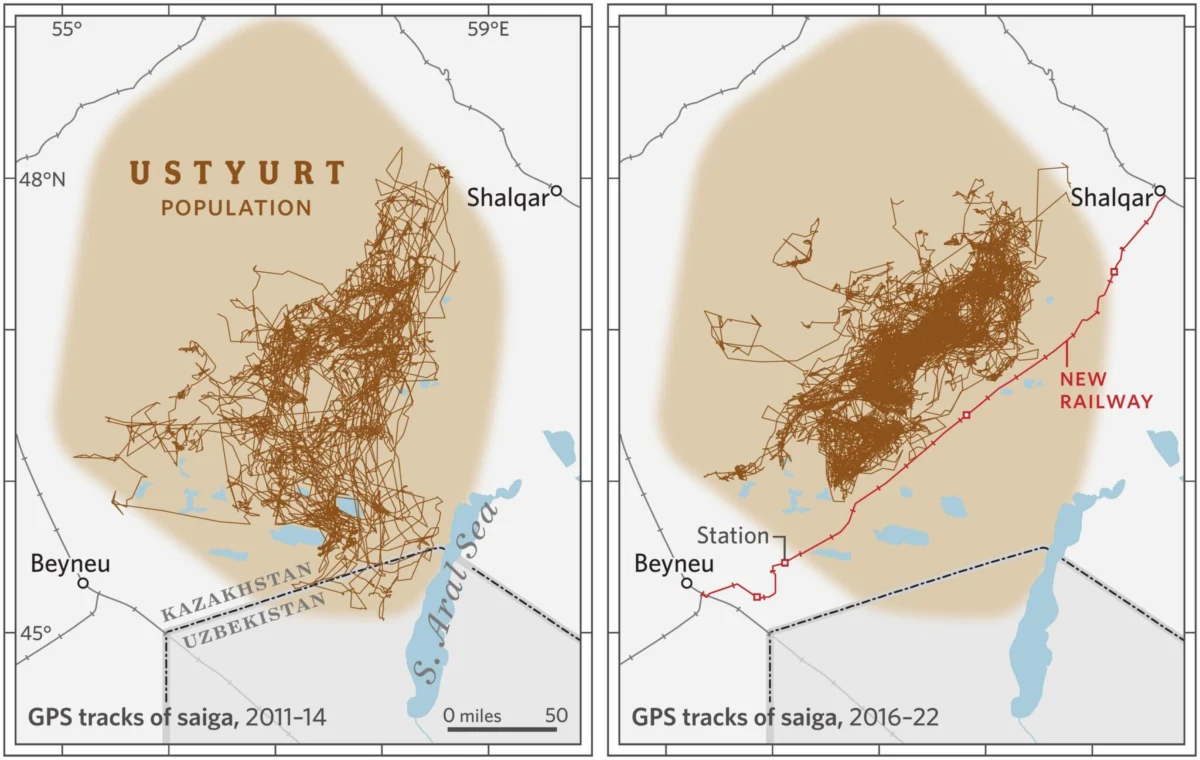
Data collected by ACBK illustrates the devastating impact of these barriers. Historically, saiga populations routinely trekked hundreds of miles from the Caucasus Mountains to Mongolia, navigating an uninterrupted expanse. However, the construction of a railway line in 2014, for example, abruptly severed traditional migration corridors extending deep into Uzbekistan. Comparative mapping data reveals a stark contrast: pre-construction tracking showed fluid, seasonal movements across international borders, while post-construction data depicts collared animals pacing despondently on the northern side of the tracks, unable to access traditional foraging grounds and water sources south of the barrier.
This artificial partitioning leads to a catastrophic loss of spatial knowledge. Similar to how human populations forced into sedentarization lost their traditional navigational literacy, young saigas learn migration routes, water sources, and seasonal shelters through active participation and observational learning passed down through generations. When migration corridors are abruptly severed, this collective cultural memory fades, threatening the long-term viability of the herds.
Cross-Border Conservation Initiatives and Mitigation Strategies
Recognizing the severity of the fragmentation crisis, conservation organizations and regional governments have initiated targeted mitigation projects to restore ecological connectivity. ACBK, in partnership with the Kazakh government, has spearheaded the construction of saiga-friendly crossing infrastructure. These initiatives include engineering slightly sloping dirt ramps that rise to the elevation of railway lines, creating the visual illusion of a natural gap in the barrier. Additionally, strategic placement of cattle-guard fencing well away from the crossings prevents direct collisions between trains and wildlife, preserving the safety and usability of the pathways.
International cooperation has also proven vital. ACBK has collaborated with authorities in neighboring Uzbekistan to modify rigid border security infrastructure. Traditional barbed-wire walls have increasingly been replaced with X-shaped barricades that effectively deter unauthorized vehicular traffic while leaving sufficient clearance for saigas to move freely underneath or between structural elements. Conservationists anticipate that these structural adaptations will gradually rebuild the structural trust necessary for herds to reoccupy historical ranges.
Broader Implications for Ecological Resilience
The plight of the saiga antelope highlights a broader global challenge in conservation biology: reconciling linear industrial development with the biological imperatives of migratory species. As human encroachment continues to alter natural landscapes, the preservation of trans-boundary migration corridors remains paramount for maintaining genetic diversity and ecosystem health.
The ongoing efforts in Kazakhstan and Uzbekistan serve as an important case study in modern wildlife management, demonstrating that data-driven conservation can successfully bridge the gap between infrastructural development and the preservation of ancient natural heritage. By restoring pathways across the Eurasian steppe, conservationists aim to ensure that the saiga—a survivor of the Pleistocene epoch—continues to navigate the boundless horizons of Central Asia for generations to come.