










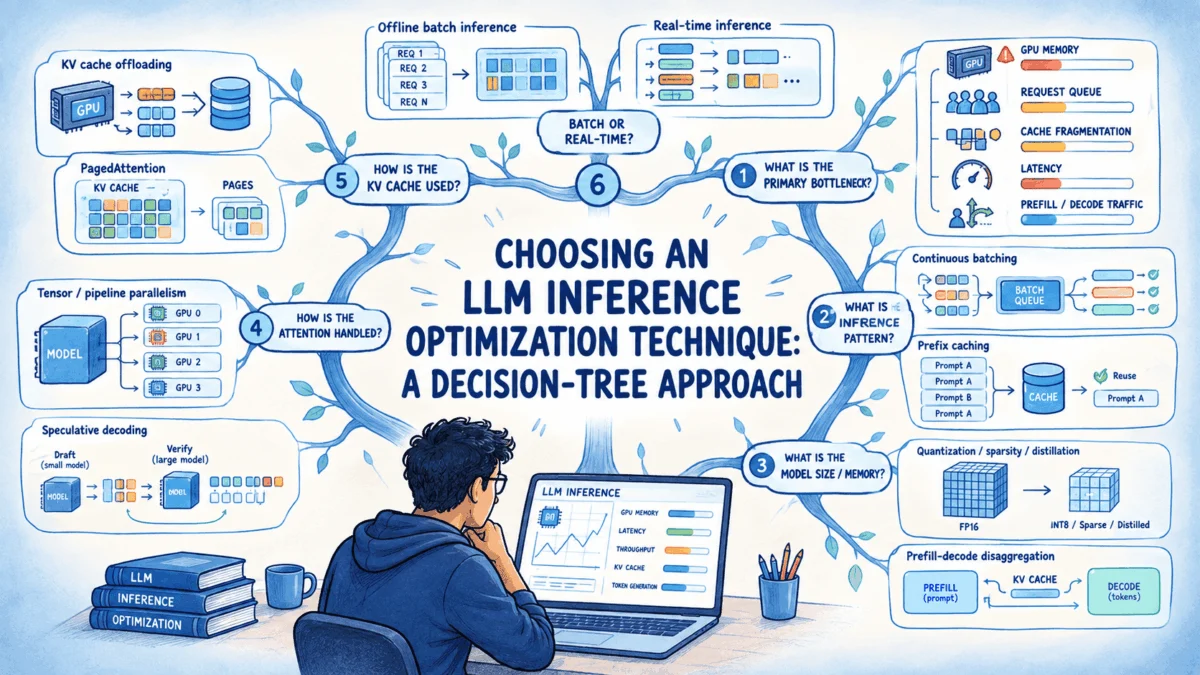
As the deployment of Large Language Models (LLMs) transitions from experimental prototypes to enterprise-scale production systems, engineering teams face mounting economic and operational pressures. While model capabilities continue to expand, the computational and memory footprints required to serve them have grown exponentially. In modern AI infrastructure, inference frequently becomes slow and prohibitively expensive as user traffic scales. Production environments routinely experience requests queuing behind protracted token generation cycles, GPU high-bandwidth memory (HBM) filling to capacity with cached attention states, and expensive hardware sitting underutilized while waiting on memory read operations.
Inference optimization encompasses a diverse array of hardware and software techniques engineered to alleviate these bottlenecks. However, these methods are not universally applicable silver bullets. Each optimization strategy targets a distinct constraint—whether memory capacity, compute throughput, or request scheduling dynamics—and relies on specific assumptions regarding workload characteristics. Selecting an inappropriate technique can introduce architectural complexity without yielding performance gains, or worse, degrade throughput and latency. To navigate this complexity, systems architects increasingly rely on diagnostic frameworks, such as a six-question decision tree, to systematically match optimizations to actual workload bottlenecks.
The Economic and Computational Reality of LLM Serving
To understand the necessity of targeted optimization, one must examine the fundamental mechanics of LLM inference, which fundamentally differs from traditional deep learning workloads. Inference occurs in two distinct phases: prefill and decode. During the prefill phase, the model processes the entire input prompt in parallel, creating a massive compute-bound workload that heavily utilizes tensor cores. Once the prompt is processed, the model enters the decode phase, generating response tokens autoregressively, one token at a time.
The decode phase is notoriously memory-bandwidth bound. Because every single token generation step requires loading the entire model’s weight parameters from GPU memory into SRAM, hardware utilization drops drastically. Furthermore, maintaining the Key-Value (KV) cache—which stores intermediate attention states to prevent redundant calculations across tokens—consumes vast amounts of VRAM. As concurrent user traffic surges, the KV cache expands rapidly, frequently causing memory fragmentation and forcing administrators to artificially cap batch sizes.
Industry benchmarks indicate that unoptimized enterprise LLM deployments often suffer from GPU utilization rates below 30%, with significant capital expenditure wasted on over-provisioned hardware. Consequently, cloud providers and enterprise engineering organizations have invested heavily in developing specialized serving engines, caching layers, and hardware-software co-design strategies to maximize hardware efficiency.
Chronology of LLM Inference Optimization Evolution
The rapid maturation of LLM serving infrastructure over recent years highlights how quickly the industry has had to adapt to soaring deployment scales:
- 2020–2022 (The Naive Era): Early LLM deployments relied heavily on standard deep learning frameworks like PyTorch or Hugging Face Transformers. Serving architectures used static batching, where incoming requests were grouped into fixed-size batches and forced to wait for the slowest generation to complete, leading to severe GPU starvation.
- Late 2022–2023 (The Memory Revolution): Following the release of architectures like LLaMA and the mainstreaming of chatbot applications, memory bottlenecks took center stage. Innovations such as continuous (in-flight) batching eliminated static batch waiting periods, while PagedAttention revolutionized VRAM management by eliminating KV cache fragmentation, dramatically raising maximum batch capacities.
- 2024 (Specialization and Disaggregation): As prompts grew longer through Retrieval-Augmented Generation (RAG) and multi-turn agent frameworks, prefix caching emerged to eliminate redundant prefill computations. Concurrently, large-scale deployments began decoupling prefill and decode phases onto separate physical hardware nodes to prevent resource contention.
- 2025–Present (Algorithmic Hardware-Software Co-Design): Modern inference stacks integrate multi-node tensor parallelism, advanced quantization schemas (such as FP8 and sub-integer formats), and speculative decoding natively within high-performance serving engines like vLLM, TensorRT-LLM, and Modular Inference Engine.
Taxonomy of Optimization Techniques and Underlying Assumptions
Before applying any mitigation strategy, engineers must verify whether their workload satisfies the core assumptions of a given technique. Deploying optimizations blindly often introduces unnecessary maintenance overhead.
| Technique | Primary Assumption | Core Benefit | Main Trade-off |
|---|---|---|---|
| Quantization, Sparsity, & Distillation | Model exceeds hardware memory limits or latency budgets. | Reduces model footprint and memory bandwidth pressure. | Potential accuracy degradation; complex activation quantization. |
| Prefix Caching | Multiple requests share identical starting token sequences. | Eliminates redundant prefill compute for system prompts/history. | Requires exact character-level matching in the prefix. |
| Continuous Batching | Concurrent traffic with highly variable output lengths. | Maximizes GPU utilization by inserting/removing requests dynamically. | Minimal downside; largely dependent on serving engine support. |
| PagedAttention | KV cache memory is fragmented or over-provisioned. | Optimizes VRAM allocation via virtual memory-style paging. | Adds a page table lookup layer to attention calculations. |
| Speculative Decoding | Decode is the primary bottleneck; draft models can guess tokens. | Reduces inter-token latency by verifying multiple tokens at once. | Dependent on a high draft model acceptance rate. |
| Prefill-Decode Disaggregation | Prefill and decode phases contend for the same GPU at scale. | Isolates workloads to stabilize Time-to-First-Token (TTFT) and latency. | High network overhead for KV cache transfer between nodes. |
| Tensor & Pipeline Parallelism | Model parameters exceed the capacity of a single device. | Enables hosting of massive frontier models across multiple GPUs. | Inter-device communication overhead and pipeline bubbles. |
A Six-Question Decision Tree for Production Workloads
To eliminate guesswork, engineers can step through a structured decision tree designed to diagnose infrastructure bottlenecks and pinpoint the ideal intervention.
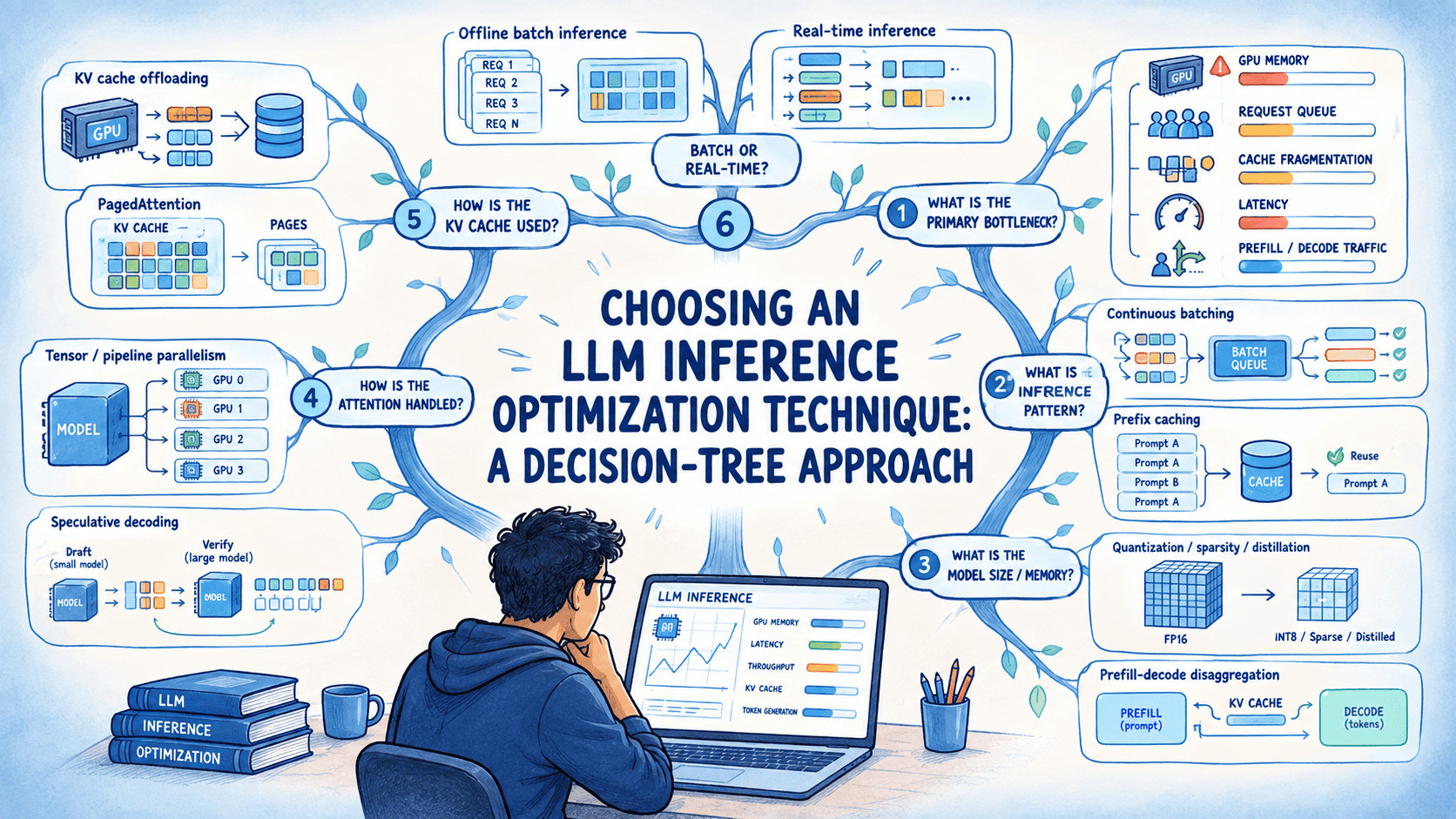
Question 1: Does the Model Fit Comfortably on Your Target Hardware?
The foundational constraint in any deployment is physical memory. A model that barely fits inside GPU memory leaves virtually no headroom for the KV cache, artificially capping maximum batch sizes regardless of how efficient the serving scheduler may be. If the base model consumes 90% of available VRAM, or if inference remains severely compute-bound even at a batch size of one, optimization must begin at the model level via compression techniques such as weight quantization (e.g., INT4/FP8), structured sparsity, or knowledge distillation. These steps are largely independent of the serving stack and establish the baseline hardware capacity available for traffic.
Question 2: Do Your Requests Share Repeated Prompt Structure?
If the model fits with ample headroom, attention shifts to traffic composition. Enterprise workloads—particularly customer support bots maintaining long chat histories, agentic frameworks executing thousands of sub-tasks with identical system instructions, and RAG pipelines prepending extensive retrieved documents—frequently exhibit high semantic redundancy. If a significant percentage of incoming traffic shares an identical prefix, prefix caching offers the highest return on investment. By caching the KV states of static text segments, the engine bypasses redundant prefill computations. Optimization engineers must note, however, that prefix caching demands exact character-for-character string matches; dynamic variables must be strictly relegated to the end of the prompt.
Question 3: Are Requests Arriving Concurrently With Variable Output Lengths?
Workloads characterized by a mix of brief classifications and extensive document generation create severe scheduling friction. Under naive static batching, the GPU remains locked until the longest generation finishes, idling hardware resources. If traffic arrives in overlapping bursts with unpredictable output lengths, continuous (in-flight) batching resolves the issue. By allowing completed sequences to exit the batch immediately and new requests to enter mid-cycle without waiting for global boundaries, GPU utilization normalizes. Most modern enterprise serving engines enable continuous batching by default.
Question 4: Is KV Cache Fragmentation Limiting Your Batch Size?
If an engine reserves static, contiguous memory blocks sized for maximum potential sequence lengths, short generations leave allocated VRAM vacant and inaccessible. If memory fragmentation restricts concurrency, PagedAttention mitigates the issue by partitioning the KV cache into fixed-size physical memory pages, managed similarly to virtual memory in operating systems. This non-contiguous allocation paradigm allows serving engines to pack significantly more concurrent requests into existing VRAM without sacrificing context length.
Question 5: Is Per-Token Decode Latency the Primary Metric?
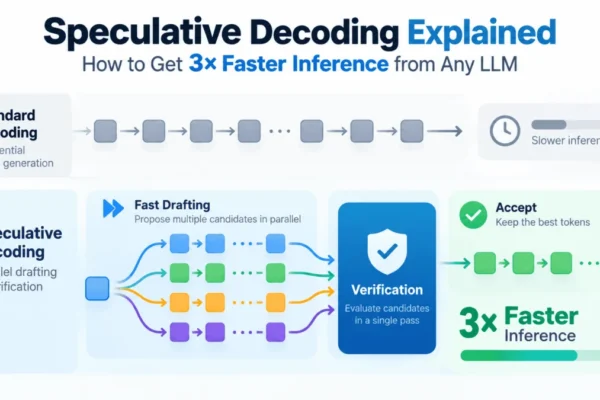
When overall system throughput is satisfactory, but interactive users experience sluggish token streaming during the decode phase, speculative decoding offers a pathway to lower inter-token latency. By pairing the primary large model with a smaller, highly efficient draft model that predicts multiple prospective tokens in a single forward pass, the system can verify and accept batches of tokens simultaneously. The viability of speculative decoding, however, rests entirely on the draft model’s acceptance rate; if predictions are frequently rejected, verification overhead outweighs the latency gains.
Question 6: Are Prefill and Decode Contending for the Same GPU at Scale?
At massive production scales, resource contention between the prefill phase (compute-bound) and the decode phase (memory-bandwidth-bound) on the same hardware can destabilize both Time-to-First-Token (TTFT) and inter-token generation latency. Prefill-decode disaggregation resolves this contention by splitting the architecture into specialized physical clusters: dedicated prefill nodes process incoming prompts and instantly transmit the resulting KV cache to dedicated decode nodes. While this architecture introduces network transfer overhead and routing complexity, it is an essential intervention for high-throughput, enterprise-grade deployments handling millions of daily tokens.
Industry Implications and Strategic Recommendations
Adopting a structured decision-tree methodology prevents engineering teams from falling into the trap of over-engineering. Industry analysts emphasize that modern LLM inference optimization is rarely solved by a single technique. Instead, scalable production architectures typically combine foundational model quantization, dynamic memory allocation via PagedAttention, and semantic request routing through prefix caching.
When optimizations fail to yield expected performance metrics, engineers are advised to audit underlying assumptions. For instance, if quantization fails to improve throughput, profiling often reveals that only model weights were compressed while activations remained at full precision, forcing the GPU to execute continuous, expensive data type conversions on the fly. Similarly, near-zero prefix cache hit rates usually point toward non-deterministic serialization or poorly structured prompt templates that place dynamic timestamps or user IDs at the head of the string.
Ultimately, aligning optimization techniques with empirically identified workload bottlenecks ensures optimal hardware utilization, controls ballooning cloud infrastructure expenditures, and delivers the low-latency experiences demanded by modern enterprise end-users.