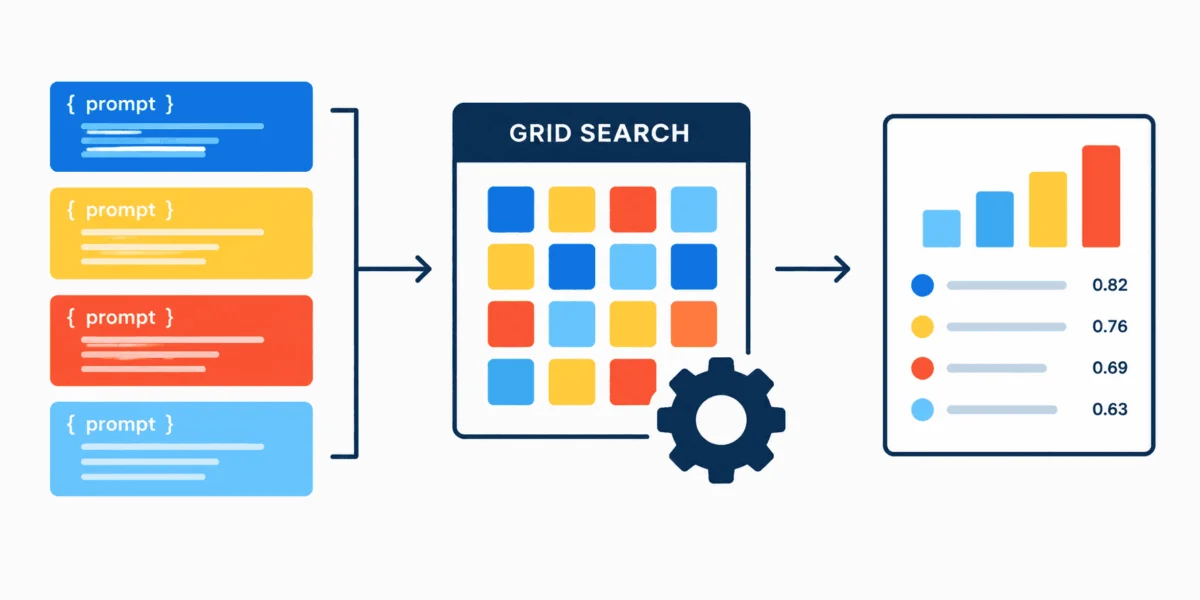
The intersection of traditional machine learning workflows and generative artificial intelligence has yielded a novel approach to prompt optimization, transforming how developers refine instructions for large language models (LLMs). By wrapping AI text generators inside custom scikit-learn compatible containers, practitioners can now apply classical hyperparameter optimization techniques—such as grid search—directly to natural language prompts. This methodological shift moves prompt engineering away from subjective trial-and-error toward rigorous, data-driven automation, bridging the gap between deterministic machine learning pipelines and probabilistic generative models.
Background and Context in Modern Machine Learning
For decades, data scientists optimizing predictive models have relied heavily on hyperparameter tuning algorithms like grid search and random search. These algorithms systematically evaluate combinations of structural parameters—such as learning rates, tree depths, and regularization penalties—to identify the configuration that maximizes performance metrics like accuracy or F1-score.
However, the advent of large language models introduced a starkly different paradigm. Traditional parameters gave way to natural language prompts, instructions, and context windows. Because minor variations in phrasing can drastically alter an LLM’s output during zero-shot or few-shot inference, prompt engineering quickly became a critical discipline. Despite its importance, prompt design has historically remained an ad-hoc, manual process characterized by subjective intuition rather than systematic experimentation.
To solve this inefficiency, modern machine learning infrastructure is increasingly adapting classical optimization tools to evaluate textual inputs. By treating prompt templates as categorical hyperparameters, developers can automate the search for optimal instruction syntax, leveraging computational power to discover phrasings that align best with a specific model and downstream task.
Step-by-Step Implementation: Building a Scikit-Learn Compatible LLM Wrapper
Implementing this workflow requires bridging the Hugging Face Transformers library with scikit-learn’s estimator interface. This integration enables standard cross-validation routines to interact seamlessly with generative language models.
The process begins by importing the necessary libraries, including NumPy, scikit-learn components (BaseEstimator, ClassifierMixin, and GridSearchCV), and the Hugging Face pipeline utility:
import numpy as np
from sklearn.base import BaseEstimator, ClassifierMixin
from sklearn.model_selection import GridSearchCV
from transformers import pipeline
To maintain computational efficiency and accessibility, developers often utilize lightweight pre-trained models, such as Qwen/Qwen2.5-0.5B-Instruct, which can run locally without specialized high-end cloud infrastructure:
generator = pipeline(
    "text-generation",
    model="Qwen/Qwen2.5-0.5B-Instruct"
)
The core of the architecture relies on a custom classifier class that inherits from scikit-learn’s BaseEstimator and ClassifierMixin. This custom class wraps the LLM generator, processes incoming data samples through parameterized prompt templates, and structures the input as a conversational message to guide the model toward a deterministic classification response rather than open-ended text completion.
class ZeroShotPromptClassifier(BaseEstimator, ClassifierMixin):
    def __init__(self, generator, prompt_template="Classify as positive or negative: text"):
        self.generator = generator
        self.prompt_template = prompt_template

    def fit(self, X, y=None):
        return self

    def predict(self, X):
        predictions = []
        for text in X:
            prompt = self.prompt_template.format(text=text)
            messages = ["role": "user", "content": prompt]
            output = self.generator(
                messages,
                max_new_tokens=5,
                pad_token_id=self.generator.tokenizer.eos_token_id
            )
            reply = output[0]['generated_text'][-1]['content'].strip().lower()
            if "positive" in reply:
                predictions.append("positive")
            elif "negative" in reply:
                predictions.append("negative")
            else:
                predictions.append("unknown")
        return np.array(predictions)
Empirical Evaluation and Hyperparameter Grid Search
To evaluate the efficacy of this automated framework, data scientists construct structured datasets consisting of text samples and ground-truth labels. Consider a lightweight sentiment analysis benchmark containing software and service reviews:
X = np.array([
    "I absolutely love this new feature!",
    "This update completely broke my workflow.",
    "Best user experience I have had all year.",
    "Terrible customer service and slow load times."
])
y = np.array(["positive", "negative", "positive", "negative"])
With the dataset and classifier defined, the next step involves establishing a hyperparameter grid (param_grid) containing distinct natural language prompt variations. Rather than tuning numerical weights, the grid tests alternate phrasing strategies to determine which instruction format resonates most effectively with the underlying model:
clf = ZeroShotPromptClassifier(generator=generator)

param_grid =
    'prompt_template': [
        "Classify as positive or negative: text",
        "Is the sentiment positive or negative? Text: text",
        "Analyze this review. Output 'positive' or 'negative': text"
    ]
By passing these components into scikit-learn’s GridSearchCV class with cross-validation configured (cv=2), the pipeline systematically evaluates each prompt variant against the training data to measure predictive accuracy:
grid = GridSearchCV(clf, param_grid, cv=2, scoring='accuracy')
grid.fit(X, y)
Upon completion of the search routine, the optimization framework identifies the superior prompt template alongside its associated cross-validated performance metric:
Optimization Complete!

Best Prompt Template: 'Analyze this review. Output 'positive' or 'negative': text'
Best Cross-Validated Accuracy: 75.0%
Industry Implications and Methodological Limitations
The successful execution of grid search over prompt templates highlights a broader maturation in AI engineering. By formalizing prompt optimization into established statistical frameworks, engineering teams can reduce their reliance on anecdotal prompt design. This methodology scales naturally: as larger datasets and more diverse prompt repertoires are introduced, the resulting performance metrics become increasingly robust.
Industry analysts note that while treating prompts as hyperparameters provides significant structural clarity, practitioners must remain mindful of computational overhead. Executing cross-validation routines that query generative language models demands considerably more compute time than traditional tabular machine learning algorithms. Furthermore, model sensitivity to subtle token changes means that minor syntactic edits outside the designated template variables can introduce variance into the evaluation process.
Despite these computational constraints, integrating LLMs into scikit-learn pipelines represents a vital step toward unified machine learning operations. As automated prompt tuning tools evolve, organizations will likely adopt similar systematic frameworks to ensure their generative AI deployments maintain optimal accuracy, consistency, and reliability across production environments.