











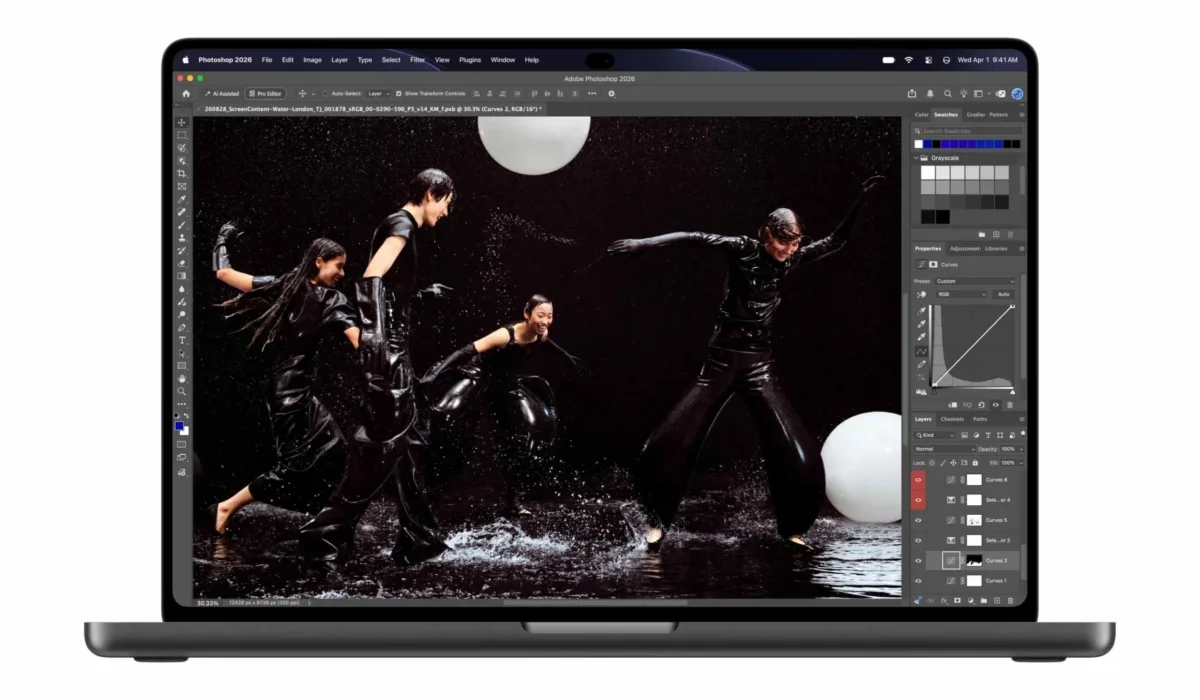
Apple Inc. has announced the launch of its most advanced and powerful professional laptop lineup to date, introducing a completely redesigned MacBook Pro family equipped with cutting-edge display technology, unprecedented hardware configurations, and a historic interface evolution. Highlighting the release is the integration of a revolutionary tandem OLED screen—marketed as the PROLED XDR display—which shatters traditional brightness and contrast thresholds for portable workstations. Furthermore, the new release marks two major milestones in the history of the Macintosh: the long-awaited introduction of touchscreen functionality to Apple’s flagship pro notebooks and the arrival of the Dynamic Island interface element.
Powered by the next-generation M5 Pro and M5 Max processors, the new MacBook Pro models are engineered to handle extreme computational workloads, ranging from complex 8K video rendering and heavy machine learning tasks to intricate software development and professional-grade digital asset creation. Available in both 14-inch and 16-inch form factors, the latest generation pairs desktop-class performance with remarkably thin, lightweight enclosures and a battery life that reaches up to 24 hours on a single charge. Pre-orders for the new devices are open immediately, with official retail availability and shipping scheduled for November 6.
Chronology and Evolution of the MacBook Pro Lineup
The trajectory of Apple’s professional laptop line has undergone several paradigm shifts over the past two decades. The transition from PowerPC processors to Intel in 2006 established the modern MacBook Pro moniker, laying the groundwork for unibody aluminum designs introduced in 2008. For years, the lineup evolved incrementally, focusing on thinner profiles, higher-resolution Retina displays, and polarizing interface changes such as the Butterfly keyboard and the Touch Bar.
A monumental turning point occurred in November 2020 with the introduction of Apple Silicon, beginning with the M1 chip. This proprietary architecture eliminated the thermal and efficiency constraints imposed by third-party silicon, delivering exponential performance gains alongside massive leaps in battery longevity. Subsequent iterations—the M2, M3, and M4 generations—steadily widened the performance gap between Apple’s hardware and legacy x86 architectures.
The introduction of the M5 Pro and M5 Max chips represents the pinnacle of this silicon evolution. Manufactured on an advanced node, these processors push multi-threaded compute performance and graphics rendering capabilities to unprecedented heights. Simultaneously, the transition from mini-LED backlighting to tandem OLED technology on the PROLED XDR display solves longstanding compromises in portable panel technology, bridging the gap between desktop reference monitors and mobile displays.
Technical Specifications and Hardware Engineering
The centerpiece of the new MacBook Pro is the PROLED XDR display. By utilizing tandem OLED architecture—which stacks two emission layers to achieve higher luminance without degrading pixel lifespan—the screen delivers a sustained 2,000 nits of peak brightness for both HDR and SDR content. This capability allows creative professionals working in brightly lit environments or outdoors to review high-dynamic-range footage with absolute fidelity. The display also boasts an astronomical 10,000,000:1 contrast ratio, a smooth 120Hz refresh rate utilizing adaptive ProMotion technology, and a wide color gamut that surpasses both P3 and Adobe RGB standards.
In a move that challenges years of traditional Apple interface design philosophy, the company has integrated capacitive touchscreen capabilities into the panel. Engineered specifically for professional workflows that benefit from direct manipulation—such as fine-tuning brush strokes in Adobe Photoshop, scrubbing through complex audio timelines, or navigating spatial design applications—the touchscreen layer is seamlessly fused into the glass without compromising optical clarity or color accuracy.
At the top of the display, the hardware cutout houses an upgraded camera system alongside the Dynamic Island. Originally introduced on the iPhone lineup, the Dynamic Island adapts in real time to display system alerts, background activities, media playback controls, and application shortcuts, offering a unified interactive notification hub on macOS for the first time.

Under the hood, the M5 Pro and M5 Max processors support configurations scaling up to an astonishing 16 terabytes of ultra-fast solid-state storage and 128 gigabytes of unified memory. This massive ceiling ensures that data-intensive applications, large language model local testing environments, and uncompressed multi-stream media assets can be loaded directly into memory without latency bottlenecks.
Despite housing these massive hardware upgrades, the physical footprint of the laptops has been reduced. The 14-inch model weighs a mere 3 pounds, while the larger 16-inch variant tips the scales at just 4 pounds. Both models feature thinner profiles than their predecessors while maintaining robust thermal architectures to sustain peak performance under heavy loads.
Audio performance has also been substantially overhauled. The upgraded six-speaker sound system features force-canceling woofers that deliver deeper, cleaner bass response and a wider soundstage, catering to mobile audio engineers and multimedia consumers alike. Connectivity options are comprehensively modern, featuring Wi-Fi 7, Bluetooth 6, Thunderbolt 5 ports for ultra-fast peripheral data transfer, an SDXC card slot, an HDMI port, a MagSafe 3 charging interface, and a high-impedance headphone jack.
Market Positioning and Pricing Structure
The new MacBook Pro lineup enters the market with a starting price of $2,749 for the entry-level configuration. Positioned squarely at enterprise professionals, software engineers, scientists, and elite creative artists, the pricing reflects the inclusion of top-tier components, proprietary silicon manufacturing costs, and advanced panel engineering.
Industry analysts note that while the starting price places the hardware at the premium end of the personal computer market, the inclusion of up to 16TB of storage and 128GB of unified memory allows the MacBook Pro to compete directly with high-end desktop workstation towers. By combining workstation-class power with a chassis that weighs under 5 pounds and delivers 24 hours of battery life, Apple continues to target mobile professionals who refuse to compromise on compute capability while traveling.
Industry Implications and Future Outlook
The launch of the MacBook Pro featuring tandem OLED, touchscreen support, and the M5 architecture is expected to exert significant pressure on the broader personal computer industry. Competitors in the Windows ecosystem have increasingly adopted OLED panels and touch interfaces, but Apple’s implementation of tandem OLED technology establishes a new benchmark for panel brightness, longevity, and color accuracy in laptops.
Furthermore, the integration of touchscreen technology into macOS signals a subtle yet significant shift in Apple’s software ergonomics. While the company has historically maintained a strict division between iOS/iPadOS touch devices and macOS desktop environments, the inclusion of touch on a pro-grade laptop suggests a converging user experience where direct manipulation complements traditional keyboard and trackpad inputs. Developers are expected to update their software suites rapidly to take full advantage of the touch-enabled PROLED XDR canvas.
As pre-orders roll out globally and devices reach consumers and enterprise clients following the November 6 shipping date, the market will closely evaluate how the M5 Pro and M5 Max handle sustained thermal loads and real-world battery benchmarks. Nevertheless, initial technical specifications indicate that Apple has delivered its most ambitious portable computer to date, setting a high standard for the future of professional computing hardware.