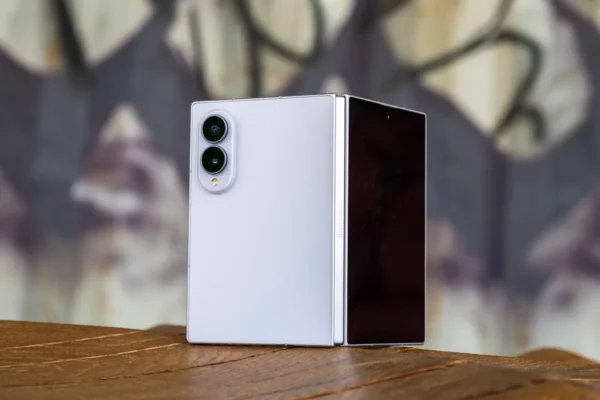









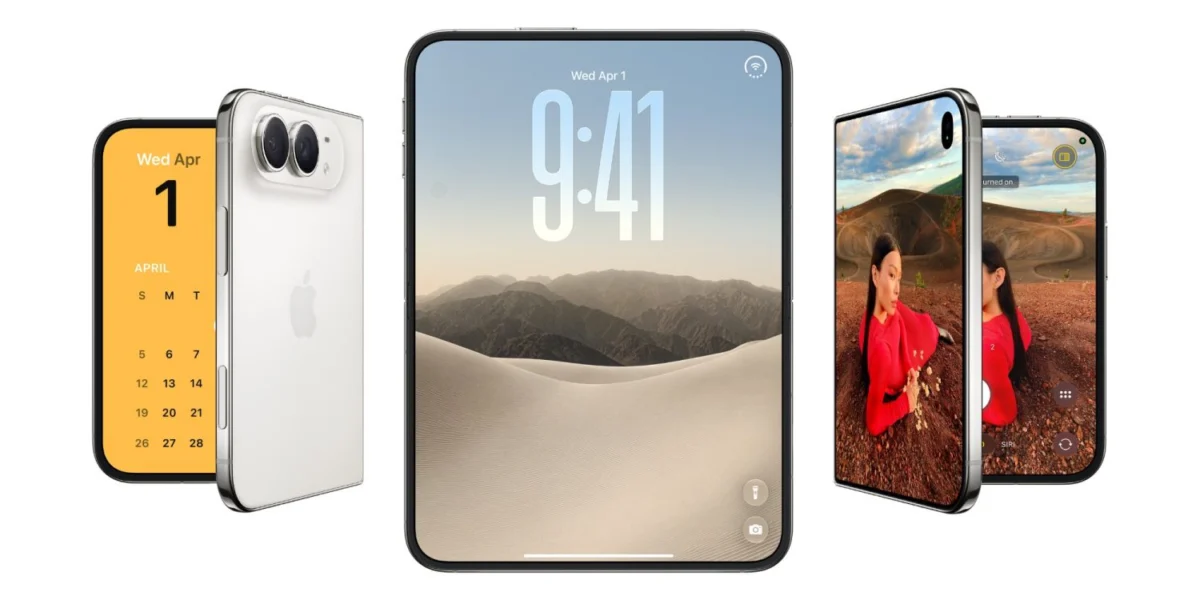
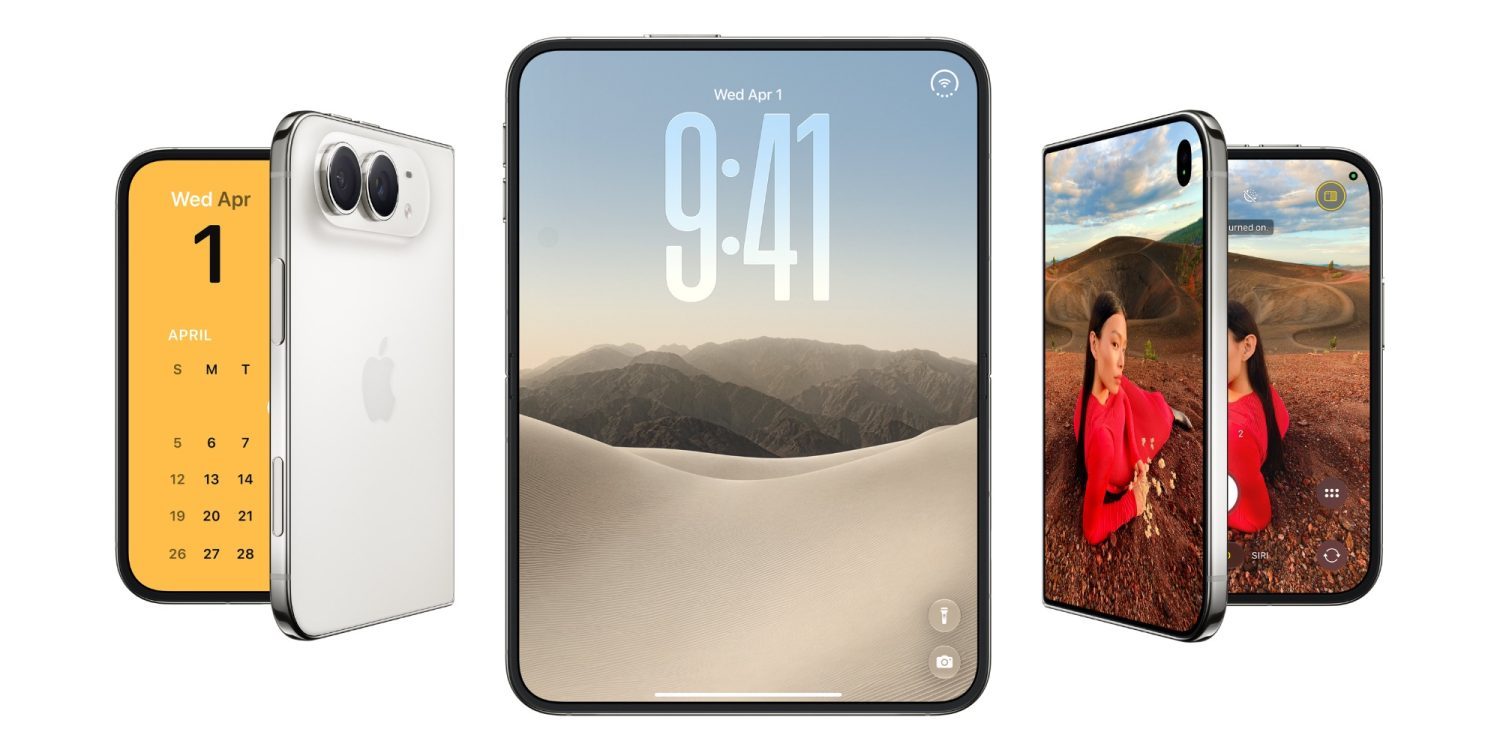
Apple’s highly anticipated entry into the foldable smartphone market with the debut of the iPhone Duo is already reshaping the mobile industry landscape. According to a comprehensive market intelligence report released by TrendForce, strong initial consumer demand out of the gate positions Apple to capture nearly 30 percent of the global foldable smartphone market by the year 2027. This projection highlights a significant shift in a segment that has historically been dominated by Android manufacturers such as Samsung and Huawei.
The milestone follows months of speculation surrounding Apple’s hardware roadmap. Industry analysts and consumers alike had waited years for the Cupertino-based tech giant to enter the foldable device category, which pioneered alternative form factors but struggled to achieve mainstream mass-market saturation due to software fragmentation, durability concerns, and high price points. With the official rollout of the iPhone Duo, market dynamics are shifting rapidly, validating Apple’s measured approach to adopting new hardware technologies.
Chronology of the iPhone Duo Launch and Market Forecasts
The trajectory of the iPhone Duo’s market impact can be traced through a precise timeline of announcements and analytical revisions. One day after Apple officially pulled back the curtain on the iPhone Duo last month, TrendForce published its initial assessment predicting that the company would successfully ship 5 million units of its inaugural foldable device by the end of 2026. At that juncture, the research firm estimated that this volume alone would secure Apple a commanding 24.8 percent share of the global foldable market within its first partial year of availability.
At the time of that initial September release, TrendForce analysts pointed to a stagnant broader market. The overall foldable smartphone market was projected to grow by a meager 0.5 percent throughout 2026, dragged down by a sharp contraction among Android brands, whose combined shipments were expected to fall by more than 20 percent year-over-year.
However, the outlook for the subsequent year presented a starkly different picture. TrendForce projected that the overall foldable market would rebound significantly in 2027, reaching 23.5 million total shipments—representing a robust 16.3 percent year-over-year increase. Analysts emphasized that Apple’s market entry would act as a primary catalyst for this expansion, driving technological refinements in hinge durability and display manufacturing while leveraging emerging artificial intelligence (AI) use cases to stimulate consumer demand.
Fast forward nearly a week after the iPhone Duo officially hit store shelves and began arriving on the doorsteps of early adopters, TrendForce issued an updated report. This latest publication reiterated the firm’s earlier bullish projections while revising Apple’s anticipated 2027 market share upward to an impressive 29.8 percent, cementing its status as an immediate powerhouse in the foldable sector.
Detailed Breakdown of Projected Market Share
To understand the magnitude of Apple’s ascent in the foldable segment, industry observers must look closely at the shifting competitive hierarchy projected for 2027. For years, the foldable market has been a two-horse race primarily contested by South Korean electronics giant Samsung and Chinese telecommunications titan Huawei, with smaller Android vendors carving out fractional niches.
According to TrendForce’s updated data, Samsung—long the undisputed pioneer and market leader in foldables—is expected to see its market share moderate. Samsung’s share of the global foldable market is projected to decline from 35.1 percent in 2026 down to 31.9 percent by 2027. While Samsung will technically retain the top spot in terms of total volume, its once-monopolistic grip on the category is clearly dissipating under competitive pressure.
Meanwhile, Huawei, which has maintained a strong foothold in domestic and select international markets with its inward and outward folding devices, is also projected to experience a downward adjustment in relative market share. Huawei’s market share is forecast to drop from 24.8 percent in 2026 to 21.3 percent in 2027.
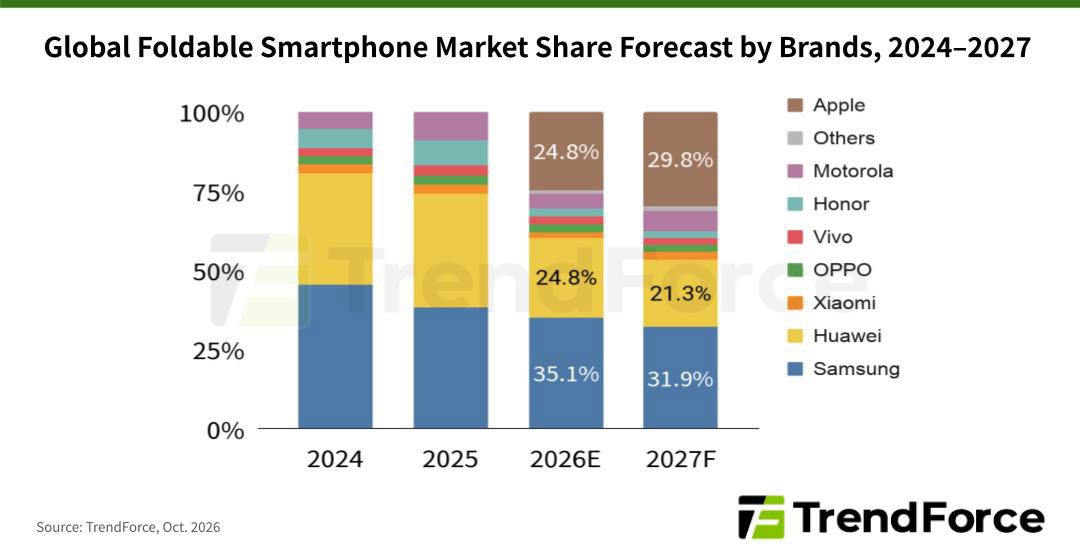
Apple, by capturing nearly 30 percent (specifically 29.8 percent) of the market by 2027, will effectively leapfrog competitors to claim a secure second-place standing globally, breathing down Samsung’s neck just over a year after launching its first-generation device. The remaining market share will be divided among other Android original equipment manufacturers (OEMs) such as Honor, Motorola, Xiaomi, and Oppo, many of whom are expected to face mounting challenges in differentiating their hardware in the face of Apple’s ecosystem integration.
The Strategic Advantages Driving Apple’s Success
Market analysts point to several structural advantages that explain why Apple is positioned to capture such a substantial share of the foldable market so quickly, despite being a late entrant to the category.
Chief among these advantages is Apple’s vertically integrated ecosystem. TrendForce specifically highlighted in its report that Apple’s greatest competitive moat lies in its proprietary ability to tightly integrate custom silicon chips, tailored operating systems, and a deeply engrained developer ecosystem. Unlike Android manufacturers, who must rely on a fragmented landscape of third-party operating system modifications and varied hardware specifications, Apple exercises end-to-end control over the user experience.
As app compatibility matures and hardware reliability improves under Apple’s stringent quality control standards, the iPhone Duo is expected to expand the practical, everyday utility of foldable displays. Industry experts note that early foldable devices often suffered from a lack of optimized software, reducing the large inner screens to glorified media viewers rather than true multitasking productivity tools. Apple’s rigorous developer framework, supported by comprehensive software development kits (SDKs) and guidelines provided to app creators, ensures that third-party applications scale seamlessly between the outer cover display and the expansive unfolded canvas.
Furthermore, the integration of advanced artificial intelligence capabilities—broadly categorized under Apple Intelligence—serves as a crucial differentiator. Consumers purchasing premium-tier devices increasingly expect sophisticated on-device AI features, and the unique dual-screen form factor of the iPhone Duo provides innovative canvases for AI-driven text summarization, image generation, and multitasking workflows.

Implications for the Broader Smartphone Industry
The rapid adoption and projected market dominance of the iPhone Duo signal a broader paradigm shift across the entire mobile phone industry. For years, competition within the foldable smartphone segment was driven primarily by form-factor innovation—manufacturers racing to build thinner hinges, crease-free displays, and novel multi-folding configurations.
However, TrendForce’s analysis suggests that Apple’s entry will fundamentally pivot the market’s competitive focus away from mere novelty hardware mechanics and toward multitasking efficiency and software utility. When a company with Apple’s market influence validates a hardware category, consumer perception shifts from viewing foldables as fragile, experimental gadgets to essential, mainstream productivity devices.
This shift places immense pressure on Android OEMs. To maintain relevance, competitors will need to move beyond hardware iteration and invest heavily in software ecosystem refinement, developer relations, and AI integration. Companies that fail to provide seamless multi-app workflows and robust application support risk losing their premium customer base to Apple’s expanding hardware ecosystem.
Looking ahead, the next twenty-four months will be critical for the trajectory of foldable technology. As production yields improve, supply chains mature, and component costs gradually decrease, the entry barrier for foldable smartphones will lower, opening the door to wider consumer adoption. With Apple anchoring a projected 16.3 percent market growth in 2027 and steering the industry toward software-driven efficiency, the foldable smartphone is officially transitioning from a niche luxury item into the next standard evolution of mobile computing.