The landscape of mechanical keyboards has long been dominated by two competing philosophies: the high-profile, long-travel enthusiast boards that prioritize tactile satisfaction above all else, and the ultra-low-profile laptop-style keyboards that prioritize portability and minimalism. On August 6, 2026, Electronic Materials Office (EMO) announced the Altar II, a device that seeks to collapse the space between these two paradigms. By engineering a proprietary dual steel-arm scissor mechanism, EMO claims to have produced the world’s thinnest mechanical keyboard, measuring just 4.75mm in thickness, while incorporating sophisticated haptic feedback and a modular control interface.
Engineering the Ultra-Thin Mechanical Profile
The mechanical keyboard industry has seen a gradual shift toward low-profile switches over the last decade, with companies like Cherry, Kailh, and Gateron iterating on shortened travel distances. However, the Altar II represents a significant departure from standard switch architecture. Traditional mechanical switches rely on a vertical spring assembly that necessitates a certain degree of height. To bypass this constraint, EMO developed a lateral tension spring system integrated into a dual steel-arm scissor mechanism.
This design allows for 1.8mm of total key travel—a depth that sits comfortably between the shallow scissor switches found on modern MacBook Pro keyboards and the 3.5mm to 4mm travel found on classic buckling-spring devices like the IBM Model M or the Unicomp Mini-M. With an actuation force of 40gf, the Altar II is designed for long-duration typing comfort, minimizing finger fatigue without sacrificing the distinct "click" or "snap" that defines mechanical typing. The chassis, constructed from CNC-machined aluminum, provides the structural rigidity necessary to support such a thin profile while maintaining a premium, weighted feel on the desk.

The M-Dial: Modular Control and Haptic Feedback
Perhaps the most distinctive hardware feature of the Altar II is the M-Dial, a detachable rotary controller that attaches to the keyboard via a magnetic interface. Unlike traditional volume knobs that rely on physical mechanical notches, the M-Dial utilizes haptic actuators to simulate the sensation of detents. This allows the user to customize the "feel" of the dial through software; one could, for instance, set the dial to feel like a smooth, weighted volume wheel in one application and a tactile, notched encoder when scrubbing through a video timeline in another.
The inclusion of the M-Dial signals a broader trend in peripheral design: the transition from static input devices to modular command centers. By providing users with 3D files and drawing templates, EMO is effectively inviting the community to customize the physical ergonomics of the dial. This open-source approach to hardware accessories is intended to extend the lifecycle of the device, allowing users to modify or replace the dial based on specific workflow requirements.
Expanding the Sensory Experience through Haptics
The Altar II distinguishes itself further by moving beyond visual feedback. While backlit keys and OLED screens have become standard in the premium keyboard market, EMO has integrated a sophisticated haptic feedback system that communicates system status through the chassis. By tapping into the macOS notification ecosystem, the keyboard can provide physical cues—ranging from subtle hums to distinct pulses—when a keyboard shortcut is executed or when a background notification arrives.
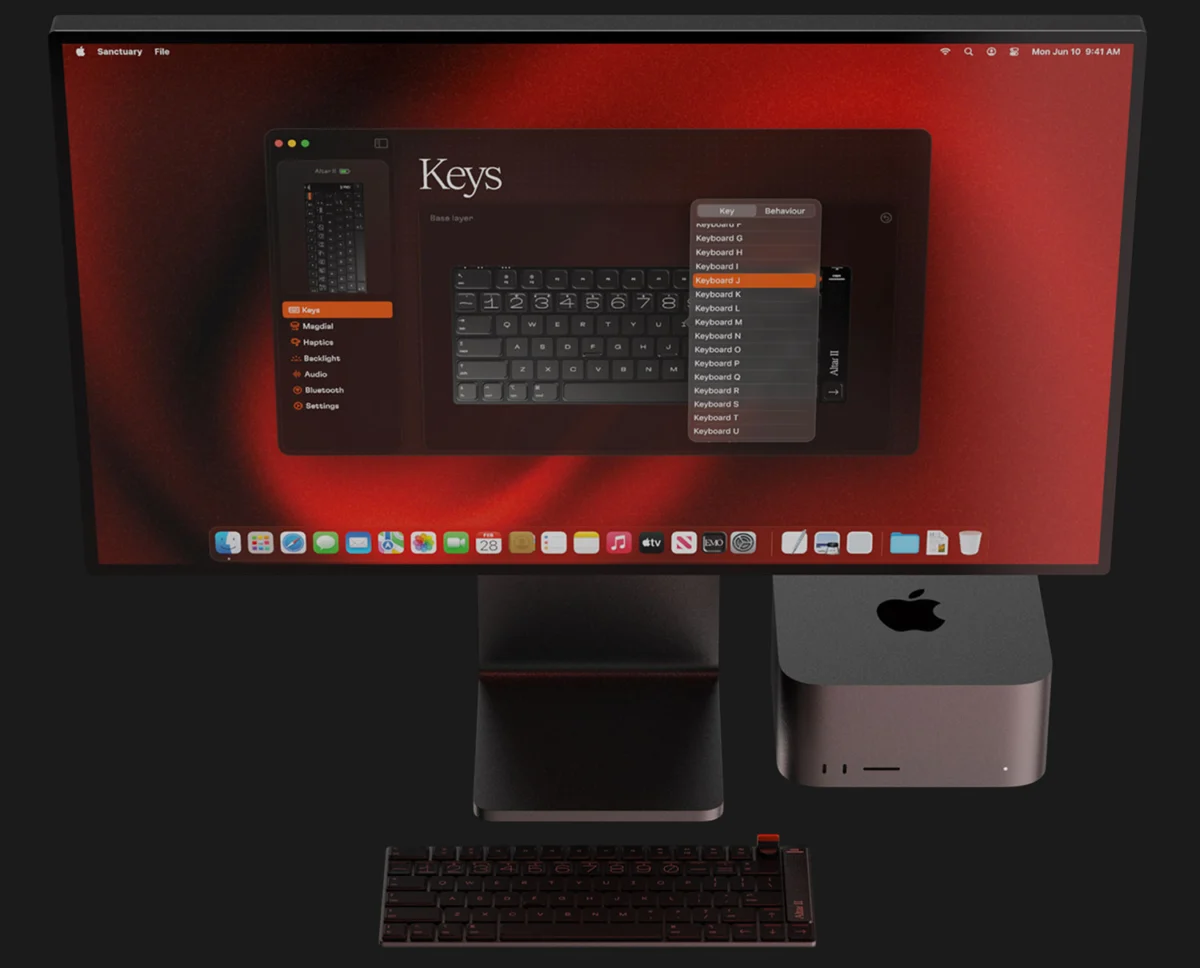
This development touches upon the concept of "active peripheral feedback," where the hardware becomes an extension of the operating system’s notification layer. Rather than forcing the user to glance at the screen to confirm a background process, the keyboard provides a physical acknowledgment. EMO’s Sanctuary software, a native Swift application built for macOS 26 Tahoe and beyond, acts as the bridge between the operating system and the hardware, allowing for granular control over haptic intensity, lighting patterns, and key remapping.

Chronology and Market Roadmap
The development of the Altar II is part of a multi-year effort by EMO to challenge established norms in input technology. The project began in earnest in early 2025, with internal prototyping focusing on the viability of the lateral spring mechanism. Following the formal announcement on August 6, 2026, the company established a reservation system to gauge market interest.
- August 6, 2026: Official announcement of the Altar II and opening of the $1 reservation window.
- November 10, 2026: Scheduled launch of the Kickstarter crowdfunding campaign.
- Q1 2027: Anticipated refinement of hardware based on early feedback and testing.
- Early Summer 2027: Projected timeline for the commencement of initial shipments.
The pricing structure is tiered to incentivize early adopters. A $1 reservation secures a purchase price of $249. Early bird backers on Kickstarter will have access to a $279 price point for the first 48 hours, after which the price increases to $299. Once the product reaches general retail distribution, the MSRP is slated to rise to $349. This aggressive pricing strategy reflects the high cost of the CNC-machined aluminum chassis and the proprietary haptic and switch components.
Technical Specifications and Connectivity
Despite its focus on design, the Altar II does not neglect the core requirements of the modern professional. The device is a 75% layout, preserving the function row and full-size arrow keys that are often sacrificed in smaller 60% keyboards.
- Connectivity: Two-channel Bluetooth 5.0 LE and USB-C wired connection.
- Compatibility: Native support for macOS 26 Tahoe and later; basic functionality for Windows and Linux.
- Battery Performance: Estimated 30 days under standard usage conditions, with a "quick-charge" capability providing two days of usage from a two-minute charge.
- Dimensions: 299 x 116.5mm with a 4.75mm height profile.
- Backlighting: Amber-red ambient lighting controlled by an integrated light sensor.
Broader Industry Implications
The introduction of the Altar II poses an interesting question for the mechanical keyboard industry: is there a ceiling for miniaturization? For years, the industry trend has moved toward "thocky," deep-sounding, and heavily dampened keyboards that are physically massive. The Altar II moves in the opposite direction, suggesting that the future of mechanical typing may lie in extreme precision and sophisticated internal electronics rather than physical mass.

By targeting the Mac ecosystem with a Swift-native software suite and a design language that mirrors the aesthetic of Apple’s hardware, EMO is positioning itself to capture the "prosumer" market that values both design and functional depth. If the haptic feedback proves effective and the battery life estimates hold under real-world testing, the Altar II could set a new benchmark for laptop-integrated peripherals.
However, challenges remain. Crowdfunding campaigns for hardware are notoriously difficult to scale, and the transition from a prototype to a mass-produced unit with such tight tolerances (4.75mm) is a significant engineering hurdle. The reliance on the Sanctuary software also limits the keyboard’s full feature set to the macOS ecosystem, which may restrict its appeal among cross-platform power users, despite its ability to function as a basic input device on Windows and Linux.
Ultimately, the Altar II serves as a proof of concept for a new category of "intelligent" mechanical keyboards. As computing becomes more integrated into the physical workspace, the move toward devices that provide sensory feedback—beyond just the tactile click of a switch—appears to be an inevitable evolution. Whether EMO can successfully bridge the gap between niche mechanical engineering and mass-market consumer demand will be determined when the first units ship in 2027. For now, the Altar II stands as a compelling look at how the humble keyboard can be transformed into a more dynamic and responsive interface.