
OpenAI has officially unveiled GPT-6.1 Sol, its newest high-performance artificial intelligence model designed to bridge the gap between elite capabilities and unprecedented cost efficiency. Representing a direct evolution of the previously released GPT-6 Sol, the new model arrives hot on the heels of the highly anticipated GPT-6 Astra, introducing advanced optimizations tailored specifically for enterprise environments, developers, and high-frequency automated workflows. According to internal metrics released by OpenAI, GPT-6.1 Sol delivers near-Astra level intelligence at a fraction of the cost, positioning it as one of the most economically viable heavy-duty language models currently available on the global market.
The launch of GPT-6.1 Sol marks another aggressive milestone in OpenAI’s rapid deployment schedule for its sixth-generation architecture. Industry observers note that the accelerated pace of rolling out specialized variants—such as the Ultrafast model tier and specialized coding endpoints via Codex—highlights the intense competitive pressure within the generative artificial intelligence sector. As foundational model providers race to capture enterprise market share, reducing inference costs while scaling reasoning capabilities has become the primary battleground.
Background and Context: The Evolution of Sixth-Generation Models
To fully understand the significance of GPT-6.1 Sol, one must examine the trajectory of OpenAI’s recent architectural updates. The foundation was laid with the rollout of GPT-6 Astra, a flagship model celebrated for its deep reasoning capacity, complex multimodal handling, and extensive contextual windows. However, while Astra set new benchmarks across various academic and professional evaluations, running tasks continuously at scale presented significant financial hurdles for enterprise clients and independent developers alike.
Recognizing the economic constraints of high-end deployments, OpenAI engineers focused heavily on optimization strategies. GPT-6.1 Sol emerges as a direct solution to this challenge. By leveraging advanced architectural refinements—particularly in how the model manages cached inputs—OpenAI has managed to preserve much of the intricate processing power associated with its premium models while drastically trimming operational overhead.

In official statements published alongside the release, OpenAI highlighted that GPT-6.1 Sol achieves approximately 32% greater performance efficiency on complex reasoning benchmarks compared to older configurations, while dropping the cost of execution significantly. This breakthrough allows organizations to deploy sophisticated multi-agent AI systems, automated software engineering pipelines, and large-scale document analysis frameworks without incurring prohibitive cloud computing expenses.
Technical Benchmarks and Performance Analysis
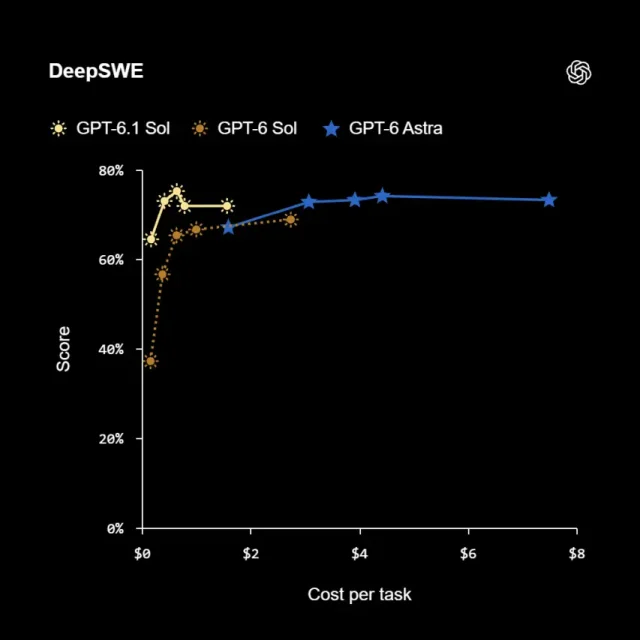
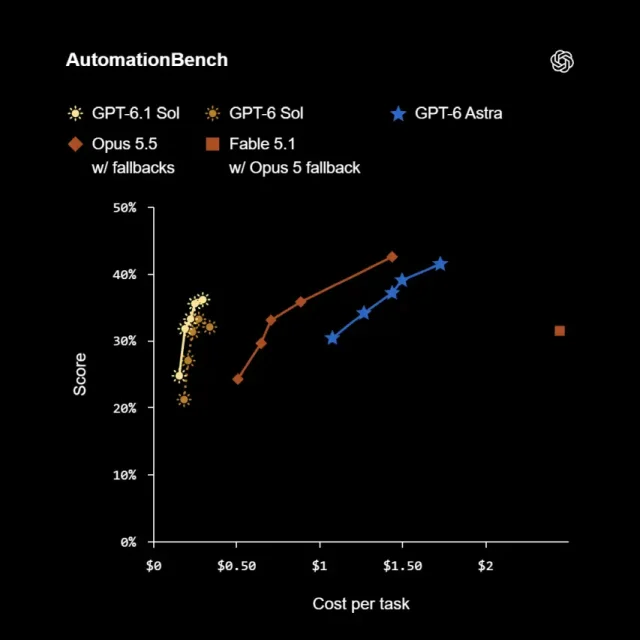
Independent evaluations and benchmark tests shared by OpenAI demonstrate that GPT-6.1 Sol punches well above its weight class, frequently challenging or closely trailing its more expensive sibling, GPT-6 Astra, across a variety of standardized tests.
On DeepSWE v1.1, a rigorous benchmark designed to measure software engineering capabilities and autonomous code generation, GPT-6.1 Sol achieved remarkable results. While GPT-6 Astra maintained a narrow lead of roughly 6.4 percentage points, GPT-6.1 Sol performed exceptionally well for a model positioned at a fraction of the price point. This makes it an ideal candidate for integration into software development life cycles, particularly through the updated Codex API integrations.
In document comprehension and complex PDF analysis tasks—evaluated via the GDP.pdf benchmark—GPT-6.1 Sol demonstrated a level of reading comprehension and data extraction that surpassed competing architectures, including Claude Opus 5.5, in specific structured-data extraction scenarios. Similarly, on AutomationBench, a framework assessing an AI’s ability to execute complex, multi-step digital automation tasks, GPT-6.1 Sol outperformed rival models by solid margins, establishing its utility as an agentic workforce tool capable of navigating operating systems and software environments with minimal human intervention.
Testing on OSWorld 2.0 further underscored the model’s proficiency. When tasked with executing complex desktop navigation and software utilization tasks, Astra led by a slim margin of roughly 2.1 percentage points, but GPT-6.1 Sol outperformed older generation standards by a substantial 7 percentage points. These metrics illustrate a narrowing performance gap between flagship models and economically optimized alternatives.
The Ultrafast Tier and Developer Integration
Alongside the debut of GPT-6.1 Sol, OpenAI introduced the Ultrafast model tier, engineered specifically for use-cases requiring instantaneous response times and high throughput. Designed to handle upwards of 300 tokens per second per user, the Ultrafast tier dramatically accelerates coding workflows through the Codex API, executing tasks up to 8 times faster than standard baseline configurations and roughly 6 times faster than typical API-tier deployments of older models.
The integration strategy for these new models spans the entire ecosystem of OpenAI products. GPT-6.1 Sol is rolling out immediately to subscribers of ChatGPT Plus, Pro, Business, Enterprise, and Edu tiers, as well as being incorporated directly into ChatGPT Work and Codex-powered developer environments. Furthermore, API access is now live for developers worldwide under the model identifier gpt-6.1-sol.
To encourage widespread adoption and experimentation, OpenAI has structured the API pricing for GPT-6.1 Sol aggressively. The pricing model charges per million tokens based on operational state:
- Input tokens without caching are priced at competitive enterprise rates.
- Cached input tokens receive a substantial discount, dropping down to a fraction of the standard cost.
- Output tokens are priced to ensure that high-volume generation remains financially viable for businesses scaling conversational agents or automated code refactoring systems.
Industry Implications and Market Impact
The introduction of GPT-6.1 Sol carries broad implications for the artificial intelligence industry at large. For over a year, enterprise adoption has been tempered by the "cost-versus-capability" dilemma—organizations frequently found that while elite models could handle intricate reasoning tasks, doing so at scale eroded profit margins. By offering near-Astra intelligence for roughly one-fifth of the operating cost, OpenAI is effectively lowering the barrier to entry for advanced autonomous agents.
Industry analysts suggest this move will accelerate the migration of legacy enterprise workflows to AI-native systems. Companies that previously relied on smaller, less capable open-source models to manage routine data processing can now upgrade to high-tier reasoning models without exponentially increasing their cloud infrastructure budgets.
Competitors in the space, including Anthropic, Google, and various open-weight model developers, are expected to respond with their own cost-optimized, high-efficiency variants in the coming months. This intensifying rivalry is driving a deflationary trend in AI compute costs, ultimately benefiting consumers and enterprise buyers alike through faster innovation cycles and more affordable access to cutting-edge intelligence.
As OpenAI continues to refine its sixth-generation architecture, the release of GPT-6.1 Sol demonstrates a maturation of the AI market—one where raw capability is no longer the sole metric of success, but must be balanced with economic sustainability, speed, and real-world deployability.