The landscape of consumer robotics reached a significant milestone at IFA 2026 in Berlin, as Chinese robotics innovator Vbot officially initiated its European expansion. The centerpiece of this debut was the SuperDog, a sophisticated quadruped robot designed to bridge the gap between industrial-grade autonomy and domestic companionship. Following a successful commercial launch in the Chinese market in May 2026, Vbot has opened pre-orders for the European region, positioning the device at a price point of €2,988. This move represents one of the most aggressive efforts to date to normalize autonomous robotic assistants within the average household.
The Evolution of the Robotic Companion
Vbot’s entry into the European market follows years of rapid development in the field of legged locomotion and artificial intelligence. The SuperDog is not merely a novelty; it is an integrated platform built on the philosophy of "move, follow, carry, and be with you." Unlike early-generation robots that required constant manual oversight, the SuperDog leverages a robust perception stack—combining binocular vision with 360-degree LiDAR—to navigate complex environments.
The integration of 128 TOPS (Trillions of Operations Per Second) of onboard AI processing allows the robot to handle real-time decision-making, such as obstacle avoidance and path planning, without the latency inherent in cloud-reliant systems. This level of autonomy is essential for the device’s core function as an outdoor companion, where it can follow an owner through crowded streets or parks without needing a remote control or direct human input.
Chronology of Vbot’s Market Expansion
The path to the IFA 2026 launch has been characterized by iterative testing and data collection. Vbot’s development trajectory can be summarized through the following key developmental phases:
- Early R&D Phase (2023–2024): Vbot focused on the refinement of its quadrupedal gait algorithms and the development of the proprietary "agent intelligence" layer, which allows for natural language processing and task execution.
- Domestic Market Launch (May 2026): The company launched the SuperDog in China, utilizing the initial months to gather real-world performance metrics. During this time, the robot accumulated over 131,500 hours of companion time and 23,700 kilometers of travel alongside users.
- The LLM Integration Phase (2026): Vbot reported that its units have facilitated over 1.26 million interactions with Large Language Models (LLMs), allowing the robots to interpret complex voice commands and provide contextual responses to users.
- IFA 2026 and European Debut (September 2026): Following CE verification—the essential regulatory hurdle for selling electronic goods in the European Union—Vbot unveiled its lineup to an international audience, signaling its readiness to compete with established robotics firms globally.
Technical Capabilities and Practical Utility
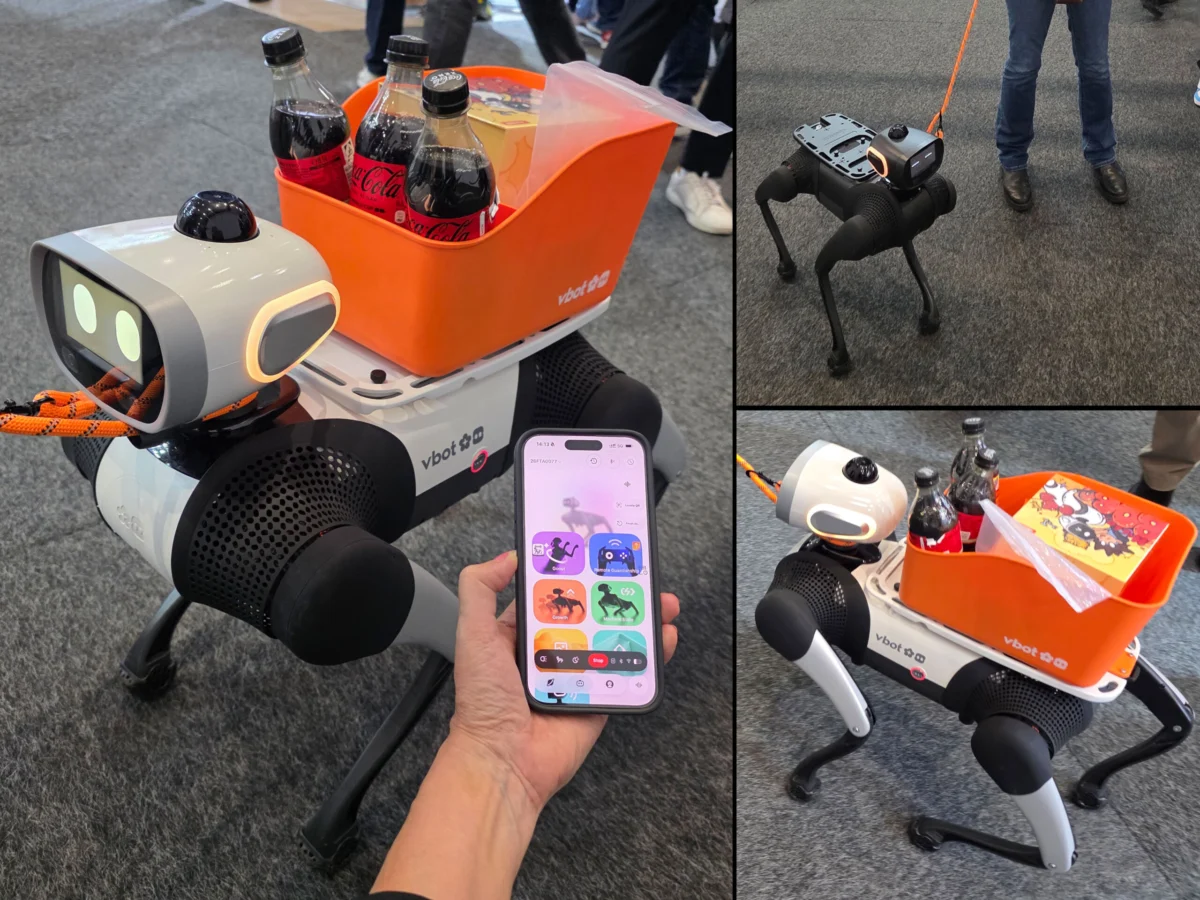
While the "companion" aspect of the SuperDog is its most marketable feature, the machine is engineered with significant utilitarian capabilities. The robot is capable of carrying up to 12 kilograms of payload, a feature Vbot demonstrated at IFA by outfitting the unit with a cargo basket for groceries and personal items. Furthermore, the robot’s structural integrity is rated for towing up to 100 kilograms, allowing for the attachment of specialized trailers or equipment carts.
This duality—serving as both an intelligent pet-like companion and a logistical assistant—sets the SuperDog apart from other market competitors. For elderly users or those with limited mobility, the ability to have an autonomous unit handle the transport of goods represents a tangible improvement in daily quality of life. The inclusion of an animated digital face serves to anthropomorphize the unit, reducing the "uncanny valley" effect often associated with featureless industrial robots.
Specialized Variants for Research and Enterprise
Beyond the standard consumer-facing SuperDog, Vbot has introduced two higher-tier models: the SuperDog EDU and the SuperDog EDU-W. These versions are explicitly marketed toward research institutions, commercial developers, and educational facilities.
The SuperDog EDU, priced at €7,988, serves as an expandable development platform. It allows users to integrate custom hardware, such as articulated robotic arms, high-fidelity sensors, or specialized computing modules, enabling it to function as a mobile laboratory or a specialized service robot. The SuperDog EDU-W, priced at €10,988, takes this further by incorporating a wheel-legged design. This hybrid locomotion allows the robot to achieve higher speeds—up to 2.5 meters per second (9.0 km/h)—and provides enhanced stability and efficiency across varied terrain, making it ideal for patrolling large facilities or navigating complex research environments.
Data-Driven Performance Overview
The hardware specifications provided by Vbot suggest a high degree of uniformity in the underlying tech stack, with subtle optimizations for the specialized models.
| Specification | SuperDog | SuperDog EDU | SuperDog EDU-W |
|---|---|---|---|
| Pre-order Price | €2,988 | €7,988 | €10,988 |
| Max Speed | 7.2 km/h | 7.2 km/h | 9.0 km/h |
| Max Payload | 12 kg | 12 kg | 15 kg |
| Battery Capacity | 594 Wh | 594 Wh | 594 Wh |
| Operational Time | 3–5 Hours | 3–5 Hours | 4–6 Hours |
The consistent 594 Wh battery capacity across all three models ensures that the power architecture remains stable, though the EDU-W’s wheel-legged design contributes to a slightly more efficient power consumption profile, resulting in an additional hour of operational time compared to the standard quadrupedal models.
Implications for the Robotics Industry
The debut of the SuperDog at IFA 2026 arrives at a pivotal time for the artificial intelligence industry. As companies race to move AI from screens to physical bodies, the focus has shifted from software-only capabilities to "embodied AI." Vbot’s strategy of building a large user base in China before moving to Europe has allowed it to refine its software—specifically its conversational intelligence—based on millions of interactions.
Industry analysts observe that the success of such products hinges on two factors: regulatory trust and real-world utility. By securing CE certification, Vbot has bypassed the initial legal skepticism often directed at Chinese technology imports in the EU. Furthermore, the shift toward autonomous home monitoring and patrol capabilities suggests that Vbot intends to position the SuperDog as an integrated component of the modern smart home, potentially rivaling stationary security systems or smart speakers.
However, challenges remain. The integration of high-level AI into a household environment raises questions regarding data privacy and the security of the monitoring footage captured by the robot’s onboard sensors. As these devices enter the European market, Vbot will likely face increased scrutiny regarding its data handling policies and the security of its cloud-based LLM interactions.
Future Outlook
The entry of Vbot into the European market is a bellwether for the robotics sector. The company has demonstrated that the technology for a functional, autonomous home companion has matured to a point where it can be mass-produced at a price point accessible to the middle-class consumer. If the SuperDog proves successful in European households, it could catalyze a broader trend of "robotic adoption," similar to the rapid proliferation of autonomous vacuum cleaners over the last decade.
As Vbot continues to scale, the company is expected to focus on software updates that improve the robot’s "agent intelligence," allowing for increasingly complex tasks and better integration with existing smart home ecosystems. For now, the SuperDog stands as a testament to the rapid advancements in perception, locomotion, and generative AI, signaling that the future of robotics is moving out of the laboratory and into the living room.