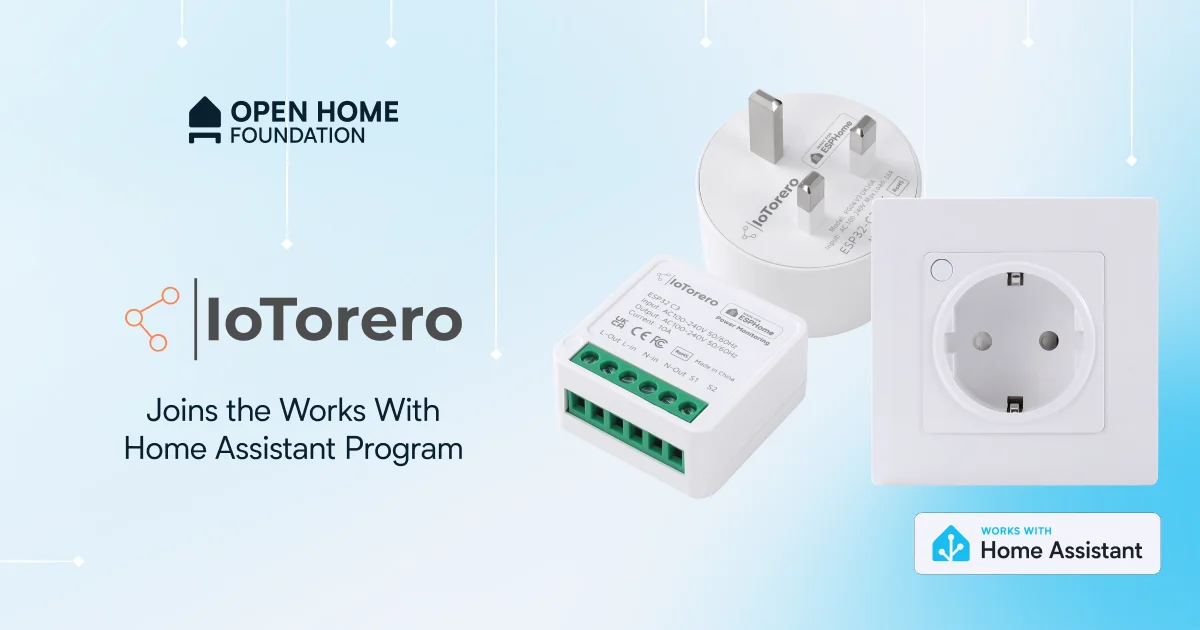
The smart home automation landscape has reached a significant milestone this month as the Works with Home Assistant program officially welcomes IoTorero as its newest partner. This collaboration introduces the first-ever ESPHome-ready smart plugs and relays to the certification program, marking a pivotal shift toward open-source, local-first hardware for mainstream consumers. IoTorero, a company that has established itself as a specialist in pre-flashed smart home equipment, joins the program with seven certified devices, signaling a robust commitment to the principles of privacy, longevity, and interoperability championed by the Open Home Foundation.
The partnership comes at a time of increasing scrutiny regarding cloud-dependent Internet of Things (IoT) devices. As many proprietary smart home ecosystems face challenges ranging from service outages to the permanent bricking of hardware following corporate closures, the demand for local-control solutions has surged. IoTorero’s entry into the Works with Home Assistant ecosystem addresses these concerns directly by providing hardware that operates independently of external servers.
The Evolution of IoTorero and the Shift to Open Standards
Founded in 2020 under its original name, Athom Technology, the company was an early adopter of the ESPHome firmware. The recent rebranding to IoTorero serves as a strategic nod to the Internet of Things, while the name itself suggests a "taming" of the often chaotic and restrictive IoT market. From its inception, the company focused on bridging the gap between the flexibility of open-source software and the convenience of "plug-and-play" hardware.
Historically, users wishing to utilize ESPHome—a system that allows for the creation of custom firmware for ESP8266 and ESP32 microcontrollers—were required to possess a degree of technical proficiency. This typically involved manual flashing of chips, soldering, and complex configuration. IoTorero’s business model disrupted this by offering hardware that arrived pre-flashed with ESPHome, effectively removing the barrier to entry for non-technical users while remaining fully customizable for enthusiasts.
The company’s journey to official certification has been a multi-year process of community engagement. In 2025, IoTorero participated in the Home Assistant Community Day, providing hardware samples to developers and users. This history of cooperation culminated in the current certification, ensuring that their devices meet the rigorous "Works with Home Assistant" standards, which prioritize local control over cloud reliance.
Technical Analysis of the Certified Hardware Lineup
The certification covers seven distinct devices, including four regional variants of smart plugs and a specialized mini relay. These devices are built upon the ESP32-C3 architecture, a RISC-V based microcontroller known for its balance of power efficiency and performance.
Smart Energy Monitoring Plugs
The certified smart plugs are available in configurations for various international markets, ensuring global compatibility. A key feature of these units is their integrated power monitoring capability. Unlike standard smart plugs that offer simple on/off functionality, the IoTorero units provide real-time data on:
- Voltage (V)
- Current (A)
- Active Power (W)
- Total Cumulative Consumption (kWh)
This data is fed directly into the Home Assistant Energy Dashboard, allowing users to track appliance efficiency and identify "vampire loads" within their homes. By utilizing local communication protocols, this data remains within the user’s home network, avoiding the privacy risks associated with sending energy usage patterns to third-party cloud providers.
The Power Monitoring Mini Relay
In addition to the plugs, the Power Monitoring Mini Relay represents a significant addition for advanced home automation. Measuring approximately the size of a matchbox, this device is designed for installation behind existing wall switches or within appliance housing. It allows for the "smartification" of traditional light switches and hardwired appliances while maintaining the same level of energy monitoring and local control found in the plug-in models.
Integration with the ESPHome Ecosystem and New UI Enhancements
The timing of this partnership coincides with a major update to the ESPHome platform. The recent release of ESPHome version 2026.6.0 introduced a redesigned User Interface (UI) and a new "Device Builder" tool. This update replaces the traditional code-heavy dashboard with a visual workspace, making it easier for users to manage their IoTorero devices.
Because these devices are pre-flashed, they are automatically discovered by Home Assistant upon connection to the network. However, the true value of the ESPHome integration lies in its "no-code" customization options. Through the Device Builder, users can rename entities, adjust sensor update intervals, or add new automation logic directly to the chip without writing YAML configuration files. For professional users, the full code remains accessible, supported by IoTorero’s public GitHub repository, which contains the official configurations for all certified hardware.
Sustainability and the Bluetooth Proxy Innovation
A distinctive technical advantage of the IoTorero lineup is the inclusion of Bluetooth Proxy functionality. Most modern ESP32-based devices have the hardware capability to communicate via Bluetooth Low Energy (BLE). By enabling the Bluetooth Proxy feature in ESPHome, these smart plugs and relays act as bridges for other BLE-only devices, such as temperature sensors, toothbrushes, or plant monitors.
This "Proxy all the things" approach, advocated by the Open Home Foundation, has significant implications for home network infrastructure. It allows users to extend the range of their Bluetooth network throughout a home without purchasing dedicated gateway hardware. This reduces the total number of devices required for a functional smart home, thereby minimizing electronic waste and energy consumption.
Official Responses and Strategic Implications
The certification has been met with positive responses from both the manufacturing and development sides of the partnership. Aiden Tang, CTO and Co-Founder of IoTorero, emphasized the company’s long-standing dedication to the open-source community. "Since inception in 2020, IoTorero has been dedicated to the research, development, and manufacturing of open-source smart home hardware products," Tang stated. "By joining the Works with Home Assistant program, we ensure that customers can select and purchase our products with complete confidence."
From the perspective of Home Assistant, the inclusion of IoTorero represents a validation of their "Made for ESPHome" badging program. This prerequisite program ensures that hardware manufacturers are not just using open-source software, but are actively contributing to its maintenance and ensuring that the hardware remains open for the lifetime of the product.
The Impact on the Consumer Market
For the broader smart home market, this partnership sets a new benchmark for what "certified" hardware should entail. The "Works with Home Assistant" badge for IoTorero devices guarantees:
- Local Control: The device must function without an internet connection.
- Privacy: No user data or usage statistics are sent to the manufacturer.
- Long-term Support: The manufacturer commits to maintaining compatibility with Home Assistant updates.
- Openness: Users are not locked into a specific app or ecosystem.
Chronology of the Partnership
- 2020: Athom Technology is founded, focusing on ESPHome-compatible hardware.
- 2021-2024: The company expands its product line to include global power monitoring plugs and specialized relays, building a reputation within the DIY community.
- 2025: IoTorero (rebranded) participates in the Home Assistant Community Day, solidifying ties with the Open Home Foundation.
- June 2026: ESPHome 2026.6.0 is released, introducing the visual Device Builder.
- July 2026: IoTorero officially joins the Works with Home Assistant program with seven certified devices.
Future Outlook for Open-Source Hardware
The integration of IoTorero into the official Home Assistant ecosystem is likely the beginning of a broader trend where hardware manufacturers move away from "software-as-a-service" models toward "hardware-as-a-tool" models. As consumers become more aware of the risks associated with cloud-only devices—highlighted by recent high-profile service shutdowns in the industry—certified local-control hardware is positioned to become the preferred choice for both security-conscious users and those seeking long-term reliability.
The Open Home Foundation has indicated that the testing schedule for IoTorero remains open, suggesting that additional products, such as LED controllers or specialized sensors, may receive certification in the coming months. For now, the availability of pre-flashed, certified ESPHome plugs and relays provides a reliable entry point for users who want the power of custom firmware with the simplicity of a consumer product.
By fostering a relationship with manufacturers like IoTorero, the Home Assistant project continues to expand its reach beyond the hobbyist market into the mainstream, proving that open-source principles can be successfully commercialized without compromising user autonomy.