










The Eurasian steppe, an unforgiving and expansive landscape stretching across Central Asia, has long served as a theater for one of nature’s most enduring migrations. Traversing this remote terrain alongside conservationists from the Association for the Conservation of Biodiversity of Kazakhstan (ACBK) reveals a fragile ecosystem under pressure. Amid shifting seasonal rains and sudden Siberian blizzards, vast herds of saiga antelope—survivors of the Pleistocene epoch—continue their ancient rutting rituals. However, the intersection of modern infrastructure, historical sedentarization, and wildlife conservation presents complex challenges for these iconic nomads.
Main Facts and the Contemporary Landscape
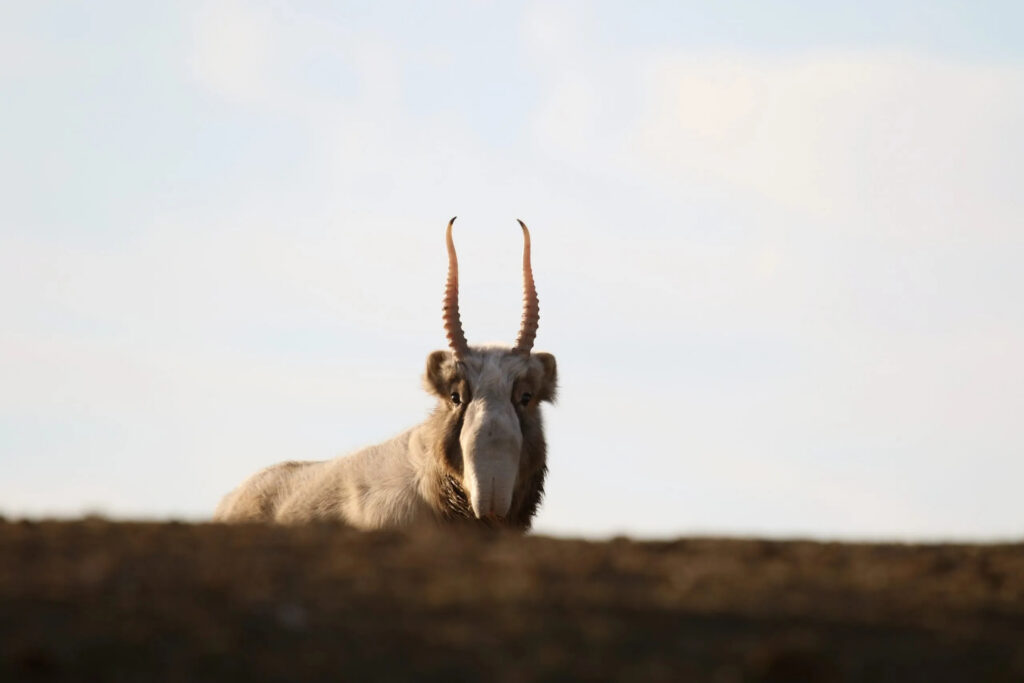
The saiga antelope (Saiga tatarica) is a critically adapted ungulate recognized by its distinct, bulbous, trunk-like snout. This specialized nose filters dust during hot, arid summers and warms frigid air during harsh winters. Historically sharing the Pleistocene landscape with woolly mammoths and saber-toothed cats, the saiga remains the sole survivor of that megafaunal cohort in this region.
During the annual late-autumn rutting season, herds congregate across the treeless plains. Males engage in aggressive headbutting displays to assert dominance, driven by physical prowess that females evaluate using indicators such as body size and snout development. This high-energy period often results in significant physical exhaustion for males.
The Western population of saigas in Kazakhstan is currently monitored closely by ACBK field researchers Alexandr and Albert. Navigating the region requires traversing unpaved, mud-slicked tracks that transform instantly under unpredictable weather systems, shifting from deep sludge to frozen whiteout conditions. Despite these logistical hurdles, field audits are essential for assessing population health, mapping movement corridors, and establishing science-backed wildlife sanctuaries.
Chronology of Human and Animal Nomadism
The tradition of nomadism in the region dates back at least to the Early Iron Age. The term Kazakh itself originates from a Turkic root meaning "wanderer" or "vagabond," reflecting a historical reliance on seasonal mobility. Small human groups migrated to higher altitudes during summers to access melting snow and grazing lands, returning to sheltered valleys for the winter.
This lifestyle shaped the geography of Central Asia, laying the groundwork for the ancient Silk Road. The Ural River, acting as a natural boundary between Europe and Asia, served as a crucial transit point where caravans rested, traded, and utilized natural resources.
However, twentieth-century Soviet policies fundamentally altered this regional dynamic through mandatory sedentarization. By forcing nomadic populations into stationary agricultural plots—often on soil poorly suited for crop cultivation—authorities sought to modernize the economy. This policy disrupted millennia-old navigational traditions among human populations, contrasting sharply with the saiga antelope, which maintained their continuous migratory patterns.
Supporting Data and Infrastructure Impacts
As human development expanded across the Eurasian steppe, the introduction of railways, fenced borders, and roadways fragmented the saiga’s historic range, which once extended from the Caucasus Mountains to Mongolia.
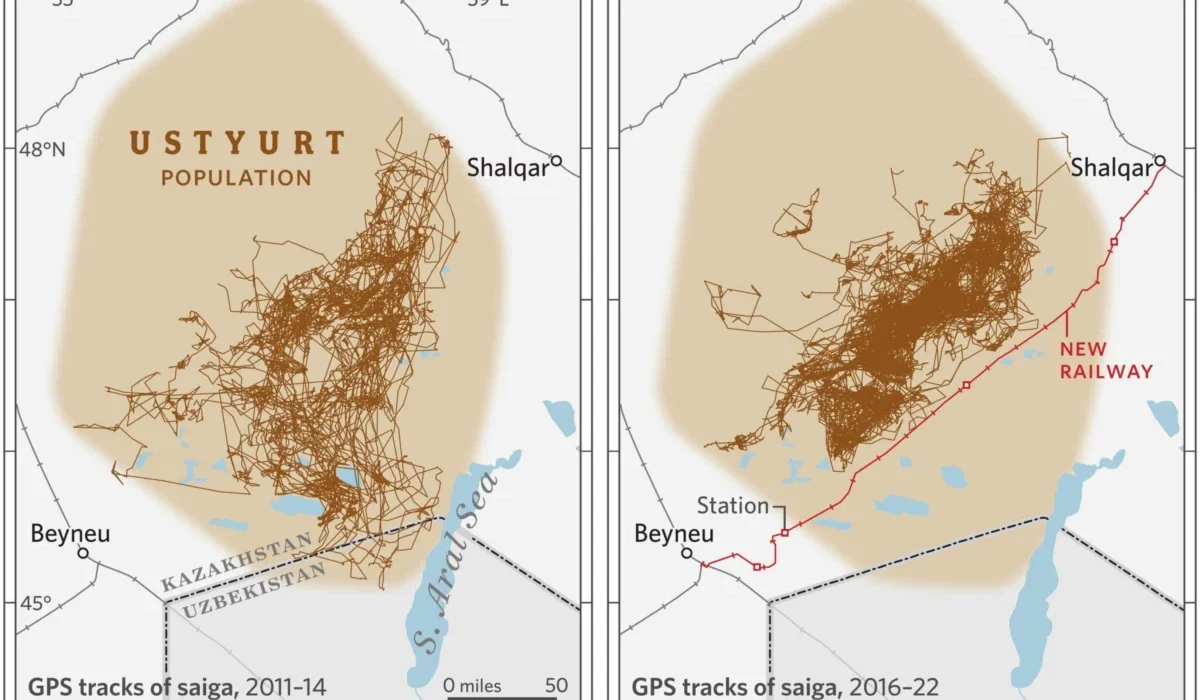
GPS-collared tracking data analyzed by ACBK highlights the immediate disruption caused by linear infrastructure. For instance, a railway constructed in Uzbekistan in 2014 abruptly severed a traditional migratory route. Telemetry data from preceding years showed fluid movement across the border, whereas post-construction data revealed herds milling despondently on the northern side of the tracks, cut off from traditional southern grazing lands and water sources.
This physical fragmentation leads to a loss of spatial knowledge—a phenomenon described by conservation scientists as equivalent to the erasure of a language. Saiga calves acquire migratory routes through social learning and observational participation within the herd. When barriers block these paths, traditional knowledge fades from the population’s collective memory.
Official Responses and Conservation Interventions
In response to declining connectivity and habitat fragmentation, ACBK has collaborated extensively with the government of Kazakhstan and neighboring nations to implement targeted mitigation strategies.
Key interventions include:
- Wildlife-Friendly Crossings: Constructing sloping earthen ramps adjacent to railway lines, allowing saigas to navigate tracks seamlessly while utilizing specialized cattle guards to prevent collisions and maintain the illusion of safe passage.
- Border Barrier Modifications: Partnering with authorities in Uzbekistan to redesign traditional barbed-wire security fences into X-shaped barricades. These structures successfully deter vehicular traffic while leaving adequate clearance for saigas to move underneath.
- Protected Area Designation: Establishing new wildlife sanctuaries informed directly by empirical GPS tracking data collected by field biologists.
These measures aim to restore ecological trust, enabling herds to reoccupy historical ranges that have been bisected by decades of industrial development.
Broader Impact and Implications
The plight of the saiga antelope reflects a broader global tension between modern infrastructural development and the preservation of ecological connectivity. As linear infrastructure continues to expand across developing regions, migratory species globally face increased risks of population isolation and genetic bottlenecking.
The preservation of saiga migration corridors carries implications not only for biodiversity conservation but also for maintaining the ecological integrity of the remaining intact grasslands of Central Asia. Sustaining these nonhuman migration routes ensures the persistence of an evolutionary lineage that predates recorded human history, offering critical insights into the resilience of species capable of navigating some of the planet’s most extreme environments.