









The recent commercial launch of the iPhone Duo introduced consumers to a cutting-edge form factor, yet early adopters quickly encountered a frustrating hardware dilemma: a notable scarcity of reliable, ergonomic desktop stands and protective solutions. Apple’s proprietary folio case with an integrated kickstand—priced at $129—has faced widespread criticism from users and reviewers alike for its flimsy construction, high cost, and intrusive design that obstructs the device’s secondary outer display. Similarly, existing third-party MagSafe wallets that double as kickstands suffer from structural proportions that are poorly matched to the phone’s expanded footprint, while the broader third-party case ecosystem remains underdeveloped.
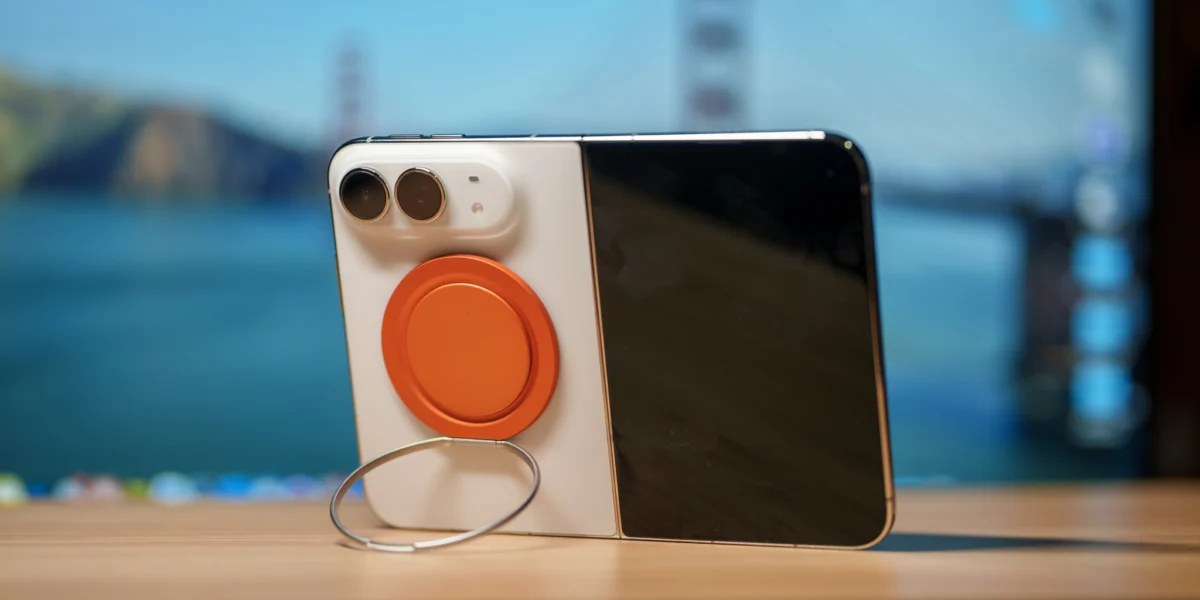
However, a practical solution to these ergonomic hurdles has emerged from an unexpected source. Rather than relying on specialized equipment engineered exclusively for the iPhone Duo, users are finding optimal functionality in a universal accessory: the PopSocket Low-Pro. Originally designed to accommodate the broader iPhone lineup, this low-profile MagSafe attachment features an integrated, flip-out ring that functions seamlessly as a stable kickstand while retaining the classic utility of a standard PopSocket.
Addressing Core Ergonomic Challenges of the iPhone Duo
The integration of the PopSocket Low-Pro directly addresses several structural and functional limitations inherent to the iPhone Duo’s physical design. When folded, the iPhone Duo measures a substantial 11.3mm in thickness. For consumers who prefer using their mobile devices entirely caseless to avoid compounding this bulk, adding traditional thick cases or bulky folio stands has proven unappealing.

The Low-Pro variant solves this issue through a minimalist engineering approach. The accessory maintains a remarkably slim profile, protruding significantly less than the device’s native camera module. Consequently, users can comfortably hold the phone without tactile interference from the attachment, preserving the raw feel of the hardware without sacrificing utility.
Beyond handheld use, the accessory provides a functional remedy to a prominent stability issue observed when using the device with standard MagSafe charging stands. Reviewers of the iPhone Duo have frequently noted that when the device is mounted in its unfolded state, the asymmetrical distribution of weight—specifically the heavier left half of the phone—causes the chassis to slowly drag downward and slip off conventional magnetic mounts.
Practical testing across multiple MagSafe desktop stands indicates that attaching the PopSocket Low-Pro substantially mitigates this gravitational slippage. While minor shifting can still occur over extended periods, the improvement is sufficient to render the unfolded desktop viewing experience stable and reliable for daily use.
Market Context and Evolution of MagSafe Ecosystems
The challenges surrounding the iPhone Duo highlight the ongoing adaptation pains associated with novel mobile form factors. Since Apple introduced MagSafe technology with the iPhone 12 series, accessory manufacturers have continuously iterated on magnetic attachment standards to support varying weights, dimensions, and use cases. Foldable and dual-screen mobile devices, which inherently possess shifting centers of gravity and unconventional weight distributions, present unique engineering obstacles for accessory designers.

Historically, standard MagSafe pucks and desktop docks were calibrated for monolithic slabs of aluminum and glass with uniform weight profiles. The introduction of the iPhone Duo disrupted these baseline assumptions, leaving a temporary void in the marketplace for accessories capable of managing specialized physical configurations. While traditional manufacturers race to develop bespoke structural cases and reinforced stands, universal modular accessories like low-profile grips have unexpectedly filled the gap, demonstrating the versatility of the open MagSafe ecosystem.
Pricing, Availability, and Color Configurations
Consumers seeking to integrate the PopSocket Low-Pro into their mobile setups will find the accessory widely accessible through major online retail channels, including Amazon. Pricing varies between $36 and $40, contingent upon the selected aesthetic finish.
The standard $40 tier encompasses a broad spectrum of colorways and patterns, including Navy, Gun Metal, Black, Electric Fuchsia, Teal, Carbon Lattice, Mint, and Tortoise. Meanwhile, select variants—specifically Lilac and Orange—are currently available at a promotional price point of $36, reflecting a 10% discount.
Broader Implications for Mobile Accessories
The widespread adoption of universal workarounds for device-specific hardware shortcomings points to a broader trend in consumer electronics. As device designs become increasingly diverse—spanning foldables, dual-screen configurations, and ultra-thin profiles—rigid, single-purpose accessories are frequently outpaced by adaptable, modular hardware solutions.

For iPhone Duo owners navigating the current limitations of the peripheral market, the PopSocket Low-Pro offers an interim bridge between minimalist aesthetics and functional stability. As the third-party accessory market matures to officially support novel form factors, universal magnetic attachments continue to demonstrate that cross-compatibility often yields the most effective practical solutions for newly debuted technology.