The vast, unforgiving expanse of the Eurasian steppe has long served as a crossroads for civilization and wildlife alike. Navigating this remote terrain requires an acute understanding of a landscape where roads quickly dissolve into mud paths and the horizon vanishes into the howling Siberian wind. It is here, in the remote corners of western Kazakhstan near the Russian border, that conservationists are racing against time to protect one of the planet’s most resilient and eccentric survivors: the saiga antelope (Saiga tatarica).
Main Facts and the Current Landscape
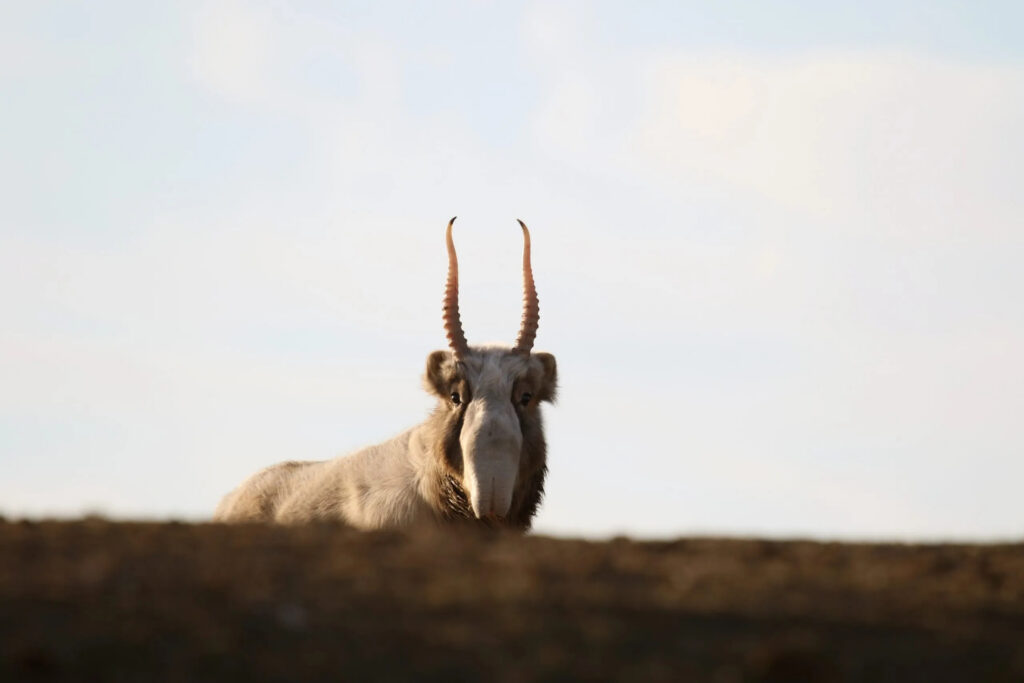
During the seasonal rutting season, field researchers from the Association for the Conservation of Biodiversity of Kazakhstan (ACBK)—including seasoned conservationists Alexandr and Albert—embark on rigorous field audits to monitor saiga herds. These expeditions offer a rare window into a prehistoric tableau. Hundreds of nomadic saigas traverse the treeless plains in single-file lines, utilizing their distinctive, floppy, trunk-like noses to filter out dust and warm the frigid winter air before it reaches their lungs.
The saiga is an evolutionary marvel. Having shared the Pleistocene epoch with woolly mammoths, saber-toothed cats, and giant deer, these ungulates outlived many of their prehistoric contemporaries. Historically, pioneering human caravans relied on saiga migration trails to safely traverse the semidesert plains. However, the modern world has introduced unprecedented hurdles. The expansion of infrastructure, including railways, roads, and border fences, has drastically fragmented the saiga’s historical range, turning once-fluid migration paths into perilous obstacles.
Chronology of Migration and Human Encroachment
The history of movement across the Eurasian steppe spans millennia. Since at least the Early Iron Age, human nomads—whose Turkic root word qaz gave rise to "Kazakh," meaning wanderer or vagabond—followed seasonal patterns, moving to higher altitudes in summer and sheltered valleys in winter. These traditional transit corridors eventually helped form the foundation of the Great Silk Road, turning western Kazakhstan along the Ural River into a vital transcontinental crossroads where East meets West.
For centuries, human and animal movements coexisted harmoniously. However, the 20th century brought a dramatic shift. During the Soviet era, mandatory sedentarization policies forced nomadic human populations into agricultural plots, disrupting a lifestyle rooted in perpetual motion. While human mobility was largely locked into place, the saigas continued their vast nomadic journeys across the Eurasian steppe, stretching from the Caucasus Mountains to Mongolia.
The modern fragmentation of these routes accelerated significantly in the post-Soviet era. A pivotal turning point occurred in 2014 with the construction of a major rail line in Central Asia. GPS-collared saiga populations that traditionally traveled deep into Uzbekistan were abruptly cut off by the new tracks. Tracking data from ACBK illustrates the devastating behavioral impacts: while pre-construction data showed animals freely crossing the region seasonally, post-construction data revealed herds wandering despondently on the northern side of the tracks while vital water sources and fresh forage withered to the south.
Supporting Data and Ecological Implications
The disruption of migratory routes triggers what scientists describe as a collapse in spatial knowledge. Much like human nomads forced into sedentarization lost their connection to ancestral navigation, young saigas learn migration routes, feeding grounds, and shelter locations through active observation of older generations. When linear infrastructure cleaves the landscape, entire stretches of ecological knowledge fade from memory.
Furthermore, historical population numbers underscore the fragility of the species. Following the collapse of the Soviet Union, rampant poaching driven by the demand for saiga horns (used in traditional Asian medicine) decimated populations, reducing their numbers from over a million down to critical lows of approximately 50,000 individuals by the early 2000s. Thanks to intensive, coordinated anti-poaching measures by the Kazakh government and international conservation bodies, populations have rebounded in recent years, numbering in the hundreds of thousands. Yet, habitat fragmentation remains a persistent, chronic threat to their long-term viability.
Official Responses and Conservation Strategies
Recognizing the existential threat posed by infrastructure development, ACBK has partnered closely with the Kazakh and Uzbek governments to implement targeted mitigation strategies. Conservationists are utilizing advanced GPS telemetry data to identify critical crossing points and design wildlife-friendly infrastructure.
In Kazakhstan, authorities have begun constructing dozens of saiga-friendly crossing points. These feature sloping dirt ramps that match the height of railway tracks, creating the optical illusion of a natural gap. Strategically placed cattle-guard fences keep trains and ungulates safely separated while maintaining connectivity across the railway barrier. Similarly, in collaboration with Uzbek authorities, traditional barbed-wire border fences are being redesigned into X-shaped barricades. These structures successfully block unauthorized vehicular traffic while leaving adequate clearance for saigas to move freely between historical ranges.
Broader Impact and Future Outlook
The plight of the saiga antelope highlights a fundamental tension in modern conservation: reconciling ecological connectivity with economic development. As roads, railways, and agricultural plots continue to expand across the Eurasian steppe, the margin for error narrows.
The ongoing efforts by ACBK and local governments demonstrate that proactive landscape management and data-driven infrastructure planning can mitigate the worst impacts of fragmentation. By restoring the physical bridges across the saiga’s ancient pathways, conservationists are not only safeguarding a critically important ungulate species but also preserving a living link to a nomadic heritage that defined Central Asia for millennia.