The current landscape of AI development frequently prioritizes model selection—debating the merits of GPT-4, Claude 3.5, or Llama 3—while treating memory as a secondary utility. However, a comprehensive survey titled "Memory for Autonomous LLM Agents: Mechanisms, Evaluation, and Emerging Frontiers" (arXiv:2603.07670) challenges this hierarchy. The study posits that the performance gap between an agent equipped with a robust memory architecture and one without is significantly larger than the performance variance between different high-tier LLM backbones. This finding indicates that for practitioners building research agents, simulation engines, or multi-agent orchestrators, the engineering effort should be redirected toward the "belief state" of the agent—its internal model of a partially observable world.
The Write-Manage-Read Framework
At the core of modern agentic memory is a three-stage operational cycle: writing, managing, and reading. While most current implementations successfully execute the "write" (storage) and "read" (retrieval) phases, the "manage" phase remains a critical point of failure. In complex environments where agents must collaborate asynchronously and hand off context through shared files or databases, the management of information becomes a matter of curation rather than mere accumulation.
The management phase involves the application of control policies to determine what information should be stored, what requires summarization, and when data should be escalated from short-term to long-term storage. Without an explicit management strategy, agents suffer from "information bloat," where the accumulation of noise and contradictory data leads to a degradation of decision-making. In distributed systems, this often necessitates moving beyond simple file-based storage toward more scalable solutions, such as vector databases or dedicated agent memory systems, to prevent the system from becoming overwhelmed by its own history.
Taxonomy of Temporal Scopes
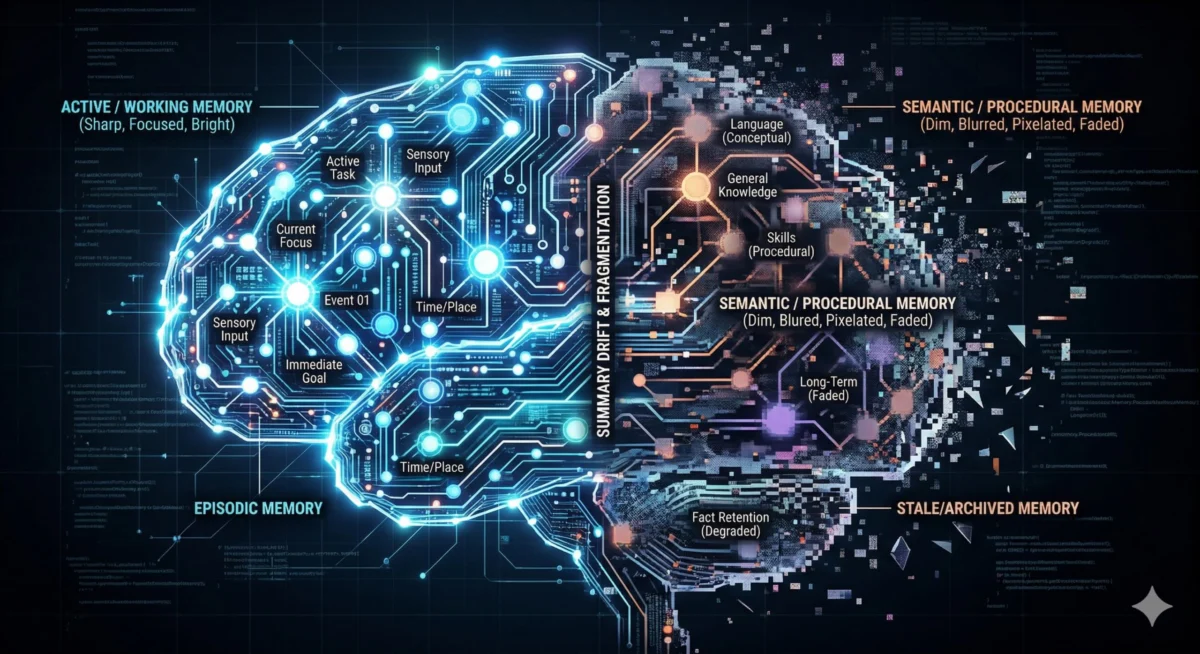
The research formalizes four distinct temporal scopes of memory, each serving a specific role in the agent’s cognitive architecture. Understanding these scopes is essential for builders attempting to resolve pain points in coordination and state maintenance.
Working Memory and the Context Window
Working memory corresponds to the immediate context window of the LLM. It is high-bandwidth but strictly limited. The primary failure mode here is "attentional dilution," often referred to as the "lost in the middle" effect. When an agent’s context becomes crowded with irrelevant information, its ability to utilize relevant data decreases, even if that data is technically present within the window. This necessitates the use of threading and task-specific sessions to prevent performance decay over time.
Episodic Memory and Experience Logs
Episodic memory captures concrete experiences in a chronological sequence. In practical applications, this manifests as activity logs or daily "standup" reports where agents summarize their findings and escalations. This allows agents to look back at previous work cycles, identify patterns, and avoid repeating unsuccessful strategies. In production environments, short-term memory mechanisms are employed to determine which specific interactions deserve to be persisted beyond a single session.
Semantic Memory and Knowledge Distillation
Semantic memory involves the storage of abstracted knowledge, facts, and learned conclusions. Unlike episodic memory, which is situational, semantic memory is curated to preserve "lasting truths." In systems like OpenClaw, this is often maintained in dedicated workspace files that are periodically updated to reflect distilled insights. Without a rigorous curation step, semantic memory risks becoming a "junk drawer" of disconnected facts that can confuse the agent’s reasoning.
Procedural Memory and Behavioral Patterns
Procedural memory consists of encoded skills and behavioral constraints. This is often stored in persona instructions or "soul" files that dictate how an agent interacts with its environment and other agents. While many developers focus on one-time prompt tuning, the research suggests that procedural memory should be an iterative process, updated through feedback loops or "dreaming" processes where the agent analyzes its own interactions to refine its behavioral patterns.
Technical Mechanisms of Memory Implementation
The survey identifies five primary families of mechanisms currently used to facilitate agent memory. These range from simple context management to advanced reinforcement learning (RL) approaches.
- Context-Resident Compression: This involves techniques like sliding windows, rolling summaries, and hierarchical compression to keep the agent within its token limits. While popular, this method is prone to "summarization drift," where the essence of the original information is lost through repeated compression cycles.
- Retrieval-Augmented Stores (RAG): RAG applies similarity-based retrieval to an agent’s interaction history. While powerful for long-running agents, it is limited by the quality of embeddings. A common issue is the "causal mismatch," where a system retrieves a memory that is semantically similar but logically unrelated to the current problem.
- Reflective Self-Improvement: Systems such as Reflexion and ExpeL allow agents to write verbal "post-mortems" of their performance. By storing these conclusions, agents can learn from mistakes. This "dream-based" reflection is increasingly seen as a way to bridge the gap between raw data and actionable knowledge.
- Hierarchical Virtual Context: Inspired by operating system architecture (notably MemGPT), this approach treats the main context window as RAM and external databases as disk storage. The agent manages its own "paging" of information. While theoretically sound, the high overhead of maintaining these tiers has hindered its widespread adoption in production environments.
- Policy-Learned Management: The most advanced frontier involves training models to invoke memory operators—such as store, retrieve, or discard—optimally through reinforcement learning. Although promising, this remains an area of active research with few production-ready harnesses available for developers.
Failure Modes and Design Tensions
The implementation of memory architectures introduces several unique failure modes that can compromise agent reliability. One of the most dangerous is "memory blindness," where an agent possesses the required information in its archival storage but fails to surface it due to restrictive retrieval policies or "silent orchestration failures" in the paging system.
Furthermore, "knowledge integrity" poses a significant challenge. "Staleness" occurs when an agent relies on outdated information about the world, such as old device states or user preferences. This can lead to "self-reinforcing errors," where the agent treats a flawed memory as ground truth, creating a confirmation loop that distorts all subsequent decisions. "Contradiction handling" is another hurdle; when new information conflicts with old data, many systems struggle to determine the current truth, leading to oscillatory behavior.
These challenges create inherent design tensions that architects must navigate:
- Utility vs. Efficiency: Enhanced memory increases latency and token costs.
- Adaptivity vs. Faithfulness: Frequent updates allow for learning but increase the risk of distorting original records.
- Governance vs. Performance: Accurate memory may inadvertently store sensitive data (PHI/PII), necessitating complex obfuscation or deletion protocols that can interfere with the agent’s "belief state."
Implications for Future AI Development
The findings of the "Memory for Autonomous LLM Agents" survey suggest that the next generation of AI development will be defined by "memory engineering." For enterprises and software engineers, the path forward involves treating memory as a first-class citizen of the system architecture.
Industry experts recommend that builders start with explicit temporal scopes rather than attempting to build a universal memory system from the outset. By keeping raw episodic records alongside summarized versions, developers can mitigate the risks of summarization drift. Furthermore, treating procedural memory—the agent’s behavioral configs—as code under source control allows for better auditing and debugging of autonomous systems.
As the field matures, the "write-manage-read" framework provides a necessary vocabulary for addressing the complexities of multi-agent coordination. The ability of an agent to maintain state over weeks or months, hand off context across distributed platforms like AWS AgentCore, and refine its own skills through reflection will be the true measure of its autonomy. In the evolving landscape of artificial intelligence, the model provides the intelligence, but the memory architecture provides the soul and the continuity of the agent.