The rugged terrain of western Kazakhstan presents a landscape where boundaries blur and the horizon stretches endlessly under howling Siberian winds. Skidding off the main paved artery onto a mud path maintained solely by the deep treads of prior tires, travelers enter a remote realm that feels frozen in deep time. Flanking this two-track trail are parallel tracks carved into the earth by centuries of movement. In the distance, a ghostly silhouette appears—a massive herd of saiga antelope piercing the frigid air with ringed horns, inhaling brittle winter shards through distinctive, elongated snouts as they sprint across the desolate steppe.
This ancient tableau, largely unchanged since the Pleistocene epoch, highlights the ecological significance of one of the world’s most resilient and unusual ungulates. As conservationists race against time and expanding infrastructure, the survival of the saiga antelope depends on maintaining ancient migratory routes that are increasingly fractured by human development.
Historical Context and Evolutionary Resilience
The saiga antelope (Saiga tatarica) is a living relic of the late Pleistocene megafauna. Having coexisted with woolly mammoths, saber-toothed cats, and giant deer with twelve-foot antlers, the saiga is the sole survivor of an ancient ecosystem that once dominated the northern hemisphere. While other iconic ice-age species succumbed to climate shifts and human hunting pressures, the saiga adapted through nomadic resilience, traversing thousands of miles of Eurasian steppe in search of seasonal grazing grounds.
Historically, these migrations served as navigational beacons for early human travelers. Long before the formal establishment of the Great Silk Road, nomadic human communities followed the seasonal pathways blazed by saiga herds. These corridors linked vital water sources, fertile riverbanks along the Ural River—which historically divides Europe and Asia—and sheltered valleys that offered protection from harsh winter gales.
For millennia, human civilization in the region mirrored this mobility. The word "Kazakh" itself is traditionally derived from the Turkic root qaz, signifying a wanderer or vagabond. However, twentieth-century Soviet policies of mandatory sedentarization largely brought an end to this traditional lifestyle, forcing nomadic populations into agricultural settlements. While this shift was framed as modernization, it disrupted a symbiotic relationship with the landscape. As filmmaker Werner Herzog famously observed, the departure from nomadic life marked a fundamental pivot in human history, one that severed communities from the seasonal rhythms of the natural world.
The Critical Rutting Season and Biological Mechanics
Field audits conducted during the winter rutting season underscore the physiological demands placed on saiga populations. Researchers from the Association for the Conservation of Biodiversity of Kazakhstan (ACBK)—an organization with decades of field experience tracking the species—monitor these vital gatherings to assess population health and habitat usage.
The annual rut is an intense period of competition and congregation. Male saigas engage in aggressive headbutting displays to establish dominance, often expending so much energy that they succumb to exhaustion without feeding. Meanwhile, females select mates based on specific physiological traits, most notably the size of the male’s floppy, bulbous nose.
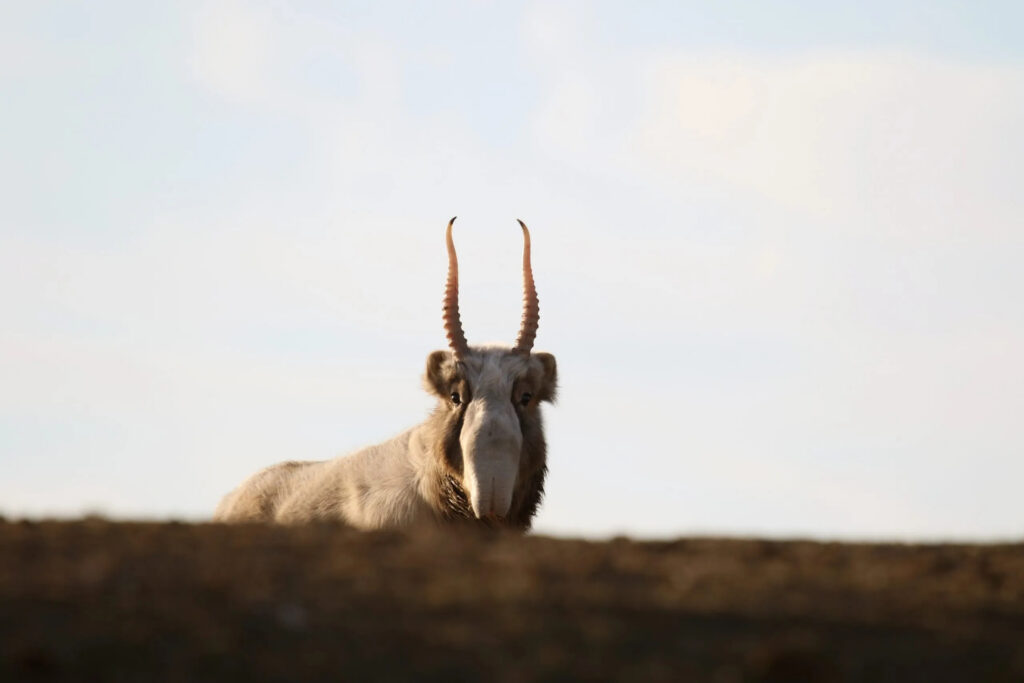
The saiga’s distinctive proboscis is an evolutionary masterpiece, acting as an internal climate-control system that warms freezing winter air before it reaches the lungs and filtering out choking dust during the dry summer months. Consequently, a large nose serves as a primary indicator of male vitality. The success of these reproductive gatherings depends entirely on the animals’ ability to travel unhindered across vast, uninterrupted expanses of land.
Infrastructure Fragmentation and the Threat to Spatial Memory
Despite their historical resilience, modern saiga populations face unprecedented anthropogenic pressures. Following the collapse of the Soviet Union and the subsequent acceleration of regional industrialization, the Eurasian steppe has become increasingly fragmented by new roads, railways, and border fences.
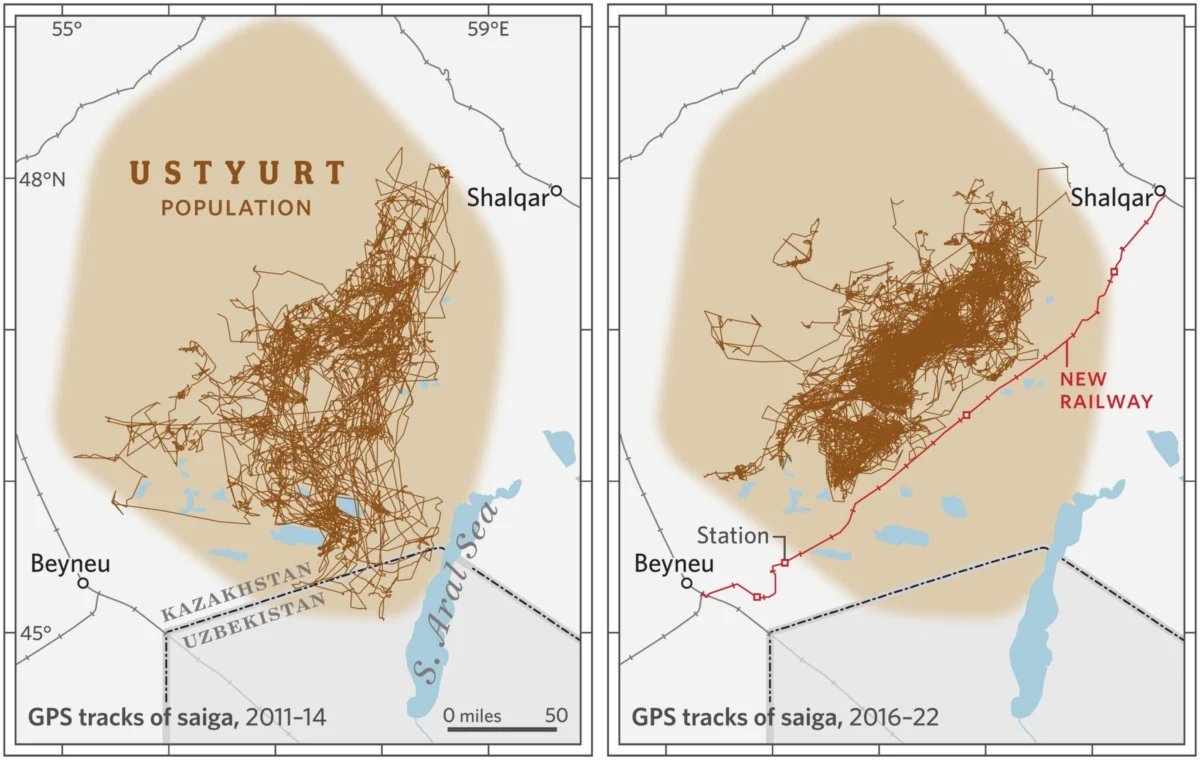
Data collected via GPS satellite collars—which have revolutionized wildlife tracking across the treeless, unobstructed plains—reveals the devastating impact of linear infrastructure on migratory patterns. For example, telemetry data from 2014 documented a thriving population of saigas that routinely migrated deep into Uzbekistan. Following the construction of a major railway line, however, the animals’ traditional route was abruptly severed.
Subsequent tracking data showed these saigas wandering despondently on the northern side of the tracks while vital water sources and fresh forage withered to the south. This disruption leads to a catastrophic loss of spatial knowledge. Similar to how human nomads forced into sedentary settlements lost their generational navigational skills, young saigas acquire migratory routes through active, experiential learning passed down by older generations. When physical barriers partition the landscape, entire cultural pathways vanish from memory.
Collaborative Conservation and Cross-Border Mitigation
To reverse this habitat fragmentation, conservation organizations and government agencies are implementing targeted mitigation strategies. ACBK, in close partnership with the Kazakh government, has spearheaded the construction of saiga-friendly crossing points. These infrastructure projects feature gently sloping dirt ramps that match the elevation of railway lines, creating the visual illusion of a natural gap in the barrier. Additionally, strategically placed cattle-guard fences keep trains and wildlife separated, preventing collisions that could compromise the safety of the crossings.
International cooperation has also proven critical. ACBK has collaborated with Uzbek authorities to modify rigid border security fences. Traditional barbed-wire walls have been replaced with X-shaped barricades designed to prevent vehicular traffic while leaving precisely enough clearance for saigas to move freely between historical feeding grounds. Conservationists hope these measures will gradually restore ecological connectivity across the Central Asian plateau.
Broader Implications for Steppe Ecosystems
The plight of the saiga antelope serves as a broader bellwether for the health of temperate grassland ecosystems worldwide. As rapid infrastructure development continues to carve up the globe’s remaining wilderness areas, the preservation of migratory corridors is emerging as a central priority for international conservation biology.
The ongoing efforts in Kazakhstan demonstrate that economic development and wildlife preservation can coexist through proactive engineering and landscape-scale planning. By safeguarding the saiga’s ancient pathways, conservationists are not merely protecting a single endangered species; they are preserving an irreplaceable ecological legacy that links the modern world to the deep history of the Eurasian steppe.