










Winter sports enthusiasts, particularly those who frequent high-altitude resorts where temperatures frequently plummet into the sub-zero range, are well-acquainted with the physiological challenges of maintaining extremity warmth. For individuals with Raynaud’s phenomenon or naturally poor circulation, the selection of hand protection is not merely a matter of comfort but a critical component of safety and endurance on the slopes. As of November 2026, industry experts and testing panels from SKI have finalized their assessments of the current market’s top-performing thermal handwear, balancing technical innovation against ergonomic utility.

The Evolution of Thermal Protection in Winter Gear
The technology behind modern ski gloves has undergone a significant transformation over the last decade. Historically, handwear relied primarily on bulky down insulation or rudimentary synthetic fibers. Today, the integration of advanced materials—such as PrimaLoft Gold, 3M Thinsulate, and specialized Gore-Tex membranes—has allowed manufacturers to achieve higher warmth-to-weight ratios. This shift is essential, as the modern skier requires a delicate balance: protection against convective heat loss caused by high-speed descents, coupled with enough dexterity to manipulate zippers, helmet straps, and smartphone touchscreens.
According to technical specifications released by leading manufacturers for the 2026-2027 winter season, the focus has shifted toward "active thermal management." This approach prioritizes moisture-wicking properties, as damp skin loses heat significantly faster than dry skin. The consensus among professional testers is that a glove’s failure is rarely due to a lack of insulation, but rather the failure of the shell to manage internal humidity generated by the wearer’s own metabolism.

Analysis of Top-Performing Gear for the 2026-2027 Season
Testing protocols conducted by industry professionals involved rigorous field trials across various climate zones, from the dry, frigid air of the Rockies to the damp, unpredictable conditions of the Pacific Northwest. The following selection highlights the top-performing models based on structural integrity, insulation technology, and user-reported satisfaction.
Mainers Mitts: Precision Engineering for Extreme Cold
Developed by Tempshield—a firm primarily recognized for manufacturing protective equipment for cryogenic research laboratories—the Mainers Mitts represent a unique crossover from industrial safety to recreational sports. The mitts utilize recycled featherless 3M Thinsulate insulation. The primary advantage of this material is its ability to retain loft and thermal efficiency even when slightly compressed. Testers noted that while the initial leather-and-nylon shell requires a break-in period, the resulting fit offers a level of dexterity rarely seen in non-heated mittens. The inclusion of a waterproof Gore-Tex liner ensures that moisture from external snowmelt does not compromise the insulating layers.

LEKI Griffin Pro Zero: The Gold Standard for Nimbleness
For skiers who prioritize tactile feedback, the LEKI Griffin Pro Zero utilizes PrimaLoft Gold synthetic insulation. This material is widely regarded in the textile industry as the preeminent alternative to down, providing superior warmth without the density of traditional polyester fill. The Griffin Pro Zero is engineered with a full leather shell and padded knuckles, providing both wind protection and impact resistance. While the glove is classified as water-resistant rather than waterproof, its design remains a favorite among competitive skiers who require precise control over pole plants and race-ready maneuvers.
Gordini Alp Pro Mitt: Advanced Moisture Management
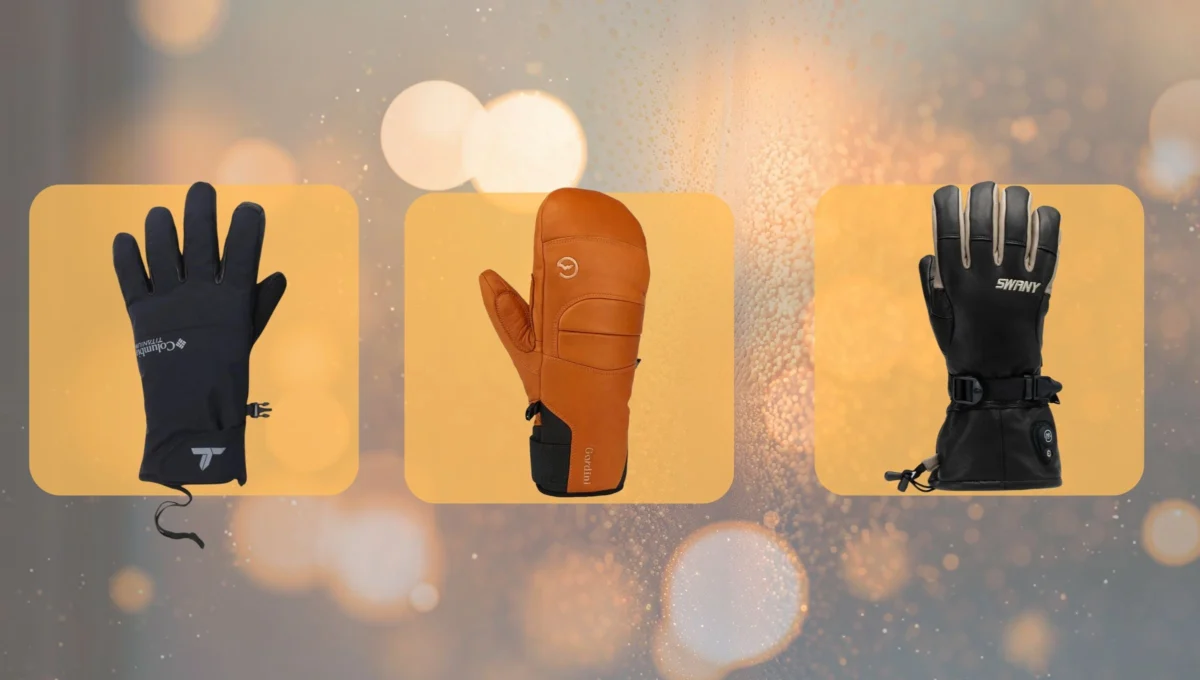
The Gordini Alp Pro Mitt stands out due to its proprietary waxed leather exterior, which serves as a secondary barrier against the elements. Unlike standard leather, which can saturate after prolonged exposure, the waxed finish repels water and prevents the leather from stiffening as it dries. The interior utilizes a hybrid insulation strategy, blending down with high-pile fleece. This combination is intended to manage the internal microclimate; the down provides high-loft heat retention, while the fleece absorbs excess perspiration to keep the interior surface dry.

Columbia PowBound Gloves: Accessible Performance
Representing the value segment of the market, the Columbia PowBound gloves utilize 200g of recycled polyester insulation. These gloves are designed for the high-volume recreational skier who needs a reliable product that can withstand multiple seasons of heavy use. While they lack the premium materials of higher-end competitors, their articulated design ensures that the hand maintains a natural, relaxed position, reducing muscle fatigue during long days on the chairlift.
Hestra Fall Line: Rugged Durability
Hestra continues to hold a dominant market position, particularly among mountain professionals and ski instructors. The Fall Line glove is constructed from heavy-duty cowhide and features a removable liner system, which allows for easier drying and cleaning. By utilizing a foam insulation core and a seam-sealed construction, Hestra has produced a glove that is exceptionally resilient against the wear and tear of repetitive motion. The included leather balm is a testament to the company’s philosophy: by maintaining the natural integrity of the cowhide, the user can extend the functional lifespan of the glove by years.

The Rise of Integrated Heating Systems
The most significant technological advancement in the current market is the refinement of battery-integrated heating systems. Modern heated gloves, such as the Swany Nexus and the Outdoor Research Sureshot, have evolved beyond the bulky prototypes of the early 2020s.
The Swany Nexus, for instance, utilizes "ewool" technology, which distributes heating elements directly to the fingertips—the area most susceptible to cold-induced injury. With a battery life of up to eight hours on low settings and a simplified, port-based charging system that eliminates the need for battery removal, these gloves are increasingly viewed as essential equipment for those living in extreme climates.

Conversely, the Outdoor Research Sureshot represents a shift toward "lifestyle-integrated" heating. These gloves are designed for users who spend significant time in stationary outdoor settings, such as winter festivals or urban commuting. By utilizing a two-layer stretch fabric, these gloves offer high breathability, ensuring that the user does not experience "overheating" when moving from the cold outdoors to a heated indoor environment.
Industry Implications and Consumer Guidance
The broader trend in the winter gear industry is a move toward circularity and longevity. Manufacturers are increasingly prioritizing recycled materials—such as the 3M Thinsulate in Mainers Mitts and the recycled polyester in Columbia products—to address growing consumer demand for sustainable manufacturing.

However, the primary implication for the consumer remains the "Warmth vs. Dexterity" trade-off. Data from SKI testing panels suggests that while heated gloves provide the highest ceiling for absolute warmth, non-heated, high-end leather gloves offer superior longevity and tactile control. When selecting equipment for the 2026-2027 season, consumers are encouraged to assess their specific needs:
- Activity Type: High-intensity skiers should prioritize moisture-wicking and dexterity (e.g., LEKI or Hestra), while recreational skiers or those with circulation issues should lean toward high-loft mittens or heated systems.
- Climate Conditions: Those skiing in the Pacific Northwest or humid maritime climates must prioritize waterproof ratings, whereas those in the arid Rockies may find water-resistant waxed leather sufficient.
- Maintenance Requirements: Prospective buyers should consider the long-term care of their equipment. Leather-based gloves require periodic treatment with balms or waxes, while synthetic options are generally easier to clean but may have a shorter lifespan.
As winter sports continue to grow in popularity, the integration of smart-fabric technology and sustainable sourcing is expected to dictate the next generation of gear. For now, the current market offers a robust array of options that ensure that even in the most unforgiving conditions, the cold remains a manageable environmental factor rather than a barrier to the experience of the sport.