



In the late 1970s and early 1980s, the landscape of motorcycle racing was defined by the raw, unrefined power of production-based machines. Legendary racer Freddie Spencer transformed this era into a golden age for the American Motorcyclist Association (AMA) Superbike championship. Riding production-based Honda CB750 and CB900 platforms, Spencer showcased a level of mechanical sympathy and precision that proved these street-legal, upright motorcycles were capable of dominating on the track. Today, Honda is looking to recapture that specific lightning in a bottle with the release of the 2026 CB1000F, a machine that balances the nostalgia of the "muscle bike" era with the sophisticated electronic architecture of the modern age.
A Chronology of the CB Lineage
The lineage of the Honda CB series is arguably the most significant in the history of Japanese motorcycling. It began in earnest with the 1969 CB750, a bike widely credited with inventing the modern "superbike" category. By the late 1970s, the platform had evolved into the DOHC (Double Overhead Cam) series.
The timeline of this heritage is as follows:
- 1969: Introduction of the CB750, the first mass-produced four-cylinder motorcycle with a front disc brake.
- 1979: The introduction of the DOHC CB750F and CB900F, which became the foundations for factory racing efforts.
- 1982: Freddie Spencer pilots the CB900F to a decisive victory at the Daytona Superbike race, cementing the bike’s reputation for reliability and handling.
- 1983–1985: The transition toward the V4 Interceptor series begins to overshadow the inline-four, relegating the air-cooled "CB" muscle bikes to the status of cult classics.
- 2026: Honda launches the CB1000F, explicitly marketed as a spiritual successor to the 1982 Daytona-winning machines, integrating the high-performance DNA of the Fireblade.
Technical Foundations: The 2017 Fireblade DNA
The core of the 2026 CB1000F is not a retro-engineered powerplant, but a refined iteration of the 2017 CBR1000RR Fireblade engine. This choice is significant because the 2017 Fireblade represented a milestone in Honda’s pursuit of the "Total Control" philosophy, focusing on a high power-to-weight ratio and exceptional chassis balance.
However, moving a race-bred engine into a street-focused "naked" platform requires extensive recalibration. Honda’s engineering team prioritized mid-range torque over the stratospheric peak horsepower figures of the original superbike. By revising the camshaft profiles and adjusting intake and exhaust timing, engineers have moved the torque curve lower in the rev range. This shift is designed to provide the rider with "real-world" acceleration, allowing for effortless overtaking without the need to constantly dance through the gearbox. The result is a powerplant that feels muscular and responsive at urban speeds while maintaining the signature raspy, high-frequency note of an inline-four configuration.
Design Philosophy and Aesthetic Engineering
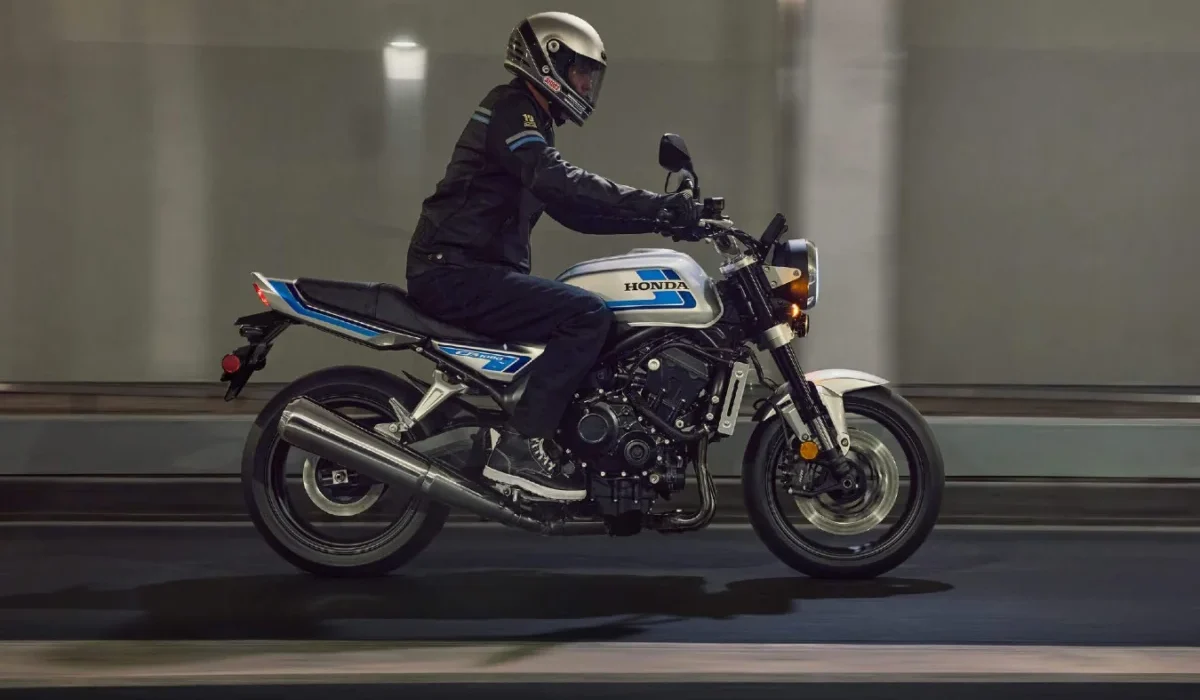
The design language of the 2026 CB1000F is a deliberate homage to the "Best Balanced Roadster" concept. The aesthetic is defined by a chiseled fuel tank that flows seamlessly into the side and rear bodywork. The paint scheme—Wolf Silver with iconic blue racing stripes—is a direct visual reference to Spencer’s 1982 race bike.
Beyond the nostalgia, the architecture serves a functional purpose. The upright seating position, facilitated by a wide handlebar, reduces rider fatigue during long-distance travel, a stark departure from the aggressive, wrist-heavy geometry of the Fireblade. The contrast between the black-coated engine, frame, swingarm, and the silver bodywork creates a sense of mechanical density. LED lighting technology has been integrated into a classic, large-format headlight housing, ensuring that the bike retains its retro silhouette while meeting modern illumination and safety standards.

Integration of Modern Electronic Suites
While the silhouette is nostalgic, the internal systems are thoroughly modern. The inclusion of a six-axis Inertial Measurement Unit (IMU) marks a significant step forward for the CB line. The IMU constantly monitors the motorcycle’s pitch, roll, and yaw, feeding data to the engine management system to provide precise traction control and cornering ABS.
Connectivity is handled through a five-inch TFT color display, which serves as the interface for the HondaSync app. This allows for turn-by-turn navigation, media playback, and telemetry data, all accessible via smartphone integration. The Honda Smart Key system further underscores the shift toward convenience, allowing the rider to operate the ignition and steering lock without removing the key from their pocket—a feature that bridges the gap between the raw simplicity of 1980s bikes and the convenience of the digital era.
Market Implications and Industry Reception
The reintroduction of the "CB-F" designation carries significant weight in the motorcycle industry. Historically, manufacturers have struggled to balance the "retro" aesthetic with the "performance" reality. Many modern classic motorcycles sacrifice chassis integrity or engine performance to maintain a vintage appearance.
Market analysts suggest that the CB1000F is positioned to challenge the dominance of bikes like the Kawasaki Z900RS and the BMW R nineT. By utilizing the proven, high-performance Fireblade engine, Honda has effectively bypassed the performance deficit often associated with the retro segment. Industry insiders have noted that this strategy targets the "maturing enthusiast"—a demographic that grew up idolizing the AMA Superbike era but now demands the reliability, safety, and technological connectivity of a 2026 model year vehicle.
Official Responses and Future Outlook
While official corporate statements from Honda have remained focused on the technical specifications of the machine, the subtext of the launch is clear: the company is reclaiming its heritage. Honda’s design lead for the project noted in preliminary press materials that the goal was to avoid "pastiche" and instead create a machine that honors the mechanical honesty of the early 80s.
The broader implication of this release is a potential shift in the "Naked" motorcycle segment. For years, the category has been split between hyper-naked bikes—which are essentially race bikes with the fairings removed—and entry-level commuters. The CB1000F carves out a middle ground: it is a "gentleman’s express." It offers the capability to hold its own on a mountain pass while providing the ergonomics and aesthetic maturity suitable for a daily commute or a weekend tour.
Conclusion: A Synthesis of Eras
The 2026 Honda CB1000F is more than a nostalgic exercise. It is a calculated synthesis of Honda’s most successful eras. By grounding the project in the visceral history of the 1982 Daytona-winning CB900F and bolstering it with the refined, high-performance guts of the 2017 Fireblade, Honda has created a motorcycle that addresses the current market demand for character-driven machines.
The bike’s success will ultimately be measured by its ability to provide a sensory experience that feels authentic to its history, while performing with the clinical, high-tech precision that modern consumers expect from the world’s largest motorcycle manufacturer. For those who remember the smell of race fuel at the track in 1982, and for those who have only ever known the convenience of a smartphone-linked dashboard, the CB1000F offers a rare middle ground: a machine that is as comfortable in the past as it is capable in the future. As the industry moves toward electrification and increasing automation, the CB1000F stands as a reminder of the enduring appeal of the combustion-engine roadster—a balanced, powerful, and iconic piece of engineering.