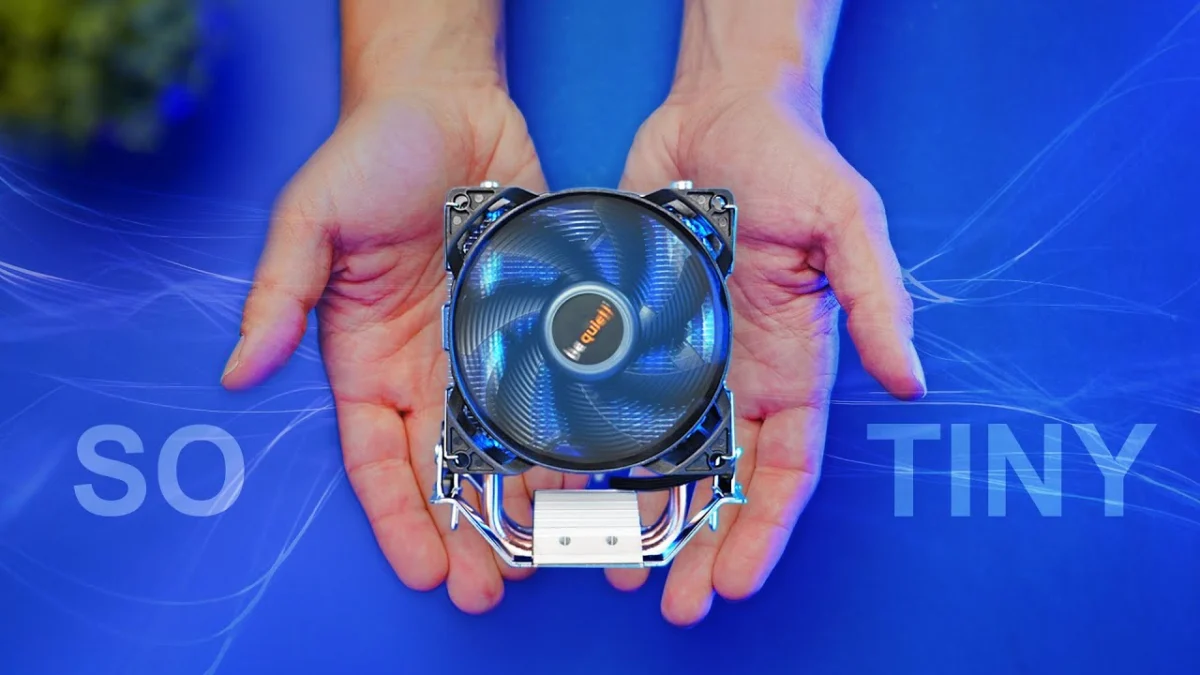
The modern personal computer hardware market is frequently dominated by discussions of massive, high-performance components. Enthusiasts and builders often focus their attention on liquid-cooling systems, massive multi-fan radiators, and towering dual-tower air coolers such as the Noctua NH-D15 or the Be Quiet Dark Rock Pro 4. These cooling behemoths, featuring 140mm fans and dense fin arrays, are undoubtedly necessary for overclocked, high-wattage desktop processors running demanding AAA video games or intensive workstation applications like video rendering and 3D modeling. However, a significant portion of the consumer base builds mainstream systems that do not require extreme thermal dissipation capacities. Recognizing this market gap, German cooling manufacturer Be Quiet has updated its entry-level lineup with the introduction of the Pure Rock Slim 2, a compact 92mm CPU cooler retailing for an accessible $25.
Designed to deliver broad hardware compatibility, whisper-quiet operation, and reliable thermal performance, this budget-friendly heatsink challenges the notion that effective cooling requires a substantial financial investment or a massive physical footprint. While the market for budget CPU coolers has historically been saturated with legacy options like the Cooler Master Hyper 212 Evo, shifting trends in PC case design—specifically the surging popularity of compact form factor (SFF) builds—have necessitated a reevaluation of what consumers need from their cooling solutions.
Market Context and the Evolution of Budget Air Cooling
To understand the positioning of the Pure Rock Slim 2, one must examine the broader economic and technological landscape of the DIY PC component market. Over the past several years, the mainstream adoption of high-core-count processors from both AMD and Intel has elevated thermal management to a critical priority for everyday builders. Simultaneously, consumer preferences have shifted toward smaller, more aesthetically pleasing chassis designs, such as the Cooler Master MasterBox NR200. These cases often impose strict height limitations on CPU coolers, frequently capping maximum clearance at 155mm or lower. Consequently, traditional 120mm tower coolers can become entirely incompatible with popular SFF enclosures.
Furthermore, supply chain fluctuations and third-party reseller markups have complicated pricing transparency across major e-commerce platforms like Amazon and Newegg. While the official MSRP of the Pure Rock Slim 2 is established at $25, early adopters have sometimes encountered inflated pricing by secondary vendors capitalizing on initial product demand. Despite these market friction points, the release of a sub-$30 cooler from an established, tier-one manufacturer represents a strategic effort to capture the entry-level segment, particularly system builders utilizing AMD’s increasingly popular Ryzen architecture.
Physical Specifications and Engineering Design
Measuring 135mm in height, 82mm in depth, and 97mm in width, the Pure Rock Slim 2 is markedly more compact than standard tower coolers. This diminutive physical footprint is its primary engineering advantage, offering unobstructed clearance for fully populated memory (RAM) slots across virtually all standard motherboards. Users frequently encounter clearance conflicts when installing bulky heat sinks that overhang DIMM slots, but the slim profile of Be Quiet’s latest offering entirely eliminates this engineering hurdle.
Structurally, the cooler utilizes a straightforward design featuring a dense aluminum fin array traversed by three 6mm copper heat pipes. These pipes employ a Heatpipe Direct Touch (HDT) base, meaning the copper tubing makes direct contact with the integrated spreader of the CPU to facilitate rapid thermal transfer. A pre-applied thermal compound is included on the baseplate from the factory, streamlining the initial assembly process for novice builders.
Driving airflow through the fin stack is Be Quiet’s proprietary 92mm Pure Wings 2 fan. Operating at a maximum speed of 2,300 RPM, the fan utilizes rifle-bearing technology designed to minimize mechanical noise while maintaining steady static pressure. When compared to its predecessor, the original Pure Rock Slim, the version 2 iteration features a slightly extended rear fin array and a revised baseplate, though the most substantial updates center around the mounting mechanism and fan tuning.
Installation Process and Compatibility
One of the most persistent criticisms of budget CPU coolers has historically been complex, frustrating, or fragile mounting hardware. Be Quiet has attempted to address this pain point by comprehensively revising the installation process for the Pure Rock Slim 2.
For users building on AMD platforms—utilizing sockets such as AM4—the installation procedure has been streamlined to leverage the stock mounting retention module that ships pre-installed on virtually all modern motherboards. Builders simply align the cooler, hook the retention clips onto the plastic mounting frame, and secure the heatsink by applying downward pressure on the levers. Because AMD processors currently command a substantial share of the DIY market, pre-installing or optimizing for this stock bracket architecture reflects an acute understanding of current consumer demographics.
Conversely, the installation process for Intel platforms relies on a more traditional push-pin mechanism. While push-pin systems are generally accessible for novice builders due to their tool-less nature, they occasionally draw criticism from hardware purists regarding uniform mounting pressure compared to backplate-and-screw configurations. Nevertheless, Be Quiet has engineered the tolerances such that the cooler remains securely seated with minimal lateral movement, ensuring adequate thermal paste spread and stable contact across the processor surface.
Thermal and Acoustic Performance Analysis
Independent benchmark testing reveals performance characteristics that defy the product’s modest price point and compact dimensions. When evaluating noise output relative to fan speed percentages, the Pure Wings 2 fan demonstrates exceptional acoustic efficiency. At 70% fan speed, the noise output drops to the minimum ambient noise floor of the testing environment—a performance metric rarely achieved by stock cooling solutions or competing budget towers. Even when operating at maximum velocity (2,300 RPM), the cooler tops out at approximately 40 decibels, maintaining a distinctly quieter acoustic profile than many larger 120mm alternatives.
Under standard thermal loads of 95 watts, the Pure Rock Slim 2 performs competitively against larger, more expensive heatsinks, matching the cooling efficiency of the Noctua NH-U12S while maintaining a lower decibel output.
When subjected to a more demanding 125-watt load—which pushes close to the manufacturer’s specified Thermal Design Power (TDP) threshold of 130 watts—the cooler continues to maintain structural thermal stability. In comparative testing benchmarks, it successfully matches the thermal performance of the Noctua NH-U12S up to 37 decibels and consistently outperforms the legacy Cooler Master Hyper 212 Evo across equivalent noise levels. However, pushing the system further to a 150-watt load quickly saturates the cooler’s physical capacity, illustrating that extreme overclockers or high-end workstation users will inevitably require a larger dual-tower air cooler or an All-In-One (AIO) liquid cooling loop.
Industry Implications and Consumer Takeaways
The introduction of the Be Quiet Pure Rock Slim 2 highlights a maturing segment of the PC hardware market where consumers no longer need to overspend to achieve reliable, quiet operation for standard desktop configurations. With a retail price point of $25, the cooler delivers a compelling balance of acoustic suppression, physical compactness, and sufficient thermal headroom for mainstream processors operating within standard TDP limits.
For the average consumer building a home office PC, a mainstream gaming rig, or a compact form factor system, the Pure Rock Slim 2 offers a cost-effective alternative to bulky tower coolers and loud stock solutions. While it is not designed to tame the thermal output of enthusiast-tier, heavily overclocked multi-core flagships, its performance profile confirms that for the vast majority of PC users, a modest $25 investment is all that is truly required to keep a system running cool and quiet.