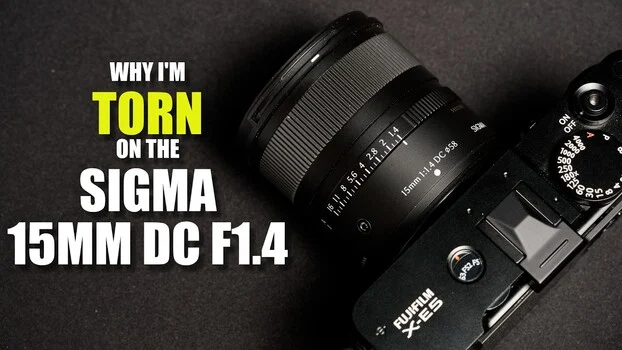
The realm of photographic equipment often presents a fascinating paradox: a lens can meticulously tick every box on a technical specification sheet, fulfilling all quantifiable requirements, yet fail to resonate emotionally with the photographer when put into practice. This nuanced gap between objective performance metrics and subjective user experience is precisely what photographer Luca Petralia explores in his recent in-depth review of the Sigma 15mm f/1.4 DC lens, tested on a Fujifilm X-E5 camera body. His analysis serves as a compelling case study, dissecting how a lens, despite its undeniable technical excellence, can leave a photographer feeling artistically uninspired.
Petralia’s comprehensive walkthrough, available via his YouTube channel, aims to illuminate why a technically superior lens might not necessarily translate into a more engaging or soul-stirring photographic output. The Sigma 15mm f/1.4 DC, on paper, presents a highly attractive proposition, particularly for APS-C camera users seeking an ultra-wide perspective with a fast aperture. Its physical characteristics, for instance, are remarkably well-balanced. Weighing in at a mere 225 grams, it complements smaller camera bodies like the Fujifilm X-E5 without creating a front-heavy feel, a crucial consideration for photographers prioritizing portability and comfort during extended shooting sessions.
A significant design element that Petralia highlights is the inclusion of a physical aperture ring. This feature, which he notes is a pioneering inclusion for Sigma’s contemporary DC line, shared only with the 12mm offering, harkens back to a more tactile and intuitive shooting experience. This physical control allows photographers to adjust aperture directly on the lens, a preference for many who value immediate tactile feedback and a more direct connection with their equipment, reminiscent of classic photographic workflows.
Further bolstering its practical appeal, the Sigma 15mm f/1.4 DC boasts robust build quality and weather-sealing. The inclusion of a gasket at the lens mount provides a critical barrier against dust and moisture ingress, a feature highly valued by photographers who venture into challenging environments or shoot in unpredictable weather conditions. The overall construction employs high-quality plastics, contributing to a durable yet lightweight feel. Priced between $500 and $600, this lens offers an f/1.4 ultra-wide aperture in a compact form factor, presenting a compelling value proposition that leaves little room for objective criticism based on its specifications alone.
The objective assessment of image quality mirrors the lens’s impressive physical attributes. Petralia describes the output as "clinical," a term often used to denote images that are technically perfect but lack a certain artistic character or "vibe." Wide open at f/1.4, the lens exhibits exceptional sharpness in the center of the frame, a testament to Sigma’s advanced optical design. The corners, while not as sharp as the center at the widest aperture, achieve comparable sharpness by f/5.6. However, the sustained sharpness of the center is so profound that stopping down the aperture rarely yields a perceptible improvement in detail, even when evaluated on a high-resolution 40-megapixel sensor. This suggests that for many practical shooting scenarios, the benefits of a narrower aperture might be largely academic in terms of pure detail rendition.
Vignetting, a common characteristic of wide-angle lenses, is effectively managed and largely disappears by f/2.8. Chromatic aberration, while present, is subtle enough to require deliberate effort to detect, indicating precise optical correction by Sigma’s engineers. Even the bokeh, the aesthetic quality of the out-of-focus areas, holds up commendably for an ultra-wide lens, maintaining a smooth appearance even when the aperture is stopped down.
Despite this litany of technical achievements, Petralia’s primary reservation lies in a less quantifiable aspect: the lens’s ability to evoke an emotional response. He articulates that the Sigma 15mm f/1.4 DC produces an image that is "technically correct" but ultimately fails to "speak to your soul." This sentiment points to a growing trend in modern lens design, where the relentless pursuit of optical perfection can sometimes inadvertently strip away the unique character or "personality" that photographers historically sought and valued in their lenses.
Autofocus performance is reported as solid, with Petralia carefully attributing any missed shots in continuous autofocus mode to the Fujifilm X-E5 body rather than the lens itself. He notes a consistent behavior pattern with other lenses he has tested on the same camera, suggesting that the camera’s autofocus system might be the limiting factor in certain dynamic shooting situations, rather than the lens’s ability to focus.
Petralia’s critique transcends the specific Sigma lens, landing on a fundamental truth that resonates throughout the photography community: "character" and technical correction are not interchangeable concepts. Modern lens manufacturers have achieved remarkable feats in minimizing optical flaws such as aberrations, field curvature, and edge-to-edge softness. While these advancements are undeniably beneficial for achieving clean, predictable image files, they also contribute to the phenomenon of "clinical" rendering, where images can appear technically flawless but artistically sterile.
The implication for consumers is significant. When faced with multiple lens options, the practical approach is to define what one truly desires from an image. A lens engineered for maximum optical correction provides a clean, consistent, and predictable output, making it an ideal companion for documentation, travel photography, and everyday shooting where reliability and ease of use are paramount. Conversely, a lens that embraces more optical "personality" may sacrifice some degree of consistency for a rendering style that a photographer will either passionately embrace or find frustratingly unpredictable. Understanding this distinction is crucial to avoid the scenario of investing in a technically perfect lens only to find oneself questioning the emotional impact or artistic resonance of the resulting photographs.
The true value of Petralia’s review is amplified through his direct comparisons with alternative lenses within the Fujifilm ecosystem and for other camera mounts. He meticulously maps out distinct buyer profiles, offering tailored recommendations based on individual priorities.
For photographers seeking the absolute pinnacle of image quality within the Fujifilm system, Petralia still endorses the Fujifilm XF 18mm f/1.4 R LM WR. He acknowledges that this lens comes at a significant premium, costing roughly double the Sigma, and is also larger and heavier. However, he contends that its rendering possesses a distinct "soul" that the Sigma lens, in his estimation, lacks. This endorsement underscores the idea that for some, the intangible qualities of a lens’s rendering can outweigh purely objective performance metrics, even at a considerable cost.
On the more budget-conscious end of the spectrum, Petralia examines the Viltrox 15mm f/1.7. This lens, priced at approximately half that of the Sigma, makes certain concessions, notably relinquishing half a stop of maximum aperture and the aperture ring. Despite these compromises, Petralia finds that the Viltrox offers a more characterful and, in his words, "fun" shooting experience for the money, suggesting that creative enjoyment can sometimes be found in less technically perfect, but more engaging, optics.
For Sony E-mount users, the calculus shifts. The Sony E 15mm f/1.4 G lens emerges as a direct competitor to the Sigma, sharing a similarly "clinical" look. However, the Sony option typically carries a higher price tag, presenting a different value proposition for Sony shooters. Petralia’s detailed breakdown of where each of these lenses fits within the broader market, and his personal reflections on moving on from his beloved Fujifilm 18mm despite the perceived loss, are best experienced in his own narrative, as presented in the video.
The ultimate verdict on the Sigma 15mm f/1.4 DC lens, as articulated by Petralia, targets a specific, albeit niche, audience. He posits that the lens is most suitable for the photographer who deliberately seeks a compact, lightweight, f/1.4 ultra-wide lens with an aperture ring and a decidedly "clinical" aesthetic, all within the $500 price bracket. For such a user, the Sigma 15mm f/1.4 DC fulfills its promise with precision and efficacy. It delivers precisely what it sets out to achieve, catering to a particular set of requirements and preferences.
Ultimately, Petralia’s comprehensive review and comparative analysis serve as an invaluable guide for photographers navigating the increasingly sophisticated and technically advanced landscape of modern lens manufacturing. His work encourages a deeper contemplation of what truly constitutes photographic success, urging individuals to look beyond the numbers and consider the emotional and artistic impact of their chosen tools. The decision of which 15mm lens deserves a place in one’s camera bag hinges not just on technical specifications, but on a clear understanding of personal photographic aspirations and the desired aesthetic outcome. The detailed comparisons within his video presentation provide a crucial resource for anyone considering this focal length and aperture combination, ensuring a more informed and ultimately more satisfying purchase decision.