The enduring question of whether the meticulous craft of writing or the spontaneous art of photography demands more of the artist is a perennial internal debate, a puzzle that resists a definitive answer. For years, the conviction has been strong, only to be dismantled by the very nature of the creative process itself. There are mornings when the act of shaping a single page of prose can consume four hours, each comma a recalcitrant piece of furniture in a mental landscape that has become alien. The resulting exhaustion is not physical, but a profound weariness that stems from hours spent in an internal dialectic, a rigorous self-interrogation.
Conversely, photography often appears deceptively accessible from an external vantage point. The image of an artist departing with a camera slung over their shoulder, embarking on a walk, can evoke a sense of escape, a stark contrast to the solitary confinement of the writing desk. Yet, this perception belies the inherent unpredictability of the street, a constant reminder of the artist’s limited control. The photographer cannot dictate the subjects who wander into the frame, the ephemeral play of light, or the serendipitous convergence of strangers. The role is one of arrival and acceptance, of embracing whatever the day may offer. Some afternoons, the urban environment seems to bestow a cascade of photographic opportunities, while other days remain stubbornly barren, irrespective of experience or effort.
The question of whether street photography can be pre-planned often arises. While deliberate preparation is possible in terms of selecting a locale, choosing a time of day, or understanding the flow of public spaces, the ultimate photograph remains largely beholden to chance. The photographic moment is far more a product of fortune than of meticulous design. This very element of unpredictability, perhaps, is what sustains the artist’s engagement over decades. Each venture into a public space becomes a negotiation with uncertainty, a testament to the dynamic and uncontrollable nature of reality.
The Search for the Ineffable Within Chaos
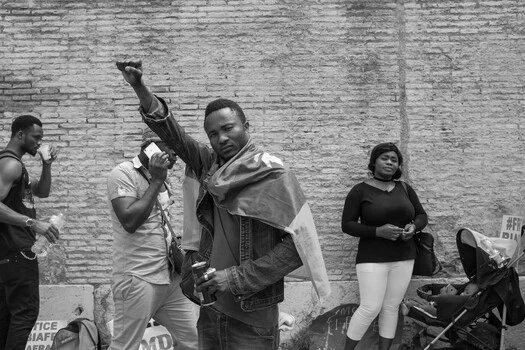
A poignant example of this dynamic occurred years ago during a demonstration in Rome. Thousands of participants, adorned with banners, faced a significant police presence, punctuated by impassioned speeches and a cacophony of noise. While many documented the event itself, the artist’s focus shifted to a more subtle, almost invisible narrative. The quest was for a gesture that resonated with classical art, a fleeting expression on a face isolated for a fraction of a second, or a composition that could distill political upheaval into visual order without distorting the fundamental truth of the situation. Developing this capacity to perceive such nuances across unfamiliar contexts can be aided by resources that explore diverse photographic genres, such as "The Well-Rounded Photographer: 8 Instructors Teach 8 Genres of Photography," which offers insights into expanding one’s visual vocabulary.
These are the moments that linger in memory, not for their inherent spectacle, but for their capacity to reveal something that existed for an infinitesimally brief period. The profound nature of photography lies in the fact that our vision is never a blank slate. Every admired photograph, every impactful film, and every imaginative novel contributes to our internal repository of images. These influences, though not consciously imitated, shape our instincts and inform our decisions before we are even aware of them. The notion of originality as an absence of influence is a misconception; true originality emerges when these accumulated influences become indistinguishable from personal experience, when they cease to be external and become an intrinsic part of one’s unique way of seeing.
The true challenge in photography transcends the technical mastery of exposure or composition, though these are undeniably important. The greater difficulty lies in accepting that every photograph is a self-portrait, a reflection of the creator’s perception. Each frame is a silent confession, not necessarily of explicit beliefs, but of what the artist chooses to observe. This act of noticing, of discerning what captures the eye, offers a more authentic insight into the individual than any formal artist’s statement could provide.
The Resonant Echo of Words
The same principle holds true for writing. Upon the publication of an article, a spectrum of reader responses is inevitable: disagreement, complete misunderstanding, or a cursory skim leading to swift forgetting. These outcomes, however, are not deterrents; they are an intrinsic part of the creative endeavor. Artistic creation inherently requires a degree of vulnerability, a willingness to expose oneself without foreknowledge of the reception.
The perception of artists as being in perpetual conflict with the world is an oversimplification. The more profound struggle unfolds internally, a quiet battle between the artist’s envisioned potential and the tangible output. It is the chasm between the photograph conceived and the one captured, the sentence desired and the one that ultimately graces the page. This distance is an immutable companion in the creative journey, and perhaps, it is this very gap that prevents complacency.
It is this symbiotic relationship between photography and writing that fuels the continued pursuit of both disciplines, rather than a choice between them. Photography cultivates an immediate trust in unfiltered experience, in moments that precede linguistic articulation. Writing, in turn, provides the framework to revisit these experiences, to dissect their significance and articulate their meaning. One medium captures the world in motion, while the other engages with it in reflection. Together, they transcend mere professions, evolving into distinct modes of profound attentiveness.
While expressions of appreciation for photographic work are always welcomed, a message from a reader stating that a particular paragraph has resonated, rekindling a forgotten aspect of their own self, evokes a distinct and deeper sentiment. This may stem from an early immersion in literature, a foundational experience as a reader long before the photographic lens became a tool. Words, in essence, still represent a sense of homecoming.
Ultimately, the endeavor to delineate photography and writing as separate entities is an exercise in futility. They are intrinsically linked components of a singular process, a process that leads to the formation and revelation of identity. Whether traversing city streets with a camera or confronting the stark expanse of a blank page, the fundamental act remains the same: an attempt to comprehend why certain moments exert such a tenacious hold on our consciousness, and the aspiration to imbue them with a form that might, however fleetingly, endure for another.
The Biafran Demonstration: A Case Study in Visual Narrative
The photographs accompanying this reflection originate from a demonstration organized in Rome by members of the Biafran community. This poignant gathering served as a fervent appeal to the global community to acknowledge and address the ongoing tragedy that has unfolded for decades in their homeland. The Biafran War, which raged from 1967 to 1970, was a brutal conflict resulting from the attempted secession of Biafra from Nigeria. The war led to widespread famine and immense loss of life, with estimates of up to two million deaths, primarily from starvation and disease. The demonstration in Rome, occurring decades after the conflict, highlights the enduring impact of this historical trauma and the persistent efforts to ensure it is not forgotten.
Within these powerful images, the essence of this essay resides, even in the absence of a single written word. The inherent uncertainty of documenting such events, the relentless pursuit of order amidst the visual chaos, and the acute awareness that every impactful frame exists for a fleeting moment—all these elements are profoundly present. These photographs stand as a pre-literary testament to the narrative, a visual essay that preceded its textual articulation. They encapsulate the core themes of navigating unpredictability, finding structure in disarray, and capturing the ephemeral nature of truth. The demonstration itself, a manifestation of a long-standing plea for international attention, provides a backdrop against which the artist’s methods and motivations are deeply interwoven. The images, therefore, are not merely depictions of an event, but a profound exploration of the human condition, rendered through the artist’s discerning eye and the unpredictable flow of life.