The landscape of local artificial intelligence development has shifted once again as Ollama, the prominent open-source platform designed for running AI models on personal hardware, officially announced the introduction of native text-to-speech generation capabilities for macOS users. This major update marks a significant milestone for the platform, which has traditionally focused on large language models and text processing tasks. By integrating advanced speech models directly into its ecosystem, Ollama is bridging the gap between silent text-based generation and dynamic auditory interaction, all while maintaining the core philosophy of local execution, data privacy, and hardware-accelerated efficiency.
The initial rollout of speech generation features is currently exclusive to Apple Silicon Macs, leveraging Apple’s specialized machine learning architecture to deliver real-time audio synthesis. Support for Windows and Linux operating systems is actively in development and is slated for release in the near future. This development introduces the Phonon model family—developed by Gradium—to local machine learning enthusiasts, developers, and everyday users who utilize Ollama to manage and execute open-source AI architectures without relying on cloud-based infrastructure.
Understanding Ollama and the Local AI Movement
To fully grasp the significance of this update, it is necessary to examine the trajectory of Ollama within the broader artificial intelligence ecosystem. Launched as an open-source project to simplify the deployment of complex machine learning models, Ollama quickly ascended to become one of the most widely recognized utilities on GitHub. Boasting nearly 185,000 stars and approximately 18,600 forks, the platform serves as an indispensable bridge between raw open-weight AI models hosted on repositories like Hugging Face and the end user’s desktop machine.
Historically, running advanced AI models required robust cloud computing infrastructure, expensive server clusters, or technical expertise in command-line programming and dependency management. Ollama democratized this process by providing a streamlined application interface and command-line tool that handles model downloading, quantization, and memory management automatically. Users can interact with models ranging from compact text generators to highly capable reasoning engines entirely offline. This local execution model guarantees that sensitive personal, corporate, or developmental data never leaves the user’s physical device, offering a stark contrast to proprietary cloud APIs that process data on remote servers.

The Integration of Apple’s MLX Framework
A critical factor enabling Ollama’s seamless performance on macOS is its utilization of Apple’s MLX framework. Introduced by Apple as an open-source machine learning framework designed specifically for Apple Silicon, MLX takes full advantage of the unified memory architecture found in M-series processors. Unlike traditional system architectures where the CPU and GPU maintain separate memory pools, Apple Silicon allows the processor cores and the integrated graphics engine to share a single, high-bandwidth pool of memory.
This unified memory design is particularly advantageous for modern artificial intelligence models, which require vast amounts of random-access memory to store model parameters, context windows, and intermediate calculation states. By leveraging MLX, Ollama bypasses traditional computational bottlenecks, allowing supported models to run with exceptional speed and energy efficiency.
This deep integration with Apple Silicon laid the technical groundwork required to support computationally intensive speech generation tasks locally, without introducing prohibitive latency or straining the system’s thermal and power limits.
Introducing Phonon: Gradium’s Text-to-Speech Innovation
At the heart of Ollama’s new text-to-speech capability is Phonon, a family of small, state-of-the-art speech models created by Gradium. Prior to this update, Ollama’s ecosystem was entirely text-centric, processing user prompts and outputting textual responses. The integration of Phonon represents the platform’s first venture into multi-modal output generation.
The Phonon architecture was selected for its balance of efficiency, high fidelity, and linguistic accuracy. Rather than requiring massive server-side computing power, these compact models are engineered to operate efficiently on client hardware. A standout feature of the implementation within Ollama is real-time generation. As the underlying language model produces text responses, the speech model converts those tokens into audible speech on the fly. Users do not need to wait for an entire paragraph or document to be fully processed before hearing the audio output; instead, speech begins streaming almost instantaneously, mirroring the conversational fluidity of human interaction.
The Phonon model family offers robust language diversity, supporting five primary languages: English, French, German, Spanish, and Portuguese. Gradium has structured the deployment so that users can utilize separate, highly optimized models for each individual language or choose a comprehensive multilingual model capable of handling all five languages dynamically. Furthermore, the models support a variety of voice profiles and regional accents—including distinct American and British English variants—allowing for a more personalized and natural listening experience.
Performance Benchmarks and Hardware Acceleration
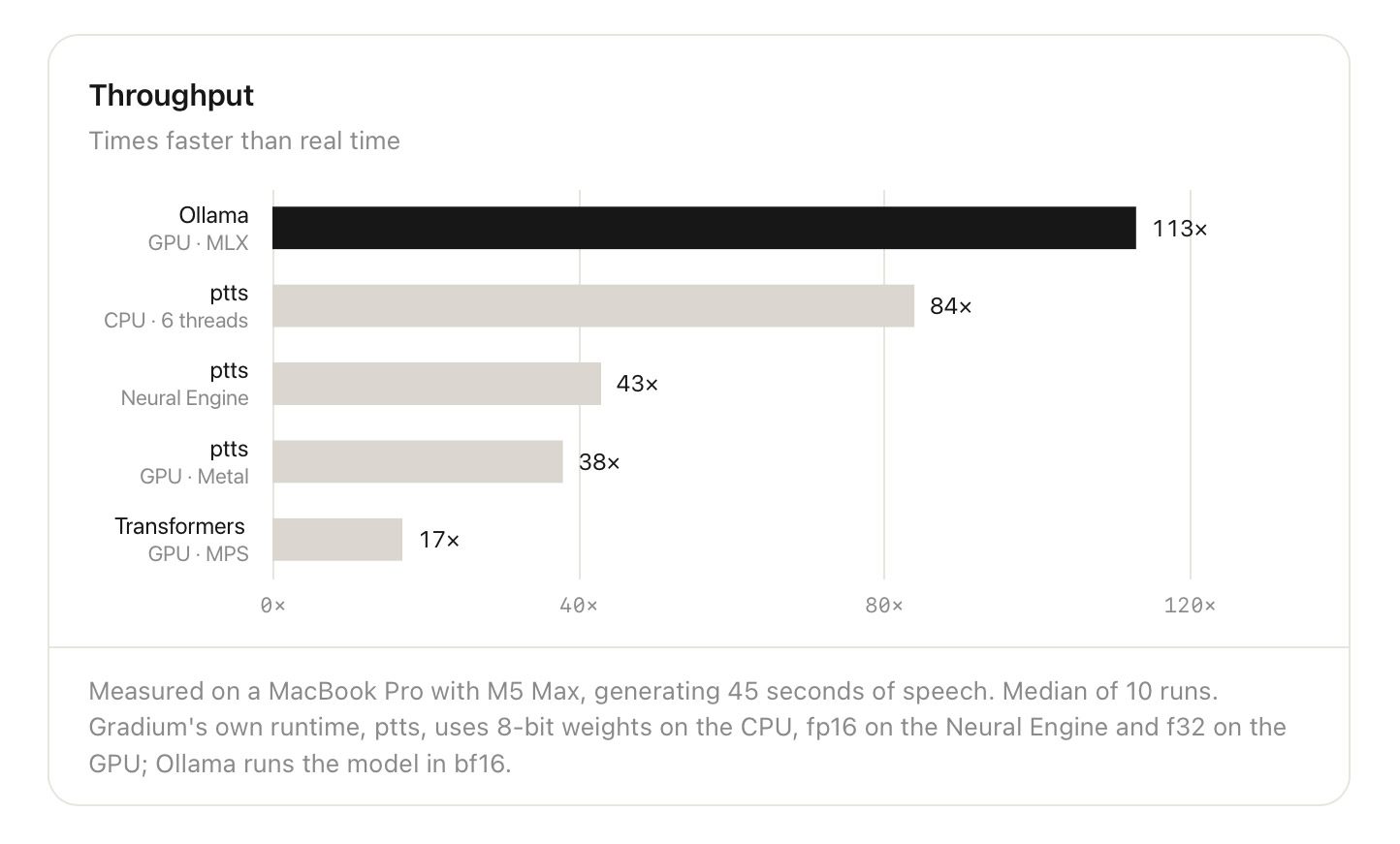
To evaluate the effectiveness of the new text-to-speech integration, developers and engineers conducted extensive performance benchmarks comparing Ollama’s implementation against standard industry baselines. Testing conducted on a high-end MacBook Pro configuration powered by the M5 Max processor revealed remarkable efficiency gains.
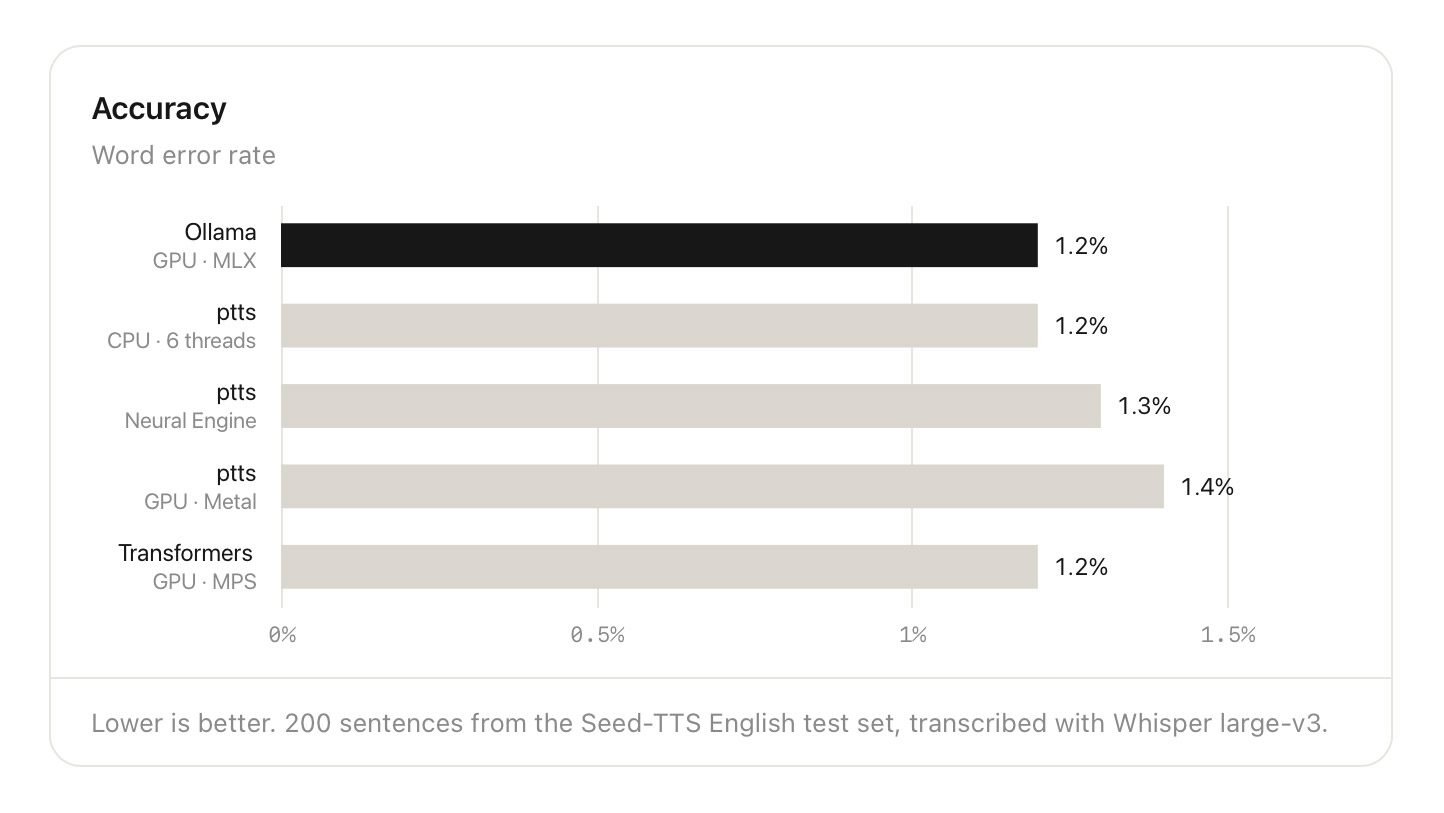
According to release data provided by Ollama, the platform achieved a 35% increase in speech generation throughput compared to Gradium’s native reference implementation. This performance uplift is attributed directly to the optimizations afforded by Apple’s MLX framework and the efficient memory bandwidth of the M-series architecture. Despite the significant boost in processing speed, the system maintained parity with the word error rate of the reference implementation found in Hugging Face Transformers, ensuring that speed enhancements did not come at the expense of audio clarity or phonetic accuracy.
These benchmarks underscore a broader industry trend: consumer-grade hardware is increasingly capable of executing complex generative media workloads that were previously restricted to data centers. For professionals, accessibility advocates, and developers building voice-enabled local applications, the ability to generate high-quality, low-latency speech locally opens up entirely new use cases for offline computing.
Availability, Accessibility, and Implementation
The new speech generation features are available immediately to users running Ollama version 0.40.11 or later on compatible Apple Silicon Macs. Getting started with the new capability requires a straightforward process within the application ecosystem. Users can browse and download Phonon models directly through Ollama’s model repository, similar to how they acquire traditional language models.
For software developers and system integrators looking to incorporate local text-to-speech functionality into their own applications, Ollama provides comprehensive documentation and API examples. Developers can invoke the speech models programmatically via the platform’s local API endpoints, enabling the creation of custom text-to-speech workflows, offline voice assistants, automated content narration tools, and accessibility applications that operate entirely air-gapped from the internet.
While macOS users are the first to experience these capabilities due to the mature optimization of the MLX framework, Ollama has confirmed that Windows and Linux support is actively undergoing development. The cross-platform implementation for non-Apple systems will likely rely on alternative hardware acceleration libraries, such as DirectML or CUDA, to achieve comparable real-time performance on compatible graphics cards.
Broader Implications for Local AI and Industry Impact
The introduction of text-to-speech generation to a mainstream local AI platform carries several important implications for the technology sector. As generative artificial intelligence transitions from experimental cloud services to ubiquitous local utilities, the demand for multi-modal local capabilities—including vision, audio input, and speech generation—continues to escalate.

By keeping audio processing local, applications built on Ollama and Phonon offer unmatched data security and privacy guarantees. Industries handling sensitive data, such as healthcare, legal services, enterprise finance, and government sectors, can utilize advanced voice synthesis without exposing confidential text documents or proprietary materials to third-party cloud vendors. This architecture also eliminates recurring API subscription costs, empowering independent developers and small businesses to experiment with and deploy voice-enabled AI agents sustainably.
Furthermore, the integration highlights the growing viability of small language and speech models. While massive foundation models continue to dominate headlines, specialized, compact architectures like Phonon demonstrate that highly targeted models can deliver exceptional performance while consuming a fraction of the computational resources. As these models become more refined and hardware accelerators continue to improve across all major operating systems, the boundary between cloud-hosted intelligence and local device capability will continue to blur, setting the stage for a more decentralized, private, and responsive artificial intelligence future.