The pursuit of four-digit horsepower figures has long been considered the exclusive domain of dedicated race engines, requiring specialized high-octane fuels, frequent teardowns, and a precarious balance between performance and reliability. However, California-based Nelson Racing Engines (NRE) has challenged this paradigm with the introduction of its Intercooled Outlaw 427, an LS-based crate engine designed to produce 1,200 horsepower while utilizing standard 91-octane pump gas. This development marks a significant evolution in aftermarket powertrain engineering, bridging the gap between extreme forced-induction performance and the convenience of a street-legal driving profile.
The Architectural Foundation: Redefining the LS Platform
While the "427" moniker is historically associated with legendary big-block powerplants from the 1960s, the Outlaw 427 is firmly rooted in General Motors’ contemporary LS architecture. With a displacement of 427.7 cubic inches—approximately 7.0 liters—the engine is engineered to withstand the extreme thermal and mechanical stresses inherent in high-boost applications.
To manage the massive output, NRE starts with a reinforced aluminum block featuring integrated iron cylinder sleeves. This foundation is further strengthened by a specialized six-bolt cylinder head design, which provides superior clamping force compared to the standard four-bolt pattern, essential for maintaining head gasket integrity under extreme cylinder pressures. The internal rotating assembly is composed of a high-strength billet steel crankshaft, forged connecting rods, and custom-engineered pistons. These components are specifically chosen to handle the massive torque loads generated by the twin-turbo system while maintaining a compression ratio of 9.0:1, a critical specification that allows the engine to run safely on pump-grade fuel without the risk of pre-ignition or engine-destroying knock.
The Power Delivery System: Mirror Image Turbocharging
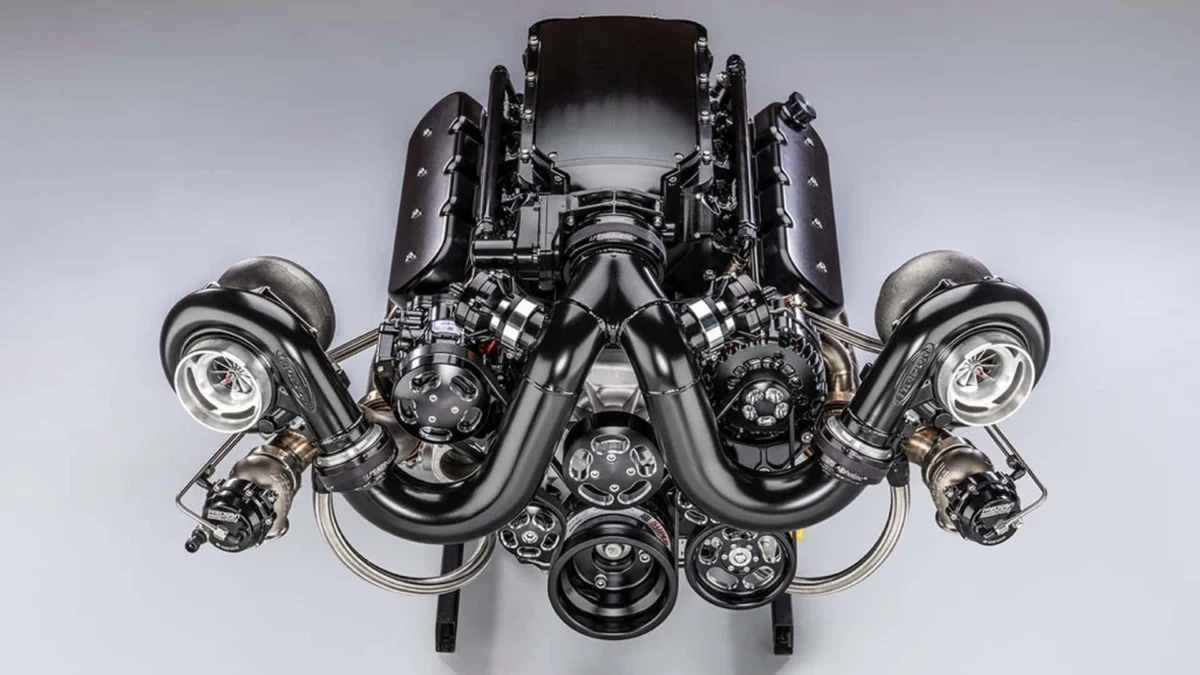
The core of the Outlaw 427’s performance lies in its twin-turbo induction setup. NRE utilizes its proprietary "Mirror Image" Generation 2 turbochargers, each featuring a 72.0-millimeter compressor wheel. The "Mirror Image" design is a signature NRE innovation, featuring turbos that rotate in opposite directions to provide a symmetrical, aesthetically balanced appearance under the hood, while also optimizing airflow plumbing.
By utilizing billet compressor wheels, these units achieve higher efficiency at lower rotational speeds, reducing heat soak and allowing for faster boost response. The system is managed through custom-fabricated exhaust manifolds that minimize backpressure, feeding the turbines with maximum kinetic energy. To regulate the output and ensure the engine does not exceed its safety parameters, the setup integrates heavy-duty wastegates and blow-off valves. These components work in tandem with an advanced intercooler system, which is vital for reducing the temperature of the compressed intake charge before it enters the combustion chamber, thereby increasing air density and further suppressing detonation.
Performance Benchmarks and Versatility
The performance statistics for the Outlaw 427 are verified through rigorous dyno-testing at the NRE facility before shipment. In its standard configuration, the engine reaches its 1,200-horsepower peak at 7,200 rpm on 91-octane fuel. This level of output is transformative for any project vehicle, providing enough power to push street-driven cars into professional-grade drag strip territory.
For enthusiasts seeking to push the boundaries of the platform further, the engine architecture is capable of supporting significantly higher output. With a switch to high-octane racing fuel and an accompanying increase in boost levels, the Outlaw 427 can reliably produce as much as 1,500 horsepower. This flexibility allows owners to tune their vehicles for different environments, from spirited street driving on pump gas to competitive track events where race fuel is readily available.

Economic and Strategic Implications
The entry price for the Twin-Turbo Intercooled Outlaw 427 begins at $41,999. While this represents a significant capital investment—comparable to the cost of a new mid-size sedan—industry analysts point out that the cost-to-performance ratio is competitive when compared to the overhead of building a bespoke racing engine from the ground up.
The appeal of this engine lies in its "plug-and-play" nature. By handling the complex engineering, calibration, and dyno-validation in-house, NRE provides a turnkey solution that mitigates the risks associated with custom forced-induction builds. For high-end vehicle restorers and custom car builders, this reliability is a major selling point. The ability to achieve 1,200 horsepower without the need for an exotic fuel supply or a dedicated pit crew to manage engine health between every outing represents a shift toward more accessible extreme performance.
Historical Context and the Evolution of Crate Engines
The crate engine market has undergone a dramatic transformation over the last two decades. In the early 2000s, high-horsepower crate engines were largely limited to naturally aspirated big-block configurations. The rapid rise of the LS engine platform, bolstered by its modularity and high-flow cylinder heads, allowed for the mass adoption of turbocharging in the aftermarket space.
Nelson Racing Engines has been a pioneer in this transition, having spent years refining the science of fuel injection and turbocharging to make high-output engines "streetable." The Outlaw 427 is the culmination of this experience. By integrating advanced engine management systems with robust hardware, NRE has essentially "democratized" horsepower levels that were previously only attainable by factory-backed race teams.
Industry Outlook: Is 1,200 HP the New Standard?
While 1,200 horsepower is far beyond the requirements for typical daily transportation, the demand for such powerplants is driven by the growing popularity of "Pro Touring" and high-end restomod projects. These vehicles, which combine the aesthetics of classic automotive design with modern chassis, suspension, and powertrain technology, are increasingly being built to levels of performance that exceed modern supercars.
From an engineering standpoint, the success of the Outlaw 427 proves that internal combustion engines still possess significant untapped potential. Despite the industry-wide shift toward electrification, the continued demand for high-output, reliable, and high-performance internal combustion units suggests that the niche for extreme-performance crate engines will remain robust for the foreseeable future.
Summary of Technical Specifications
- Engine Type: LS-based V8
- Displacement: 427.7 cubic inches (7.0 liters)
- Compression Ratio: 9.0:1
- Forced Induction: Twin 72.0mm Mirror Image Gen 2 Turbochargers
- Standard Output: 1,200 hp @ 7,200 rpm (on 91-octane fuel)
- Maximum Potential: 1,500+ hp (on high-octane race fuel)
- Construction: Aluminum block with iron sleeves, billet steel crankshaft, forged internals, six-bolt head design
The Outlaw 427 is not simply a high-power engine; it is a statement on the state of modern mechanical engineering. By prioritizing the user experience—specifically, the ability to operate at extreme power levels using pump fuel—Nelson Racing Engines has created a benchmark for the crate engine industry. While it remains a high-cost, high-performance product, it provides a viable path for builders to achieve professional-tier power without the traditional headaches of racing-only equipment. Whether destined for a drag strip, a show car, or a high-performance track toy, the Outlaw 427 serves as a reminder that the pursuit of horsepower, when paired with thoughtful, modern engineering, remains a powerful force in the automotive world.