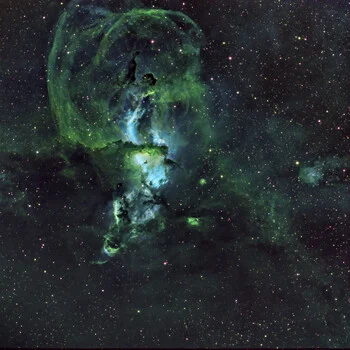
NASA’s recent selection of astrophotographer Logan Carpenter’s breathtaking image of the Statue of Liberty Nebula for its prestigious Astronomy Picture of the Day (APOD) on July 20, 2026, has brought a celestial marvel and a testament to amateur astrophotography’s capabilities to global attention. The image, capturing a vibrant stellar nursery approximately 9,000 light-years distant, showcases NGC 3576, a luminous emission nebula within the constellation Carina, also known as RCW 57. This recognition not only highlights the intricate beauty of deep-space objects but also underscores the growing accessibility of advanced astronomical imaging for enthusiasts worldwide.
A Celestial Landmark Revealed
The nebula, officially designated NGC 3576, is a spectacular cosmic cloud formation recognized for its striking resemblance to the iconic Statue of Liberty. This resemblance, particularly a prominent torch-like structure near its core, has earned it the popular moniker. NASA’s APOD feature on July 20, 2026, described the image as a "re-mapped color view" that masterfully accentuates the nebula’s complex composition. Viewers are treated to dense swathes of shadowy interstellar dust, which act as cosmic veils, obscuring the birthplaces of stars. Interspersed are expansive regions of hydrogen gas, energized and illuminated by the intense radiation from young, massive stars forming within. Sweeping arcs of material, evidence of stellar evolution and the remnants of dying stars, further add to the nebula’s dramatic visual narrative.
Beyond its aesthetic appeal, the Statue of Liberty Nebula holds significant scientific value. NASA’s accompanying description detailed that an extensive analysis of NGC 3576, which also shares designations NGC 3582 and NGC 3584, has revealed the presence of at least 33 large stars in their advanced stages of formation. Crucially, the nebula also harbors polycyclic aromatic hydrocarbons (PAHs), intricate carbon molecules that play a vital role in astrochemistry. Scientists theorize that PAHs form within the cooling gases of stellar nurseries. Their presence in NGC 3576, a region of active star formation, provides insights into the chemical environments that may have seeded early Earth with the building blocks of life, approximately five billion years ago when our own Sun was born in a similar stellar nursery. This connection elevates the nebula from a mere astronomical curiosity to a profound reminder of our cosmic origins.
Historical Context and Discovery
The journey of understanding NGC 3576 began centuries ago. The nebula was first observed and cataloged by the pioneering astronomer John Frederick William Herschel on March 16, 1834. Situated within the southern constellation of Carina, a region rich with celestial wonders, NGC 3576 spans an impressive 100 light-years across and resides within the Sagittarius arm of our Milky Way galaxy. The popular "Statue of Liberty Nebula" nickname, while evocative, is a relatively recent addition to its astronomical lexicon. It was first proposed by Dr. Steve Mazlin of the Star Shadows Remote Observatory (SSRO), an organization dedicated to remote astronomical observation. The dark, sculpted formations visible within the nebula are identified as Bok globules – dense concentrations of gas and dust that serve as the cradles for new stars. These globules are actively shaped and eroded by the intense radiation emanating from nearby massive stars, a process that sculpts the nebula into its visually stunning and recognizable forms.
The Art and Science of Modern Astrophotography
Carpenter’s achievement underscores a significant evolution in the field of astrophotography. Capturing such intricate details of NGC 3576 requires not only advanced equipment but also a deep understanding of imaging techniques and post-processing. The nebula, being a southern hemisphere object, is best observed and imaged under optimal conditions. For amateurs, this often involves utilizing narrowband filters, such as those for Hydrogen-alpha (H-alpha), Oxygen III (OIII), and Sulfur II (SII) emissions. These filters isolate specific wavelengths of light emitted by celestial objects, allowing for extended exposures that reveal fine structures and create striking color contrasts that would be imperceptible to the naked eye.
The APOD description’s reference to a "re-assigned color" image highlights a standard and legitimate technique in astrophotography. Rather than reproducing the exact colors the human eye would perceive, specific emission lines are mapped to different colors (red, green, and blue) in the final image. This process, known as false-color imaging, is crucial for visualizing the often-faint details and spectral information present in deep-sky objects. It is a scientific method employed to enhance the scientific and aesthetic value of the captured data, not a mere artistic embellishment. This technique is fundamental to how most of the spectacular deep-sky images shared online are created.
A Testament to Accessible Technology and Dedication
Logan Carpenter is not a novice in the world of astrophotography. His previous recognition, including an interview with ZWO astrophotography in 2023, sheds light on the dedication and technical expertise required to produce images of this caliber. In that interview, Carpenter detailed the intricate process of acquiring data from faint celestial targets, often involving the meticulous combination of hydrogen-alpha data with LRGB (Luminance, Red, Green, Blue) imaging. His workflow further relies on sophisticated processing software like PixInsight and Adobe Photoshop to bring out the subtle details and vibrant colors of the universe.
Carpenter’s reflections in the 2023 interview offer a compelling insight into the current state of amateur astronomy: "I was pleasantly surprised by the results which is a testament to the quality of the cameras and telescopes available to amateur astrophotographers these days." This statement encapsulates a broader trend: the democratization of advanced astronomical imaging. The advent of remote telescope services and increasingly affordable, high-quality cooled astronomical cameras has significantly narrowed the gap between what was once exclusively achievable by professional observatories and what dedicated amateurs can now produce from their own backyards.
The Significance of an APOD Feature
Achieving a spot on NASA’s APOD is considered one of the highest forms of recognition for amateur astrophotographers. It signifies that an editor has meticulously evaluated the submitted image, judging its aesthetic composition, technical execution, and scientific accuracy against a vast global pool of submissions. For Carpenter, this APOD feature is not just a personal triumph but also a validation of the advancements in amateur astronomy technology and the dedication of its practitioners. It serves as a powerful inspiration for aspiring imagers, demonstrating that with passion, perseverance, and access to modern tools, breathtaking glimpses into the cosmos are within reach.
The selection of Carpenter’s image also highlights the continuous scientific exploration of nebulae like NGC 3576. While the nickname "Statue of Liberty Nebula" adds a touch of popular appeal, the scientific community remains focused on unraveling the mysteries of star formation, the evolution of interstellar dust, and the origins of complex organic molecules in the universe. Images like Carpenter’s provide invaluable data for these ongoing studies, bridging the gap between public fascination and scientific inquiry.
Broader Implications for Scientific Outreach and Education
The widespread dissemination of Carpenter’s image through NASA’s APOD platform has far-reaching implications for scientific outreach and education. By presenting a visually stunning and scientifically significant object in an accessible format, NASA and its collaborators can ignite curiosity about astronomy and space science in a broad audience. The story behind the image – the dedication of an amateur astrophotographer, the advanced technology involved, and the profound scientific insights derived from the nebula – offers a multi-faceted narrative that appeals to diverse interests.
This event can serve as a catalyst for increased engagement with STEM fields, particularly among younger generations. The tangible connection between a captivating image and the underlying scientific principles can demystify complex concepts and foster a lifelong interest in exploration and discovery. Furthermore, it reinforces the value of citizen science initiatives and the contributions that dedicated amateurs can make to the broader scientific endeavor. The "Statue of Liberty Nebula" is not just a distant cloud of gas and dust; it is a vibrant laboratory of cosmic processes and a poignant reminder of our shared journey through the universe.