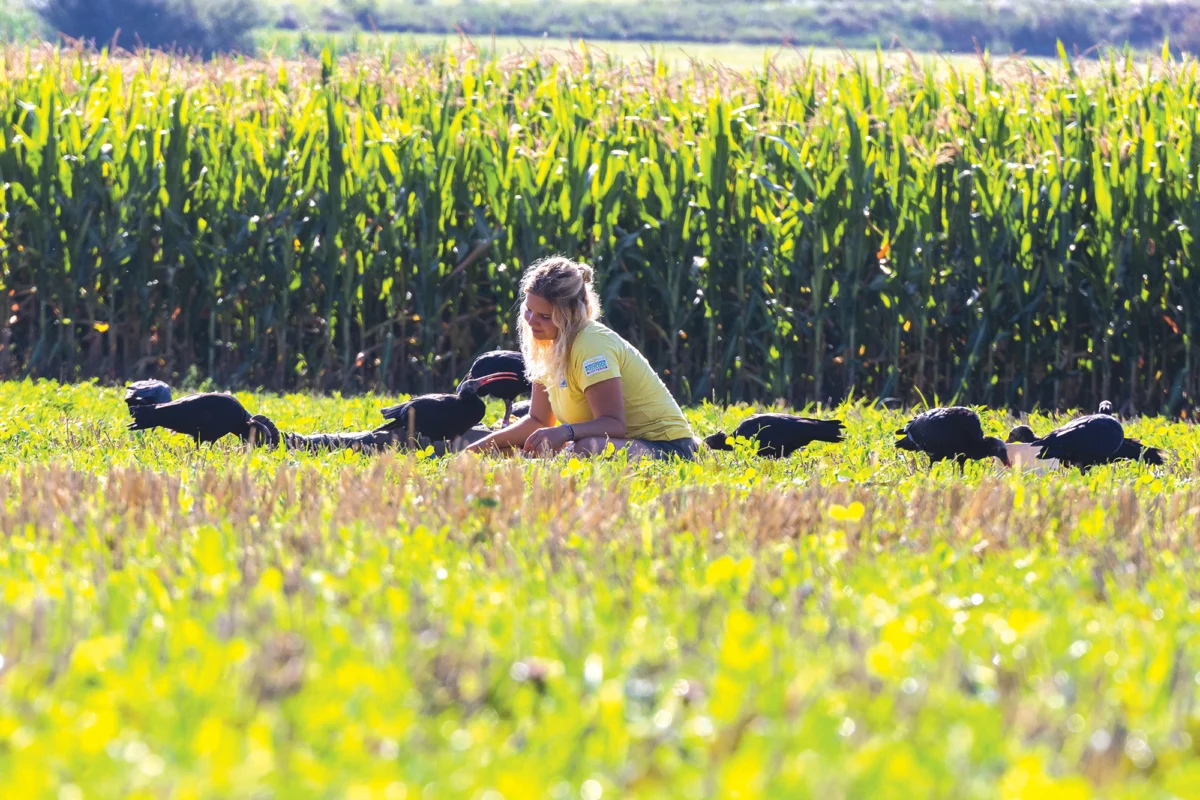
The quiet mountains of southern Austria, a landscape of rugged peaks giving way to verdant, sprawling valleys, became the unlikely stage for a pioneering conservation effort. Here, mere meters from an aviary at Wildlife Park Rosegg, a pivotal moment unfolded for Barbara Steininger, then twenty-five years old. Her task: to become a foster mother. Not to a human child, but to one of the world’s most critically endangered avian species, the northern bald ibis (Geronticus eremita). This endeavor, fraught with the anxieties of any new parent, carried the immense weight of safeguarding a lineage teetering on the brink of oblivion.
The gravity of the situation was palpable. Steininger’s role transcended mere caregiving; it was about imprinting a survival instinct, a primal knowledge of migration routes lost to generations of this iconic bird. As a zookeeper placed two featherless chicks into her warm hands, Steininger’s freckled face illuminated with a mixture of trepidation and profound hope. This was just the beginning, the first two of thirty-three chicks that would rely on her and her colleague, twenty-eight-year-old Helena Wehner, for their very survival.
From that chilly April day in 2023, Steininger and Wehner embraced their roles as the chicks’ sole human guardians. The process mirrored the tender, unwavering dedication of human parenthood. Cuddles, words of encouragement, and expressions of adoration, all delivered in the soft, cooing tones of baby talk, were as crucial as the meticulous feeding regimen. Eight times a day, they would hand-feed the fragile chicks. "Just that it’s not breast milk or formula," Wehner noted, a hint of the unconventional diet to come in her voice, but rather a nutrient-rich mixture of shredded beef hearts and mice. This extraordinary commitment underscored the precarious state of the northern bald ibis and the lengths to which these biologists were willing to go.
A Species on the Precipice: The Northern Bald Ibis Crisis
The northern bald ibis, a striking bird characterized by its bald, red, wrinkled head and long, decurved bill, was once a widespread species across Europe, North Africa, and the Middle East. Its scientific name, Geronticus eremita, meaning "aged hermit," aptly describes its solitary and reclusive nature. However, relentless human encroachment, habitat destruction, agricultural intensification, and hunting drastically reduced its populations throughout the 20th century. By the late 20th century, the wild population in Europe had dwindled to a mere handful, with the species facing imminent extinction.
The last wild breeding colony in Europe was located in Birecik, Turkey. This colony, once numbering in the thousands, was decimated by development and a lack of understanding of the birds’ migratory needs. By the early 2000s, only a few dozen individuals remained in the wild, and the migratory instinct, honed over millennia, was fading. The chicks hatched in captivity no longer possessed the innate knowledge of where to fly, when to fly, or how to survive the arduous journey south to their traditional wintering grounds. The future of the species in Europe hung precariously in the balance.
The Genesis of a Groundbreaking Project: Re-establishing a Lost Migration
The initiative to reintroduce the northern bald ibis to Europe and re-establish its migratory route is the culmination of decades of research and conservation efforts. Spearheaded by organizations like the Waldrappteam, an Austrian-based research and conservation group, the project is a testament to innovative thinking in wildlife management. The core of their strategy is what is known as "displacement," a method that involves imprinting young birds with a human leader who then guides them on their migration using a ultralight aircraft.
The process begins with hand-rearing the chicks. Once they are old enough and have developed a strong bond with their human caregivers, they are introduced to the concept of following an ultralight aircraft. Johannes Fritz, a seasoned ornithologist and the driving force behind the Waldrappteam, became the lead "bird dad" for this crucial phase. The young ibises, having imprinted on him and his distinctive aircraft, learn to associate the sound of the engine and the sight of the plane with food and safety.
The ultimate goal is to guide these birds on their ancient migratory path, from their breeding grounds in Austria and Bavaria (Germany) to their wintering grounds in Tuscany, Italy. This journey, spanning hundreds of kilometers, is fraught with natural dangers, including predators, harsh weather, and the challenges of finding food and safe roosting sites. The success of the project hinges on the birds’ ability to learn and adapt, to trust their human-guided route, and eventually, to breed and raise their own young in the wild, perpetuating the species’ survival.
The 2023/2024 Migration: A Test of Resilience and Dedication
The chicks under Steininger and Wehner’s care in 2023 were part of a critical cohort destined to undertake this monumental journey. The months following their hatching were a blur of intensive care. They were fed, kept warm, and nurtured, all while being gradually exposed to the sounds and sights that would become their guide.
By late summer, as the air began to cool and the instinct to migrate stirred, the young ibises were ready. Johannes Fritz, at the controls of his ultralight, took to the skies, his young charges following close behind. This was not merely a flight; it was a carefully orchestrated ballet of nature and human intervention. The aircraft acted as a surrogate parent, leading the birds along pre-determined routes, navigating them over obstacles, and guiding them towards familiar stopping points where they could rest and forage.
The journey was not without its setbacks. Reports from the conservation team detailed challenges such as adverse weather conditions that forced delays and required the birds to be temporarily housed in secure locations. There were also moments of anxiety when some birds strayed or appeared hesitant. However, the unwavering dedication of the Waldrappteam, coupled with the birds’ remarkable resilience, saw them through.
The 2023/2024 migration saw a significant number of these reintroduced ibises successfully reach their wintering grounds in Tuscany. This achievement marked a crucial milestone, demonstrating that the learned migratory route was viable and that the birds possessed the capacity to survive the journey. The data collected from GPS trackers on some of the birds provided invaluable insights into their flight patterns, endurance, and the specific challenges they encountered.
Supporting Data and Scientific Insights
The reintroduction of the northern bald ibis is underpinned by rigorous scientific research and data collection. Since the inception of the Waldrappteam’s efforts, thousands of hours of flight data have been accumulated. Studies have focused on:
- Imprinting Success: Research indicates that the imprinting process is highly effective, with birds demonstrating a strong tendency to follow the lead aircraft. Studies have shown that the critical period for imprinting occurs within the first few weeks of a bird’s life, coinciding with the intense hand-rearing phase.
- Migration Success Rates: While challenging, the migration success rates have shown gradual improvement with each cohort. Early migrations saw higher losses, but as the team refined their techniques and gained a deeper understanding of the birds’ needs, survival rates have increased. For instance, in some years, over 70% of the birds have successfully reached their wintering grounds.
- Ecological Impact: The reintroduction of the northern bald ibis is expected to have a positive impact on the ecosystems they inhabit. As insectivores, they play a role in controlling insect populations. Their return also contributes to the biodiversity of their breeding and wintering grounds.
- Genetic Diversity: Ensuring genetic diversity within the reintroduced population is paramount. Conservationists work to manage breeding pairs to avoid inbreeding and maintain a healthy gene pool, crucial for long-term species survival. The current breeding population is drawn from various European zoos and conservation centers to maximize genetic variability.
Reactions from the Conservation Community and Beyond
The pioneering work of the Waldrappteam has garnered significant attention and praise from conservation organizations worldwide. Experts acknowledge the immense challenges involved in re-establishing a migratory species, particularly one as critically endangered as the northern bald ibis.
Dr. Anya Sharma, a leading ornithologist specializing in migratory birds, commented, "The Waldrappteam’s approach is nothing short of revolutionary. It addresses the core issue of lost migratory knowledge, which is a major hurdle in reintroducing species that have been absent from their ancestral routes for generations. The dedication of individuals like Johannes Fritz, Barbara Steininger, and Helena Wehner is truly inspiring and represents the cutting edge of applied conservation science."
Local authorities in Austria and Italy have also expressed their support for the project, recognizing its contribution to biodiversity and ecotourism. The presence of these majestic birds, even if guided, has the potential to raise public awareness about conservation issues and foster a deeper connection with the natural world.
Broader Impact and Future Implications
The success of the northern bald ibis reintroduction project has far-reaching implications for avian conservation globally. It provides a compelling case study for other critically endangered migratory species that have lost their traditional routes due to human-induced factors. The "displacement" method, while resource-intensive and requiring a high level of expertise, offers a tangible pathway to restoring lost migratory behaviors.
The long-term goal of the Waldrappteam is to reach a point where the northern bald ibis can migrate independently, without human intervention. This means that the birds need to successfully breed in the wild, and their offspring must learn the migratory routes naturally from their parents. Each successful migration and breeding season brings them closer to this ultimate objective.
The project also highlights the critical role of public engagement and support in conservation efforts. The story of these "foster moms" and the determined biologists resonates with people, fostering empathy and a sense of responsibility towards these vulnerable creatures. As the northern bald ibis slowly but surely finds its wings again, it serves as a powerful symbol of hope – a testament to what can be achieved when scientific innovation, unwavering dedication, and a profound respect for nature converge. The journey from featherless chick to a self-sustaining wild population is a long one, but with each flight, the northern bald ibis inches closer to reclaiming its rightful place in the skies.