




The intricate architecture of Apple’s latest hardware release has been laid bare as the device dissection specialists at iFixit published their comprehensive teardown of the new MacBook Pro equipped with the PROLED XDR Display. This year’s hardware refresh has captured significant industry attention, primarily due to the reintegration of the fan-favorite illuminated Apple logo on the laptop’s exterior lid, the implementation of an advanced tandem OLED panel, and a notable reduction in overall physical weight. The publication of the teardown offers hardware enthusiasts, engineers, and consumers a microscopic look at the engineering feats and compromises required to achieve Apple’s design goals for its premier portable workstation.
Main Facts of the Teardown
At the core of the iFixit examination is the new tandem OLED screen, a display technology that stacks two distinct light-emitting layers to achieve luminance thresholds significantly higher than those found in traditional single-layer organic light-emitting diode configurations. Microscopic analysis conducted during the teardown revealed a distinct architectural choice: the blue subpixels are noticeably larger than their red and green counterparts. According to iFixit’s technical assessment, sizing the blue subpixels more generously helps mitigate electrical and thermal strain on the underlying organic materials, a design strategy intended to prolong the operational lifespan of the panel and stave off premature degradation.

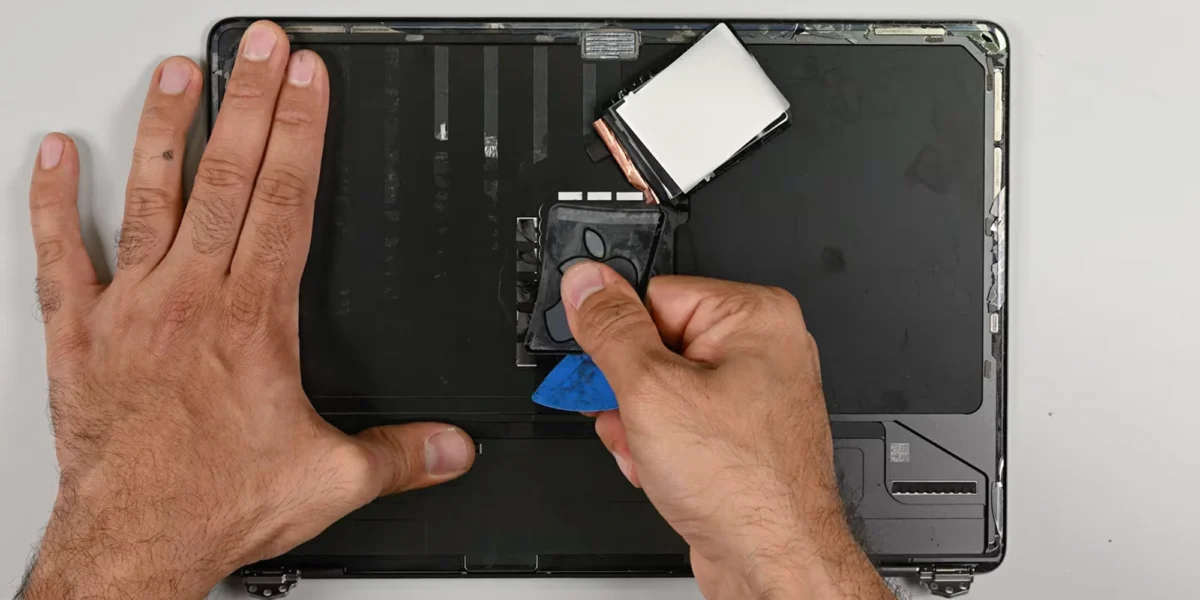
Beyond the display, the teardown investigated the mechanics behind the return of the illuminated Apple logo. Accessing the lighting apparatus proved exceptionally difficult; the procedure required the destruction of the fragile OLED assembly, highlighting the challenges technicians will face if attempting component-level repairs in that specific area of the lid. Once successfully breached, the mechanism was found to consist of a strip of four high-efficiency LEDs working in tandem with a specialized reflective layer and an optical diffuser to evenly distribute light. The exterior logo itself features a sophisticated two-way mirror coating, which creates a polished, reflective metallic appearance when the internal LEDs are powered down, yet seamlessly permits illumination to pass through when activated.
Physical Reductions and Weight Distribution
Achieving a lighter profile without sacrificing structural integrity or thermal performance is a perennial challenge in laptop engineering. For the current generation, Apple successfully trimmed the weight of the standard 14-inch model from 3.4 pounds (1.55 kg) down to a much leaner 3 pounds (1.38 kg). iFixit’s component-by-component weight analysis illuminated how these savings were distributed across the machine’s anatomy.
The engineering team shaved 92 grams directly off the unibody aluminum chassis, while redesigning the display assembly accounted for a reduction of 101 grams. Minor modifications contributed further marginal savings: the internal battery was found to be just 2 grams lighter than its predecessor, and a slightly scaled-down trackpad shaved an additional 8 grams off the overall mass. These reductions are particularly striking given the inclusion of heavy new hardware additions, specifically the touchscreen digitizer layers and the optical components required for the backlit logo.

Internal Layout and Modular Limitations
Despite the external redesigns and internal miniaturization, the fundamental layout of the logic board and peripheral connections remains largely consistent with recent MacBook Pro generations. iFixit noted that routine maintenance or component swaps involving the internal cooling fans or the USB-C ports still necessitate the complete removal of the primary logic board, complicating what should ideally be modular, straightforward repairs.
Similarly, the headphone jack is deeply integrated and requires the extraction of the logic board for access. Meanwhile, core performance hardware—including the HDMI port, the high-speed SDXC card reader, unified memory (RAM), and solid-state storage—remains permanently soldered directly onto the logic board, precluding any possibility of post-purchase upgrades by the end user.
Chronology of Repairability and Calibration Improvements

A major point of interest for independent repair advocates and consumer electronics technicians is how modern operating systems handle hardware swaps. In previous hardware iterations, such as the M5-powered MacBook Pro released the prior year, swapping major components between donor machines routinely triggered software locks or calibration failures. Most notably, the M5 model failed to successfully complete Touch ID sensor calibration through Apple’s proprietary Repair Assistant software following a logic board swap.
The teardown of the new PROLED XDR model demonstrated a notable shift in Apple’s software architecture regarding component pairing. During testing, iFixit swapped the logic board between two separate MacBook Pro units with PROLED XDR displays. Unlike previous generations, the system successfully recognized the newly introduced battery, display assembly, and Touch ID sensor immediately following the swap. Core display functions, including True Tone color calibration, manual and automatic brightness controls, and touchscreen inputs, functioned properly out of the box. Furthermore, technicians were able to successfully enroll a new biometric fingerprint using a donor logic board sourced from an entirely separate device, signaling a potential loosening of restrictive software locks that have historically hampered independent and third-party repair efforts.
Official Responses and Industry Context
While Apple has not yet issued a formal engineering white paper specifically addressing the intricacies of the teardown, the company has consistently emphasized its commitment to balancing product durability, user security, and environmental sustainability. The inclusion of more flexible software calibration tools via the Repair Assistant points toward an ongoing adaptation to global "right to repair" legislative pressures, which have steadily gained momentum across North America and the European Union over recent years.

Independent watchdogs and right-to-repair advocates have historically scrutinized Apple’s reliance on serialized parts and software pairing, which often forced consumers to rely exclusively on authorized service providers. The ability of the new MacBook Pro to seamlessly accept swapped genuine components without rendering key features inert marks a measured step toward improving the practical viability of component harvesting and independent servicing, even if fundamental barriers remain.
Broader Impact and Repairability Scoring
Weighing the totality of its design choices, iFixit awarded the new MacBook Pro with PROLED XDR Display a repairability score of 5 out of 10. This rating places the high-end professional workstation one point higher than the previous year’s M5 MacBook Pro, reflecting the improved performance of the Repair Assistant and better handling of swapped genuine modules. However, it remains one point below the more budget-oriented MacBook Neo, which benefits from a structurally simpler assembly designed with mass production and rapid servicing in mind.
The broader implications of this teardown extend to both professional users and the broader consumer electronics market. The successful implementation of a tandem OLED panel that actively manages subpixel wear indicates that high-brightness, long-life displays are becoming increasingly viable for mainstream portable computing. At the same time, the return of the illuminated Apple logo proves that aesthetic heritage can successfully coexist with modern miniaturization, provided manufacturers are willing to engineer complex optical diffusers and micro-LED assemblies. As the tech industry continues to digest the full capabilities of the new MacBook Pro, the insights provided by iFixit’s physical analysis underscore a complex evolution in modern laptop design—one where advanced display engineering and slightly improved repair flexibility begin to offset the immutable limitations of soldered components and tightly integrated unibody architecture.