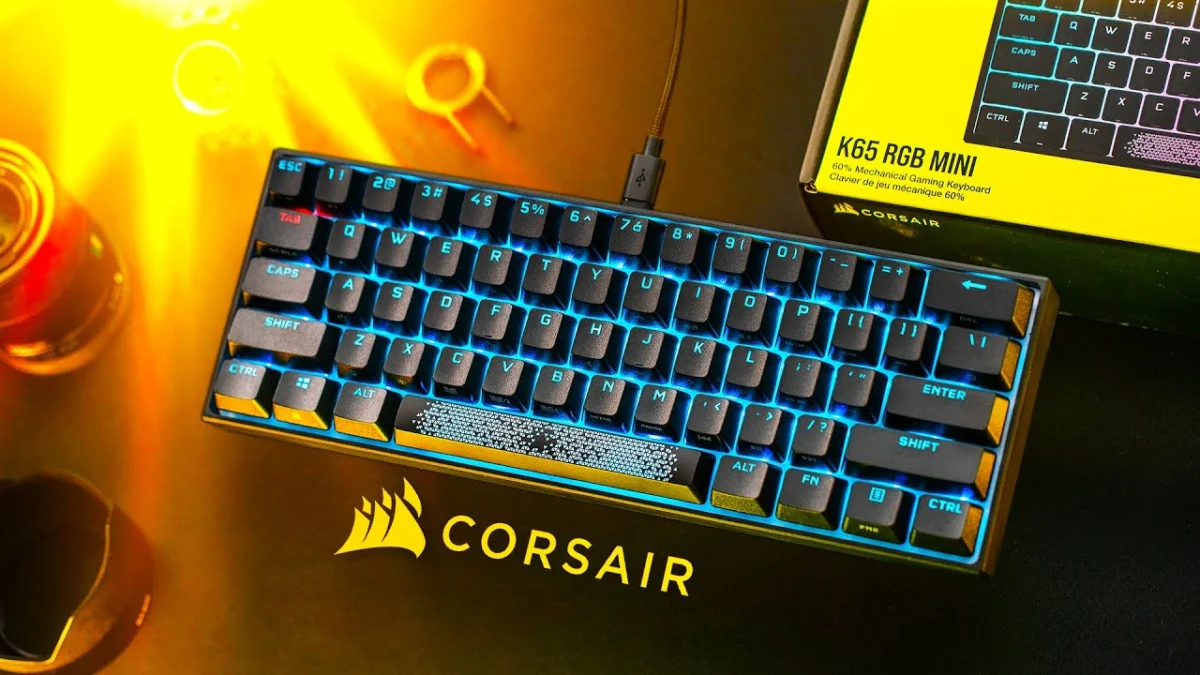
The mechanical keyboard market has experienced a profound shift over the past several years, moving away from massive, feature-laden full-sized boards toward streamlined, minimalist layouts. Among the most popular iterations is the 60% form factor, a design that eliminates the numeric keypad, function row, and dedicated navigation cluster to maximize desk real estate and improve ergonomic posture by allowing a mouse to sit closer to the hands. For years, major mainstream manufacturers watched as enthusiast-focused brands like Ducky dominated this specialized space. However, industry giant Corsair has officially entered the arena with the launch of the Corsair K65 RGB Mini 60% mechanical keyboard. Priced competitively at $110 USD, the device positions itself directly against established heavyweights such as the Ducky One 2 Mini and the Razer Huntsman Mini. Despite arriving somewhat later to the compact keyboard trend than its primary competitors, Corsair attempts to carve out a distinct market share by packing high-end proprietary technology, extensive software customization, and ultra-fast polling rates into a compact footprint.
Background Context and Evolution of the 60% Form Factor
The rise of the 60% keyboard is not merely an aesthetic fad; it is a direct response to changing ergonomic preferences and the demands of competitive gaming. Historically, desktop setups featured sprawling 100-percent layouts that included dedicated tenkey pads. While useful for data entry and spreadsheet management, these wide boards forced users to position their computer mice far to the right, creating awkward shoulder angles during extended gaming sessions. As esports grew in prominence, professional players sought setups that allowed for broader mouse movement ranges and closer arm placement.
Enthusiast brands first filled this niche, but mainstream adoption exploded when devices like the Ducky One 2 Mini gained viral popularity through streaming platforms and online gaming communities. Recognizing this massive shift in consumer demand, major peripheral manufacturers gradually began releasing their own compact alternatives. Corsair’s entry with the K65 moniker—despite its numerical overlap with existing 65% concepts and older model designations—represents a strategic effort to capture mainstream retail distribution channels that smaller enthusiast brands often struggle to reach. By leveraging its vast supply chain and global retail presence, Corsair aims to make the 60% form factor accessible to a broader demographic of everyday gamers and productivity users.
Design, Build Quality, and Ergonomics
At first glance, the Corsair K65 RGB Mini presents a sturdy, cohesive aesthetic that borrows design cues from the ventilation patterns found on the company’s high-end PC chassis. The chassis itself is slightly chunkier than standard 60% keyboards, a physical trait that Corsair utilizes to establish a comfortable typing angle without the inclusion of traditional fold-out height-adjustment feet at the base. While the omission of adjustable feet may disappoint users accustomed to customizing their typing slope, the embedded rubber feet ensure the keyboard remains securely anchored to a desk surface during intense gaming sessions.
The keyboard features double-shot PBT keycaps renowned for their exceptional durability, resistance to shine, and textured tactile feel. A notable design inclusion is the absence of glaring imperfections on the illuminated characters, a common flaw in double-shot manufacturing where small plastic bridges obscure the backlighting. Furthermore, Corsair includes a stylized patterned spacebar and an optional branded escape key crafted from ABS plastic, alongside a standard textured PBT replacement spacebar for users preferring a uniform material composition.
Despite these structural strengths, physical ergonomics reveal minor shortcomings. The edges of the keyboard housing situated immediately beneath the lower keycap row feature unrefined, sharp angles. Users who naturally rest their thumbs or palms near the bottom edge may experience discomfort or a grinding sensation against the plastic housing. On the visual front, the internal white backplate effectively disperses light from the underlying mechanical switches, though slight luminance drop-offs and dead zones can be observed along the extreme outer edges when ambient lighting is removed.
Switch Performance and the AXON Hyper-Processing Controversy
The Corsair K65 RGB Mini is offered in three distinct Cherry MX switch variants: Cherry MX Silent, standard Cherry MX Reds, and the high-speed Cherry MX Speed silver switches. Lacking hot-swappable sockets—a feature increasingly demanded by modern mechanical keyboard enthusiasts who prefer customizing switches without soldering—users are permanently committed to their initial purchase configuration.
Testing the Cherry MX Speed variants reveals a nuanced performance profile. Engineered with a high actuation point of 1.2mm, these linear switches are ostensibly optimized for rapid input registration. However, prolonged typing and gaming sessions indicate a slight mechanical "grindiness" during travel, lacking the ultra-smooth glide found in competing optical switches or properly lubricated custom builds. Furthermore, while the stabilizers represent a notable improvement over Corsair’s historical output, a distinct metallic ping reverberates through the chassis during forceful bottom-out keystrokes.
The most technologically ambitious feature of the K65 RGB Mini is its integration of Corsair’s proprietary AXON hyper-processing technology, enabling an unprecedented 8000Hz polling rate. Polling rate refers to the frequency at which a peripheral reports its status to the host computer; while standard keyboards operate at 1000Hz (reporting every 1 millisecond), an 8000Hz rate reports every 0.125 milliseconds.
While ultra-fast polling rates have demonstrated measurable benefits in gaming mice—where continuous, high-precision spatial tracking is critical for competitive aiming—the practical advantages for mechanical keyboards remain a subject of intense debate within the hardware community. Mechanical switches inherently possess physical debounce delays and physical travel times that far exceed the transmission intervals of traditional 1000Hz polling. Consequently, pushing polling frequencies to 8,000Hz on a non-optical mechanical keyboard yields negligible real-world input latency improvements for the average user.
Furthermore, empirical testing reveals measurable system resource implications. Operating the K65 RGB Mini at its maximum 8000Hz polling rate introduces a consistent minor reduction in frame rates—averaging approximately a 3 frames-per-second drop in both average and 99th percentile metrics during demanding game titles—compared to standard 1000Hz operation. While CPU utilization remains stable during heavy typing, the marginal performance tax on system resources forces users to weigh theoretical responsiveness against actual hardware efficiency.
Software Integration and Customization via iCue
Corsair’s unified iCue software ecosystem underpins the operational configuration of the K65 RGB Mini, featuring a redesigned and simplified user interface that streamlines device management. The software layout categorizes functionality into distinct, easily navigable tabs covering key assignments, hardware lighting, lighting effects, performance parameters, and device settings.
Key remapping and macro creation are handled intuitively, with the added benefit of onboard profile storage. The inclusion of Hardware Key Assignments and Hardware Lighting ensures that custom macros and illumination profiles persist independently of whether the iCue software is actively running in the background—a critical feature for gamers who transport their peripherals across multiple systems.
Lighting customization utilizes a layered architecture, allowing users to apply specific animated effects to targeted zones, such as highlighting the WASD cluster in a solid color while running a dynamic rainbow pattern across the remaining keys. The Performance tab allows users to configure Windows Lock behaviors, including the ability to assign custom indicator colors to the Windows key when the lock is engaged. Finally, the Device Settings tab serves as the control center for adjusting the polling rate between 1000Hz and 8000Hz, managing device brightness, and updating firmware.
Broader Market Impact and Industry Implications
The introduction of the Corsair K65 RGB Mini marks a significant milestone for a mainstream manufacturer traditionally entrenched in full-sized and tenkeyless gaming peripherals. By pricing the device aggressively at $110 USD, Corsair has successfully positioned itself beneath competing alternatives like the Razer Huntsman Mini while matching the pricing tier of enthusiast favorites like the Ducky One 2 Mini.
The keyboard successfully delivers core functionality expected from a modern 60% layout, blending durable double-shot PBT keycaps, robust onboard programming, and comprehensive software support into a compact chassis. However, the decision to prioritize bleeding-edge specifications like an 8000Hz polling rate—at the expense of minor frame rate penalties and without addressing basic physical ergonomics such as sharp housing edges or non-swappable switches—illustrates the challenges traditional hardware brands face when attempting to capture an enthusiast-driven market segment.
Ultimately, the Corsair K65 RGB Mini establishes that mainstream brands can successfully compete in the compact keyboard ecosystem. Whether consumers will value the theoretical advantages of hyper-polling over traditional, refined typing experiences remains the central question as Corsair continues to evolve its footprint in the minimalist hardware space.