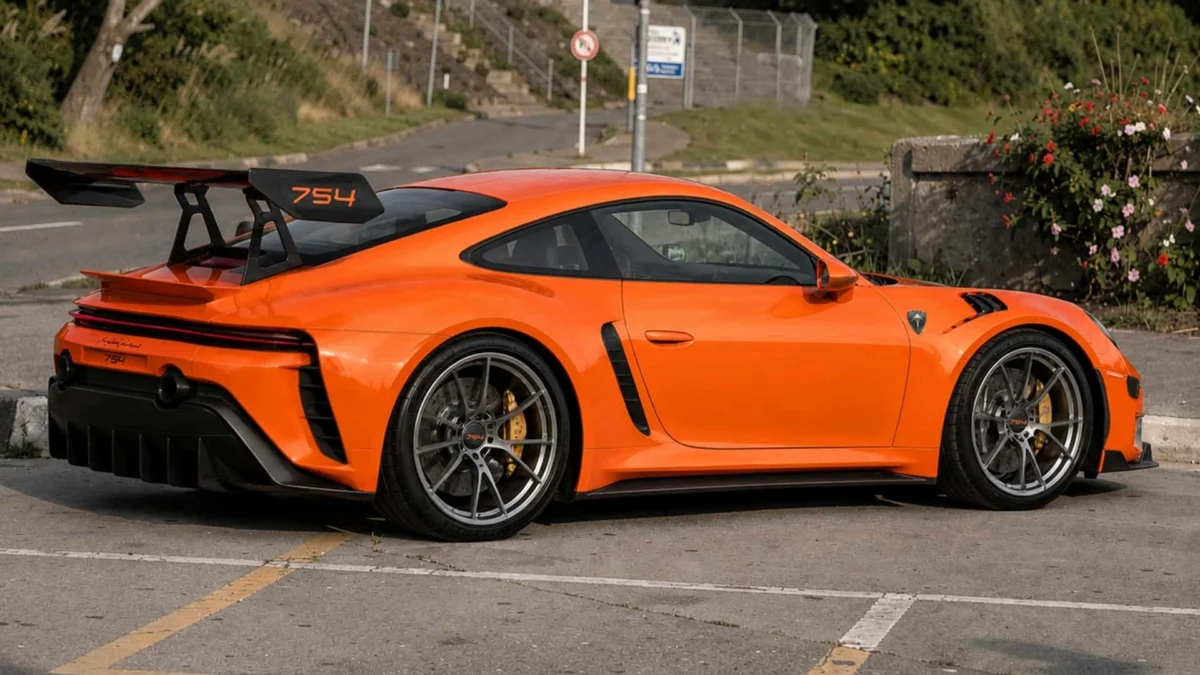
Angelelli Automobili, an Italian firm dedicated to pioneering advanced technologies for high-performance vehicles, has officially lifted the veil on its ambitious new supercar, codenamed Project 754. This ultra-exclusive machine promises a potent blend of power, exotic materials, and bespoke engineering, with a planned production run of only 50 meticulously crafted examples. Project 754 represents a significant departure from mass-produced sports cars, positioning itself as a coachbuilt marvel built upon an existing technical foundation.
The chosen platform for this ambitious endeavor is none other than the venerable Porsche 911, specifically drawing from the 991 and 992 generations. Angelelli Automobili emphasizes that this collaboration is purely technical, with no commercial or industrial ties to the German automotive giant. The Italian company’s vision involves a comprehensive transformation of the 911’s underpinnings, resulting in an entirely new design, significantly revised mechanical components, and tailor-made aerodynamic solutions that aim to redefine the supercar experience.
Two Distinct Driving Philosophies, One Singular Vision
Project 754 is not a monolithic offering; instead, it will be presented in two distinct configurations, each catering to a different driving enthusiast’s preference. The first variant, designated the 754 R, retains the iconic rear-engine layout synonymous with the Porsche 911. This configuration is engineered to maximize acceleration, optimize traction, and deliver a raw, aggressive driving character that enthusiasts crave. The placement of the engine behind the rear axle, a hallmark of the 911, is leveraged to provide a visceral connection between the driver and the road, emphasizing explosive launches and a thrilling sense of immediacy.
In contrast, the 754 M model undergoes a more radical metamorphosis, adopting a mid-engine setup. This strategic shift in powertrain placement is designed to achieve a more balanced weight distribution, a crucial factor in enhancing handling precision and stability, particularly at the extreme limits of performance. By centralizing the mass, the 754 M aims to offer a more neutral and predictable cornering experience, allowing drivers to explore the car’s capabilities with greater confidence and finesse. This mid-engine architecture, while a departure from the 911’s inherent design, underscores Angelelli’s commitment to creating a unique automotive statement.
Both the 754 R and 754 M variants are slated to deliver an awe-inspiring power output, with figures expected to range between a formidable 700 and 800 horsepower. This formidable power will be harnessed and delivered through meticulously engineered drivetrains, ensuring a thrilling and exhilarating performance. A key aspect of Project 754’s exclusivity and appeal lies in its built-to-order production process. Angelelli Automobili is offering an unprecedented level of customization, allowing discerning buyers to tailor virtually every facet of their vehicle. From the intricate details of mechanical components and the nuanced tuning of suspension systems to the selection of premium materials and finishes, and even the fine-tuning of aerodynamic elements, each Project 754 will be a unique reflection of its owner’s desires and specifications.
Angelelli Automobili explicitly states that Project 754 was not conceived as an imitation of existing supercars. The company’s ambition was to forge a vehicle with an independent identity, characterized by distinctive proportions, a completely novel body design, bespoke-developed components, and an aggressive strategy focused on radical weight reduction. This commitment to originality suggests a holistic approach to design and engineering, aiming to create a machine that stands apart in a crowded supercar landscape.
Weight Optimization Through Advanced Manufacturing
The pursuit of exhilarating performance is intrinsically linked to the concept of lightness. Project 754 places a significant emphasis on advanced manufacturing techniques to achieve its weight-saving objectives. Angelelli Automobili has reportedly employed proprietary generative design systems, a sophisticated form of computer-aided design that utilizes algorithms to create optimal structures. Coupled with topology optimization, a process that refines the distribution of material within a given space to maximize performance while minimizing weight, these systems enable the creation of highly efficient and lightweight components.
Furthermore, the company leverages metal 3D printing (also known as additive manufacturing) to produce intricate titanium and alloy parts. This cutting-edge technology allows for the creation of complex geometries that would be impossible or prohibitively expensive to achieve with traditional manufacturing methods. These 3D-printed components are meticulously engineered to eliminate unnecessary material, thereby reducing overall weight, while simultaneously ensuring the required strength and rigidity for high-performance applications. This approach to component design represents a significant leap forward in automotive engineering, pushing the boundaries of what is possible in terms of material efficiency and structural integrity.
This lightweight hardware is then integrated with a meticulously crafted carbon-fiber body. Carbon fiber, renowned for its exceptional strength-to-weight ratio, forms the structural backbone and exterior shell of Project 754, further contributing to its impressive performance potential. Complementing the carbon-fiber construction is a purpose-built aerodynamic package. This bespoke aero kit is designed not only to enhance the car’s visual aggression but also to optimize its high-speed stability, improve cooling performance for critical components, and boost overall aerodynamic efficiency. The intricate interplay between the car’s form and its function is a testament to Angelelli’s commitment to delivering a truly holistic supercar experience.

The production of Project 754 will be strictly capped, with a total of just 25 examples of the 754 R and 25 examples of the 754 M to be manufactured. Each vehicle will bear a unique individual numbering, signifying its place in this exclusive lineage. The commitment to bespoke craftsmanship means that each car will be meticulously assembled to the precise specifications and individual desires of its prospective owner, ensuring an unparalleled level of personalization and exclusivity.
Context and Implications in the Coachbuilding Landscape
The emergence of Angelelli Project 754 arrives at a fascinating juncture in the automotive industry, particularly within the niche of ultra-exclusive coachbuilding. For decades, specialized firms have sought to imbue existing high-performance platforms with unique styling, enhanced performance, and unparalleled luxury, creating bespoke automobiles for a discerning clientele. The Porsche 911, with its enduring appeal, iconic design, and robust engineering, has often served as a fertile ground for such reinterpretations.
Historically, coachbuilders have taken production cars and transformed them into unique creations, sometimes focusing on aesthetic redesigns, while others delve deeper into mechanical enhancements and material upgrades. The concept of a coachbuilt supercar, while rare, is not entirely new. However, Angelelli’s approach, leveraging advanced generative design and 3D printing alongside a radical powertrain configuration shift for the 754 M, suggests a forward-thinking evolution of the coachbuilding tradition.
The strict limitation of 50 units worldwide immediately places Project 754 in the realm of hypercars, vehicles produced in extremely low numbers that often command astronomical prices and significant collector interest. The emphasis on extensive customization further amplifies this exclusivity, transforming each car into a rolling work of art tailored to the individual. This approach caters to a segment of the automotive market that values uniqueness, craftsmanship, and a personalized driving experience above all else.
The reliance on a widely recognized platform like the Porsche 911, while strategically sound from an engineering and development perspective, also invites comparison. Enthusiasts and critics will undoubtedly scrutinize how Angelelli’s modifications elevate the already exceptional capabilities of the 911. The success of Project 754 will hinge on its ability to transcend its donor car, offering a distinctly superior or at least a remarkably different experience that justifies its exclusivity and presumed price point.
From a broader industry perspective, Project 754 exemplifies the continued innovation within the specialized automotive sector. Companies like Angelelli Automobili, by pushing the boundaries of material science and manufacturing processes, contribute to the overall advancement of automotive technology, even if their creations are not destined for mass production. The techniques and materials explored in such projects can often find their way into more mainstream automotive applications over time, driving progress and inspiring future designs.
The dual-engine configurations – the rear-engine 754 R and the mid-engine 754 M – highlight a thoughtful approach to catering to different performance philosophies. This strategic differentiation allows Angelelli to appeal to a wider range of purists within the supercar community. The rear-engine setup offers a nod to the classic 911 character, while the mid-engine variant presents a more contemporary, track-focused proposition. This versatility, combined with the extensive customization options, ensures that Project 754 is not just a car, but a deeply personal statement of automotive passion.
The Road Ahead for Angelelli Automobili
The successful realization and delivery of Project 754 will be a significant benchmark for Angelelli Automobili. It will serve as a powerful statement of their engineering prowess, design vision, and ability to execute complex, low-volume automotive projects. The company’s focus on advanced technologies suggests a long-term ambition to be at the forefront of high-performance vehicle development, potentially extending beyond coachbuilding into developing their own unique platforms in the future.
The automotive world will be watching with keen interest as the first Project 754 examples roll off the production line. The ultimate success of this ambitious endeavor will be measured not only by sales figures but also by the critical reception and the enduring legacy of this exclusive Italian supercar. It represents a bold fusion of heritage and innovation, a testament to the enduring allure of the supercar and the relentless pursuit of automotive perfection.