The rapid globalization of digital commerce and communication has created an urgent demand for artificial intelligence systems capable of processing information across diverse linguistic landscapes. Traditionally, deploying text classification models for a global audience meant building, training, and maintaining separate machine learning pipelines for every targeted language. This fragmented approach frequently introduced prohibitive computational costs, complex data synchronization challenges, and significant administrative overhead for engineering teams. However, recent breakthroughs in large language model (LLM) architectures and shared vector spaces have fundamentally altered this paradigm. By leveraging multilingual LLM embeddings alongside robust machine learning frameworks like Scikit-Learn and Scikit-LLM, developers can now deploy unified, language-agnostic text classification pipelines that operate seamlessly across dozens of languages without requiring language-specific model training.
The Evolution of Multilingual Natural Language Processing
For years, natural language processing (NLP) practitioners relied on two primary methodologies to address multilingual datasets, both of which carried severe operational drawbacks. The first approach involved translating all incoming text data into a single dominant pivot language—typically English—before executing classification tasks. While straightforward in theory, machine translation introduces latency, consumes massive API resources, and frequently strips away cultural nuances, idioms, and contextual subtleties vital for accurate text analysis.
The second conventional strategy required training distinct, localized models for each language. Under this framework, a company targeting English, Spanish, German, and Japanese markets would need to curate separate training corpora, fine-tune independent algorithms, and monitor multiple production endpoints simultaneously. As businesses expanded into new regions, this model proliferation quickly became unmanageable.
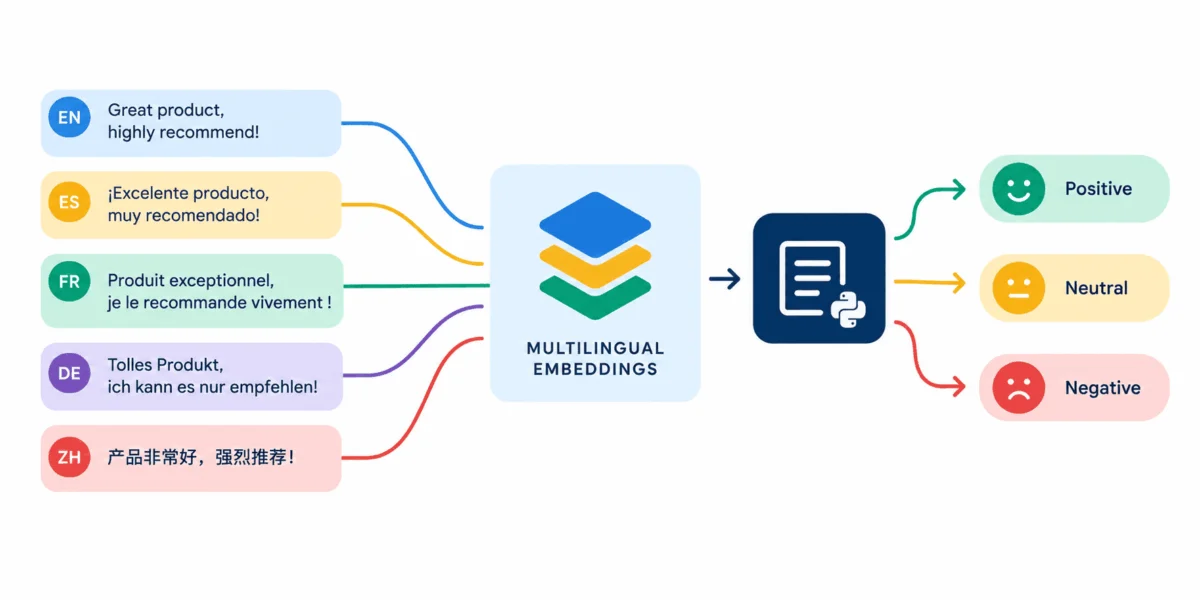
The advent of multilingual LLM embeddings has resolved this friction. Advanced embedding models are pre-trained on massive, highly diverse corpora spanning over a hundred languages. Instead of analyzing text purely through the prism of distinct vocabulary tokens, these models map semantic meaning into a shared, high-dimensional vector space. Consequently, semantically equivalent phrases in different languages—such as "This product is fantastic!" in English and "¡Este producto es fantástico!" in Spanish—yield nearly identical numerical embeddings. This capability effectively dissolves language barriers at the data representation layer, enabling downstream classifiers to evaluate intent and sentiment without needing to parse the underlying linguistic syntax.
Technical Architecture: Integrating Scikit-LLM with Local Open-Source Infrastructure
Building a modern, cost-effective multilingual pipeline requires a deliberate selection of software components. While proprietary commercial APIs offer convenience, they can introduce data privacy concerns, recurring subscription costs, and rate limits that complicate high-volume text processing. To ensure a scalable, privacy-compliant, and entirely free execution environment, developers increasingly turn to open-source toolchains combining Python, Scikit-Learn, Scikit-LLM, and local model runtimes.
The implementation begins with the installation of essential Python dependencies and local execution environments. By utilizing Ollama—a lightweight distribution framework for running open-source large language models locally—developers can bypass paid cloud APIs entirely. The core vectorization engine in this architecture relies on BGE-M3, a state-of-the-art, open-source embedding model developed specifically to handle multilingual information retrieval, dense retrieval, and multi-vector representations.
To operationalize the pipeline, the local Ollama server is initialized as a background process, and the BGE-M3 model weights are downloaded into the local runtime environment. Scikit-LLM’s configuration utility then points directly to the local instance via a local host URL, using a placeholder API key to satisfy internal client authentication requirements without interacting with external servers.
import subprocess
import time
from skllm.config import SKLLMConfig

# Starting the Ollama server in the background
subprocess.Popen(["ollama", "serve"])
time.sleep(5)  # Allow the server time to initialize

# Pulling the multilingual embedding model
# (Executed via terminal or system commands prior to runtime)

# Point Scikit-LLM to the local Ollama instance
SKLLMConfig.set_gpt_url("http://localhost:11434/v1/")
SKLLMConfig.set_openai_key("free-friendly-dummy-key")
This local-first infrastructure guarantees reproducibility, eliminates external network dependencies, and provides complete control over data governance—an essential consideration for enterprises handling sensitive customer feedback or proprietary communications.
Constructing the Bilingual Classification Pipeline
To demonstrate the efficacy of this approach, engineers can utilize standardized public benchmarks such as the Amazon Multi-language Reviews dataset. This corpus contains customer product reviews mapped to a standardized five-star rating scale, internally encoded as discrete classification labels ranging from 0 to 4.
To maintain computational efficiency during the embedding generation phase while ensuring balanced class representation, datasets are sampled uniformly across linguistic segments. For instance, a combined dataset of 2,000 samples can be constructed by extracting 1,000 randomized English reviews and 1,000 randomized Spanish reviews. Shuffling this bilingual corpus prior to executing a standard training-test split prevents regional or language-based clustering artifacts from biasing the machine learning model.
from datasets import load_dataset
import pandas as pd

# Loading and balancing English and Spanish review splits
data_en = (load_dataset("mteb/amazon_reviews_multi", "en", split="train", trust_remote_code=True)
           .shuffle(seed=42)
           .select(range(1000)))

data_es = (load_dataset("mteb/amazon_reviews_multi", "es", split="train", trust_remote_code=True)
           .shuffle(seed=42)
           .select(range(1000)))

# Combining and shuffling bilingual records
df = pd.concat([pd.DataFrame(data_en), pd.DataFrame(data_es)], ignore_index=True)
df = df.sample(frac=1, random_state=42).reset_index(drop=True)

X = df['text']
y = df['label']
Once the data is preprocessed, constructing the classification pipeline within Scikit-Learn requires chaining two distinct operational stages: a feature extraction transformer and a supervised classification algorithm.
The pipeline integrates the GPTVectorizer—configured to utilize the local bge-m3 model—with a standard LogisticRegression classifier. When the training script executes, the vectorizer transforms raw text inputs from both English and Spanish into unified semantic vectors. The downstream logistic regression model then ingests these numerical representations to learn the underlying patterns associated with each star rating. Because the vector space is language-agnostic, the regression algorithm trains effectively on the combined dataset without distinguishing whether a specific review was originally written in English or Spanish.
from skllm.models.gpt.vectorization import GPTVectorizer
from sklearn.pipeline import Pipeline
from sklearn.linear_model import LogisticRegression
from sklearn.model_selection import train_test_split
from sklearn.metrics import classification_report

# Splitting data into training (80%) and testing (20%) sets
X_train, X_test, y_train, y_test = train_test_split(X, y, test_size=0.2, random_state=42)

# Defining the Scikit-Learn pipeline
pipeline = Pipeline([
    ("vectorizer", GPTVectorizer(model="bge-m3", batch_size=32)),
    ("classifier", LogisticRegression(max_iter=1000, random_state=42))
])

# Training the pipeline
pipeline.fit(X_train, y_train)
Performance Analysis and Empirical Results
Evaluating the trained pipeline against an independent test set reveals valuable insights regarding the capabilities and current limitations of embedding-based multilingual classification. Running predictions across the test split yields structured classification metrics that highlight model performance across individual rating categories.
y_pred = pipeline.predict(X_test)
print(classification_report(y_test, y_pred))
Empirical evaluations of models trained on concise sample sizes typically demonstrate robust predictive performance when identifying extreme classes—such as clear-cut 1-star (label 0) or 5-star (label 4) reviews—where sentiment is highly polarized and linguistically distinct. However, intermediate ratings (such as 2-star, 3-star, and 4-star reviews) often present greater classification challenges.
Several technical and domain-specific factors contribute to this performance variance. First, intermediate customer reviews frequently contain mixed sentiments—praising product quality while complaining about shipping times, or expressing mild dissatisfaction mixed with constructive feedback. These nuanced evaluations blur the boundaries between adjacent numerical categories. Second, smaller training sample sizes limit the logistic regression classifier’s ability to capture subtle semantic gradations within the shared vector space. Scaling the dataset from a few thousand samples to tens of thousands typically yields significant performance gains across all classification brackets.
Broader Enterprise Implications and Future Outlook
The architectural pattern established by combining multilingual LLM embeddings with standard machine learning libraries marks a significant maturation point in enterprise data engineering. By decoupling feature extraction from downstream classification, organizations can deploy agile, highly maintainable NLP systems that scale effortlessly across global markets.
The implications for international enterprises are profound. Customer support routing, automated content moderation, global sentiment analysis, and cross-border market research can now be powered by centralized, unified codebases rather than fragmented, regional silos. Furthermore, the rapid advancement of open-source embedding models ensures that high-performance multilingual capabilities are no longer restricted to organizations with multi-million-dollar cloud infrastructure budgets.
As open-source LLMs continue to evolve, engineers can anticipate even tighter integrations between deep learning embedding spaces and classical machine learning algorithms. By embracing unified pipelines that respect linguistic diversity while eliminating redundant operational complexity, data science teams are well-positioned to build the next generation of truly global artificial intelligence applications.