






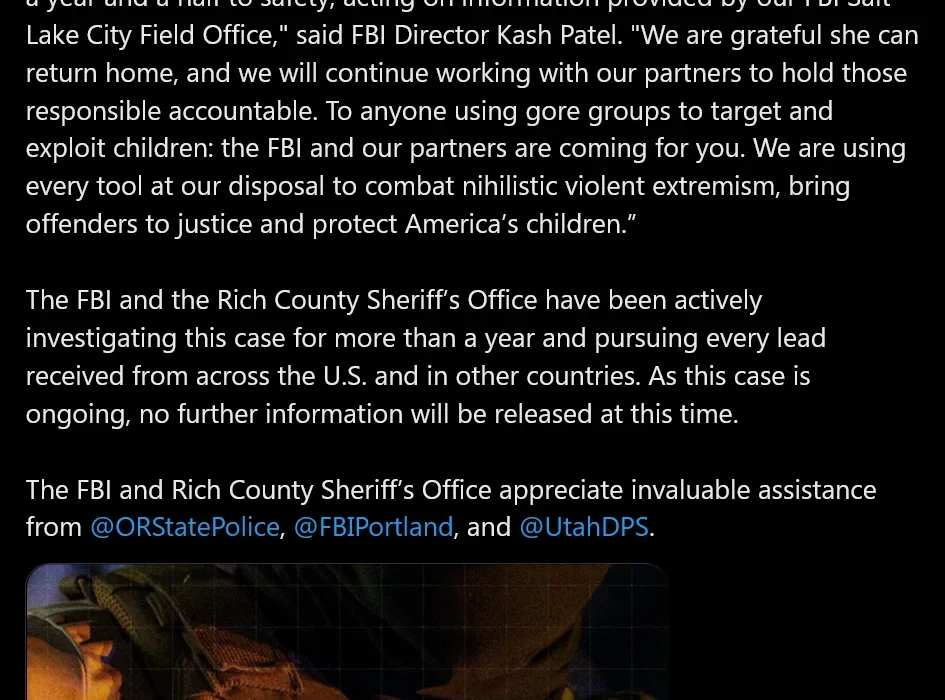
A 17-year-old girl who had been missing for over a year was successfully rescued and returned to her family following a complex, grassroots-led investigation triggered by an unlikely source: a friendship formed within the popular social deduction game Among Us. The recovery, which involved a teenager and his mother acting as amateur investigators, highlights the evolving role of online social platforms in both the exploitation of minors and, conversely, in their eventual salvation.
The victim, who had been missing from Garden City, Utah, since May 2025, was located in Oregon after 16-year-old Landon Tresp and his mother, Khristina Tresp, pieced together critical evidence that had previously eluded formal law enforcement efforts. The case, which concluded on November 1, 2026, resulted in the arrest of 39-year-old Adam Hunter Harmel, who now faces serious federal charges related to the transportation of a minor for criminal sexual activity.
The Genesis of a Digital Lifeline
The investigation began not in a police precinct, but in the virtual lobbies of the hit title Among Us. Landon Tresp, a 16-year-old gamer, struck up a casual conversation with an anonymous player. Over time, the digital acquaintance deepened into a bond of trust. According to statements made to the BBC, the girl eventually disclosed the harrowing reality of her situation: she was not merely a player, but a runaway being held against her will.
The gravity of the disclosure prompted Landon to involve his mother, Khristina. While initial parental skepticism is common regarding online claims, Khristina’s investigative instincts were validated when she initiated a direct communication channel via Discord. By requesting and receiving verifiable documentation, such as personal identification and mail, she confirmed the girl’s identity and her status as a missing person.
Chronology of the Investigation
The timeline of this rescue demonstrates a rapid escalation once credible information was presented.
- May 2025: The 17-year-old victim is reported missing from her home in Garden City, Utah. She allegedly met Adam Hunter Harmel on a social media platform, where he reportedly posed as a disabled individual, promising compensation for assistance with travel from Utah to Oregon.
- The Captivity: Upon arrival, the suspect allegedly confiscated and destroyed the victim’s phone. She was subsequently held in his basement in Oregon, subjected to restrictive conditions, and kept under constant threat of violence, including the presence of a knife under the suspect’s pillow.
- Late 2026: The victim gains access to a Wi-Fi-only mobile device provided by the captor. She uses this device to play games, leading to her fateful encounter with Landon Tresp.
- November 1, 2026: Following weeks of coordination, property record analysis by Khristina Tresp, and verification via video chat, the FBI and Oregon law enforcement are alerted. The victim escapes the residence while the suspect is away, successfully entering the custody of state troopers.
- November 1, 2026 (Evening): The FBI officially announces the recovery of the minor and the arrest of the suspect.
Data and Contextual Analysis of Online Exploitation
This incident underscores a growing trend identified by the Department of Justice and the National Center for Missing & Exploited Children (NCMEC): the weaponization of gaming platforms and social media by predators to groom and isolate vulnerable youth. According to recent NCMEC reports, the number of cyber-enticement cases—where predators leverage digital platforms to initiate contact—has seen a marked increase since 2020.
The suspect, Adam Hunter Harmel, utilized a common predatory tactic known as "deceptive altruism," where the perpetrator manufactures a need for assistance to lower the victim’s defenses. The isolation strategy—forcing the victim to move across state lines and destroying communication devices—is a hallmark of human trafficking cases, designed to sever ties with the victim’s support network and establish total control.
Official Responses and the Role of Federal Agencies
The official narrative provided by the FBI Salt Lake City Field Office and the Department of Justice initially omitted the pivotal roles played by the Tresp family, focusing instead on the collaborative efforts of the FBI, the Rich County Sheriff’s Office, and the Oregon State Police.
FBI Director Kash Patel, in a formal statement following the recovery, emphasized the agency’s commitment to combating digital threats against minors. "To anyone using gore groups to target and exploit children: the FBI and our partners are coming for you," Patel said. "We are using every tool at our disposal to combat nihilistic violent extremism, bring offenders to justice, and protect America’s children."
While the DOJ press release acknowledged that the FBI received a tip regarding the victim’s location on November 1, the public-facing statements largely framed the resolution as a triumph of institutional investigation. This discrepancy has raised questions regarding how law enforcement agencies categorize and credit civilian intelligence in high-stakes abduction cases.
The Psychological Aftermath and Support Systems
The recovery of the victim marks only the beginning of a long-term recovery process. Khristina Tresp has remained a consistent pillar of support for the victim, maintaining daily contact to ensure the teenager has a bridge to normalcy.

"Sometimes we just sit on video chat, just so she knows she has someone that cares," Khristina told the media. "It’s nice to know that when she has a bad day or a bad moment, she can call me right away or call Landon right away. She’s doing great for what she’s gone through."
Psychologists specializing in adolescent trauma note that the role played by the Tresps is invaluable. By providing a "safe harbor" connection—a person who is neither a captor nor an authority figure—the family has helped the victim maintain a sense of agency and humanity.
Implications for Gaming and Social Media Safety
The case serves as a stark reminder of the safety paradox inherent in online gaming. While platforms like Among Us are designed for social interaction, the anonymity that makes them fun also provides cover for bad actors.
- Platform Responsibility: There is mounting pressure on developers to implement more robust reporting tools and AI-driven moderation to detect predatory language patterns.
- Parental Engagement: The case highlights that parents who engage with their children’s digital lives are better equipped to identify red flags. Khristina Tresp’s ability to use Discord effectively as a tool for investigation rather than just a source of screen time was a decisive factor in the rescue.
- Cross-Agency Cooperation: The success of the mission relied on the rapid transition of information from a civilian to the FBI. It suggests a need for more streamlined channels for the public to report credible, time-sensitive information to federal agencies without fear of the tip being lost in a backlog.
As the legal proceedings against Adam Hunter Harmel move forward, the case will likely serve as a reference point for future investigations involving digital grooming. For now, the story stands as a testament to the fact that while the internet can be a place of danger, it can also be the site of a miraculous rescue when vigilance and compassion are brought to the screen.
The victim is currently in the care of state authorities and is working toward reunification with her family. The FBI and local law enforcement have indicated that, due to the ongoing nature of the legal case, no further specific details regarding the evidence or the victim’s current location will be released at this time.