








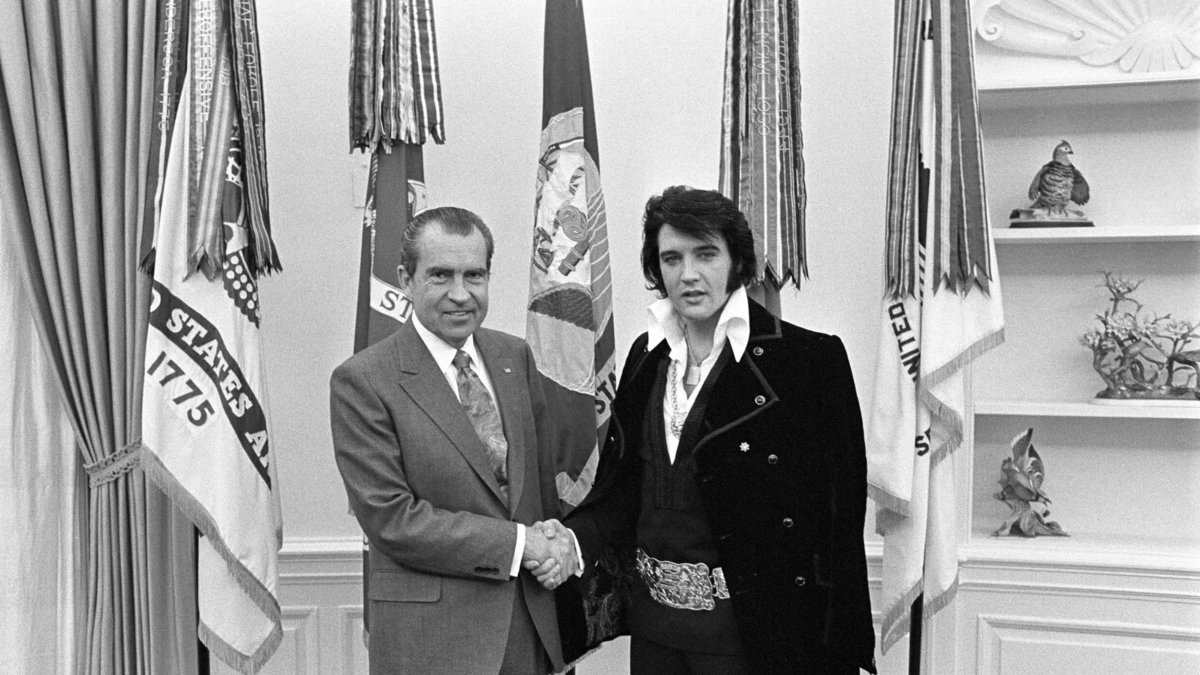
On a brisk Monday morning in December 1970, an unexpected visitor arrived at the northwest gate of the White House, setting in motion one of the most bizarre, pop-culture-defining political encounters of the 20th century. Elvis Presley, the 35-year-old undisputed King of Rock ‘n’ Roll, stood outside the executive mansion holding a five-page handwritten letter and a profound desire to serve his country as a federal narcotics agent. What followed was a hastily arranged, strictly confidential summit with President Richard Nixon—an encounter meticulously documented by White House chief photographer Ollie Atkins on roll 5364 of his Kodak Tri-X film. Decades later, frame 18 of that contact sheet, capturing a posed handshake between the conservative president and the flamboyant musical icon, has transcended its administrative origins to become a legendary piece of Americana and arguably the most requested photograph in the vast holdings of the United States National Archives.
The Genesis of an Unlikely Alliance: The Five-Page Letter
The timeline of this historic meeting began to unfold in the early hours of December 21, 1970, when Presley caught an overnight American Airlines flight from Los Angeles to Washington, D.C. Aboard the same flight was California Senator George Murphy, an acquaintance who inadvertently helped facilitate the rocker’s mission. At approximately 6:30 a.m., Presley presented himself at the White House security gate, armed with five pages of personal stationery and a sixth sheet detailing private telephone numbers for his residences in Memphis, Beverly Hills, and Palm Springs.
Addressed to President Nixon via Senator Murphy, the letter was both an introduction and an ideological pitch. Presley expressed deep admiration for the presidency while lamenting the cultural upheaval of the era. He specifically singled out the counterculture, hippies, the Students for a Democratic Society, and the Black Panthers, explicitly distancing himself from their anti-establishment ethos. In a surprising pivot, Presley offered his celebrity influence to aid the federal government in combating drug abuse and youth dissent. In exchange for his services as an undercover operative, the singer made a singular demand: he wanted to be officially credentialed as a "Federal Agent at Large," operating under strict secrecy.
Administrative Machinery and Presidential Skepticism
The letter was quickly intercepted by the White House administrative apparatus. Dwight Chapin, a special assistant to the president, forwarded the document that same morning to Chief of Staff H.R. Haldeman. Recognizing both the potential public relations value and the inherent absurdity of the request, Chapin proposed that Egil "Bud" Krogh, a deputy assistant whose portfolio included drug abuse policy, vet Presley during the president’s morning "Open Hour"—a routine block reserved for brief courtesy visits.
The proposal was met with characteristic bureaucratic cynicism. In the margin of Chapin’s memo, alongside a suggestion that Presley might help the administration connect with disaffected youth, a handwritten note appeared: "You must be kidding." Archives historians and the White House Historical Association widely attribute this skeptical annotation to Haldeman. Nevertheless, Haldeman initialed his approval, and the meeting was officially scheduled for 12:30 p.m. that afternoon.
To maintain his anonymity, Presley had checked into the Washington Hotel under the pseudonym Jon Burrows. When he finally crossed the threshold into the West Wing, he was accompanied by his close aides, Jerry Schilling and Sonny West. The president’s Daily Diary officially logs "Elvis Presley, entertainer" meeting with Krogh from 12:45 to 1 p.m., followed by a brief second entry from 1:09 to 1:11 p.m. involving his entourage.
Capturing History: Inside Roll 5364
While the political machinery hummed behind the scenes, Ollie Atkins was tasked with visually recording the encounter. Atkins, a veteran photojournalist who had spent two decades with the Saturday Evening Post before joining Nixon’s 1968 presidential campaign, was the chief of the White House Photo Office. His documentation of the Presley meeting survives as a masterclass in photojournalism, preserved across two rolls of film, most notably roll 5364.
Atkins’ contact sheet for roll 5364—famously carrying a typed label that misspelled the singer’s surname as "Presly"—contains 22 frames of 35mm Kodak Tri-X black-and-white film. The sequence offers a chronological narrative of the visit. Frames 02 through 04 capture the initial greeting: Presley stepping through the door wearing oversized tinted glasses, a high-collared shirt, and carrying a stack of photographs alongside a leather case. Frames 05 through 09 show the men gathered around the Resolute Desk, where Presley displayed his extensive collection of law enforcement badges from California, Colorado, and Tennessee, alongside signed photographs of his wife, Priscilla, and daughter, Lisa Marie.
It was during the middle frames that the iconic imagery was produced. Frames 14 through 19 depict a formal, staged handshake in front of the Oval Office flags. For these exposures, Presley removed his sunglasses. Frame 18, in particular, captures a split-second alignment where both Nixon and Presley look directly into Atkins’ lens. The roll concludes with frames 20 through 23, showing Nixon examining Presley’s elaborate cuff links while Krogh observes. A second roll, 5369, captured the arrival and departure of Presley’s aides.
Notably, because the Secret Service did not install Nixon’s voice-activated taping system in the Oval Office until February 1971—nearly two months later—no audio recording of the conversation exists. Historians are entirely reliant on Bud Krogh’s contemporaneous two-page memo. According to Krogh’s account, Presley grew emotional during the conversation, denouncing the Beatles as a corrosive anti-American influence, reiterating his absolute loyalty to the administration, and punctuating the visit by throwing his left arm around the president in a warm embrace.
The Quest for the Badge and Public Disclosure
Although Krogh’s official memo made no mention of a federal badge request, subsequent accounts confirm that Presley’s primary objective was indeed a Bureau of Narcotics and Dangerous Drugs (BNDD) credential. According to later recollections by Krogh and Schilling, Nixon instructed his staff to accommodate the request. John Finlator, the deputy director of the BNDD—who had initially rebuffed Presley earlier that morning—ultimately relented, presenting the singer with a specially manufactured federal narcotics badge that afternoon in the Old Executive Office Building. In return, Presley gifted the president an encased, commemorative World War II Colt .45 pistol, an artifact now housed in the Nixon Library, alongside family portraits.
The meeting remained a closely guarded secret for over a year. It finally broke into the public sphere on January 27, 1972, when syndicated columnist Jack Anderson published a report detailing the unusual exchange. The White House, prepared for the leak, swiftly drafted briefing guidance to minimize political embarrassment, emphasizing Presley’s active anti-drug advocacy and his recent recognition by the U.S. Chamber of Commerce as one of the nation’s ten outstanding young Americans. Curiously, despite the cultural magnitude of the story, contemporary public reaction was notably muted.
From Administrative Record to Cultural Phenomenon
Following the implementation of the Presidential Recordings and Materials Preservation Act of 1974, Atkins’ photographs were transferred to the National Archives, where they were formally opened for research in the early 1980s. Almost immediately, frame 18 struck a chord with the public. Throughout the late 1980s and 1990s, syndicated newspaper columns, television broadcasts, and museum exhibits fueled an exponential rise in public demand.
By the late 1990s, the National Archives digitized all 28 frames, launching online exhibits that cemented the image’s legendary status. Archival staff soon found themselves overwhelmed by requests. While the Archives’ internal publications have historically cautioned that tracking the exact circulation of any single photograph is practically impossible due to distributed regional holdings and digital downloads, institutional consensus has consistently ranked the Nixon-Elvis handshake at or near the pinnacle of its popularity. Blog posts, educational portals, and research guides frequently cite it as the most requested image in the agency’s 15-million-item repository, surpassing even foundational constitutional documents in sheer volume of public inquiries.
Implications and Legacy
The enduring fascination with the meeting between Richard Nixon and Elvis Presley lies in the profound juxtaposition of two entirely different American worlds. On one side sat the embattled, formal leader of the free world, navigating the turbulent geopolitical and domestic crises of the Vietnam War era. On the other stood the undisputed King of Rock ‘n’ Roll, a symbol of youthful rebellion who paradoxically sought to align himself with the conservative establishment to preserve traditional American values.
Ultimately, Ollie Atkins’ roll 5364 captured more than a routine political photo-op; it preserved a surreal, theatrical moment in American cultural history. What began as a desperate plea scrawled on airline stationery evolved into an institutional legend—a permanent testament to an era when the highest office in the land opened its doors to the most famous musician on the planet, leaving behind a photographic legacy that continues to captivate the public imagination more than half a century later.