






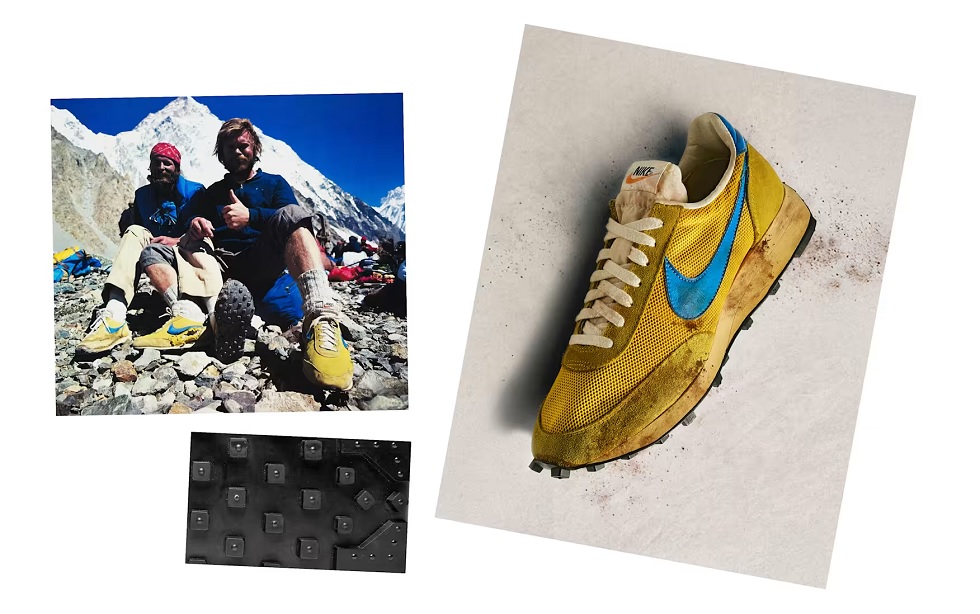
There is a photograph that explains Nike ACG better than any marketing lookbook ever compiled. Two men sit at the foot of K2, their faces lean and weathered after 68 grueling days on the mountain, with snow-streaked ridgelines rising dramatically behind them. On their feet are yellow Nike running shoes, torn to absolute shreds. One of the men raises a thumb to the camera, a silent testament to survival against immense geographical odds.
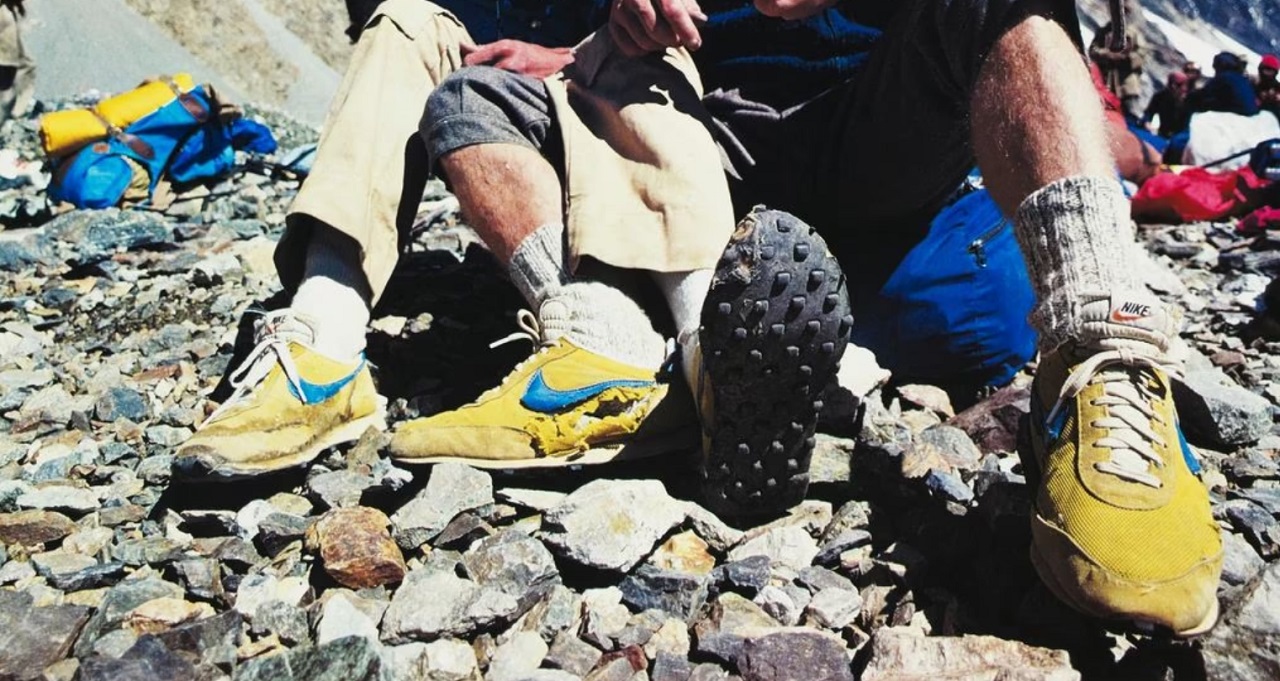
Those shoes were originally provided as a last-minute, informal gift for the long approach walk by a young sportswear company that was not yet operating in the specialized outdoor business. That moment in 1978 marked the accidental genesis of what would become a cult brand. Over the subsequent decades, the line evolved, inspired generations of designers, and for a long stretch, faded into something of a corporate ghost. Now, as the brand navigates its strategic landscape, it is attempting to earn its way back into the heart of the technical outdoor community—a task far more complicated than its glossy marketing campaigns suggest.
The 1978 K2 Expedition: A Accidental Product Brief
By 1978, the summit of K2 had been achieved precisely twice. An Italian expedition reached the apex in 1954, followed by a massive Japanese effort in 1977. American mountaineers had attempted the climb four times since 1938 and failed each time, earning the peak the unflattering moniker of the American mountain.
The 1978 attempt was spearheaded by Jim Whittaker, the first American to summit Mount Everest, who was running REI at the time. Whittaker had turned back at 22,000 feet on K2 in 1975, leaving an unresolved ambition. Assembling a fourteen-person team—primarily Seattle-based climbers alongside photographer Dianne Roberts—the expedition was partially funded by cold-calling corporate brands. One of the few companies that agreed to support the endeavor was a rapidly growing, yet financially constrained, athletic firm from Oregon: Nike.
The expedition faced typical K2 hostility: nine consecutive storms, repeatedly destroyed camps, and underlying interpersonal friction. Finally, in early September, a narrow meteorological window opened. On September 6, Louis Reichardt and Jim Wickwire reached the summit. Reichardt’s oxygen delivery system suffered a puncture, forcing him to complete the final push without supplemental oxygen—making him the first person to summit K2 under such conditions. Wickwire spent nearly twenty minutes changing camera film in extreme sub-zero temperatures, resulting in a descent executed in gathering twilight without a headlamp and culminating in one of the highest bivouacs ever recorded.
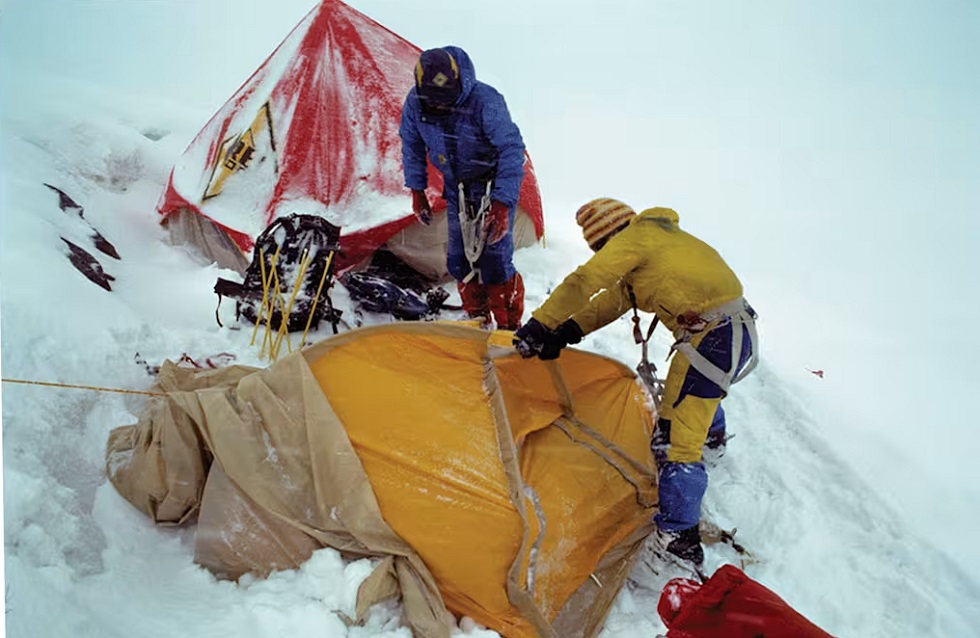
The following morning, Rick Ridgeway and John Roskelley pushed upward under the assumption they were executing a rescue mission. Finding Wickwire descending safely, they bypassed the direct finish due to severe avalanche danger, traversed to the standard route, and successfully reached the summit. Four Americans stood on top of the world within two days.
Crucially, prior to the technical climbing, the team had undertaken a grueling 110-mile walk to base camp, much of it off-trail. Nike had quietly supplied lightweight running shoes for this approach: yellow Long Distance Vectors (LDVs), road shoes evolved from the LD-1000 and designed by Bill Bowerman alongside Eugene orthopedist Dennis Vixie. Ridgeway and Roskelley wore these instead of the rigid, heavy European leather boots standard to the era.
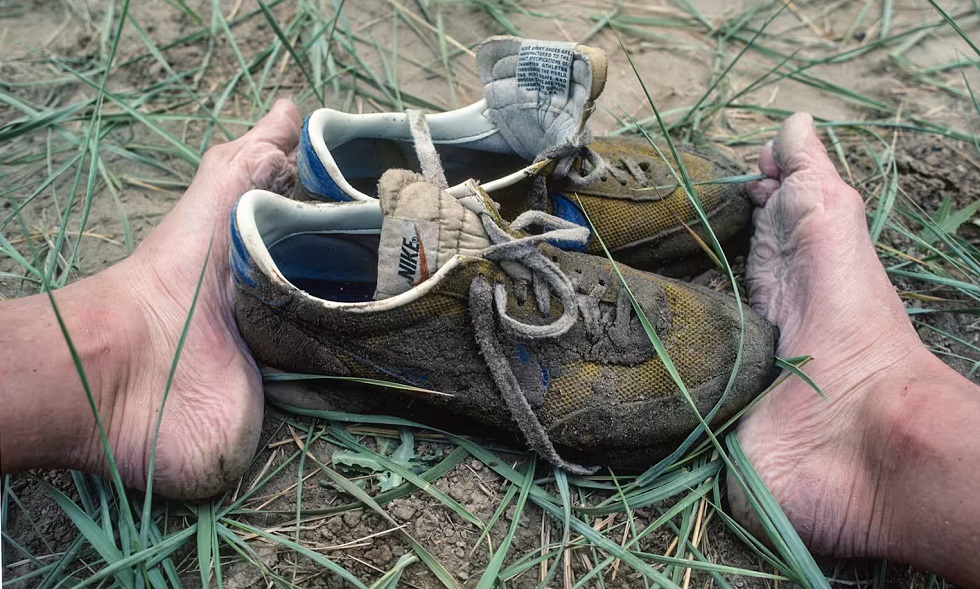
The shoes proved exceptionally comfortable, flexible, and breathable, perfectly suited for the relentless boulder-hopping required by the approach. However, they were structurally unequipped for high-altitude mountaineering; by base camp they were severely compromised, and by the walk out, Ridgeway and Roskelley were securing them with adhesive tape and glue. Upon returning home, they mailed the ruined footwear back to Nike alongside a concise product brief: build a tougher sole, construct a more rugged upper, and above all, keep it light. Nobody in Beaverton, Oregon, realized they had just received the blueprint for a new division.
The Philosophy of Lightweight Performance
Taking the mountaineers’ feedback seriously, Nike transformed the conceptual argument—that lightweight footwear could survive environments previously reserved for heavy boots—into a design mantra. By the early 1980s, this philosophy yielded three foundational models: the Lava Dome, the Approach, and the Magma.
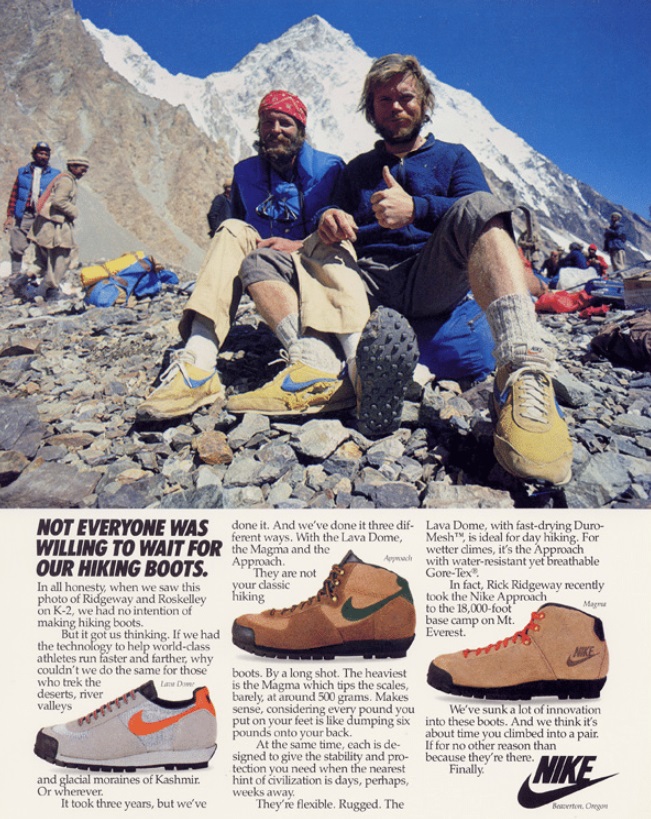
The Approach served as Nike’s debut footwear model featuring a GORE-TEX lining, manufactured in Saco, Maine, utilizing a waffle outsole and a combination leather-and-Cordura upper. The Lava Dome, conceived by Trip Allen and Monte Mayko, established itself as one of the earliest lightweight hiking shoes in the marketplace. Monte Mayko, operating out of Nike’s Exeter, New Hampshire facility, viewed the pivot as a natural evolution mirroring elite athletes shifting toward minimalist gear.
Simultaneously, internal structural shifts were underway. In 1984, designer Mark Parker sketched the Escape, marking Nike’s formal entry into trail running. Three decades later, as CEO, Parker would hand over the reins of the ACG division to avant-garde Berlin techwear designer Errolson Hugh, deeply altering the trajectory of the brand.
The Birth and Golden Era of All Conditions Gear
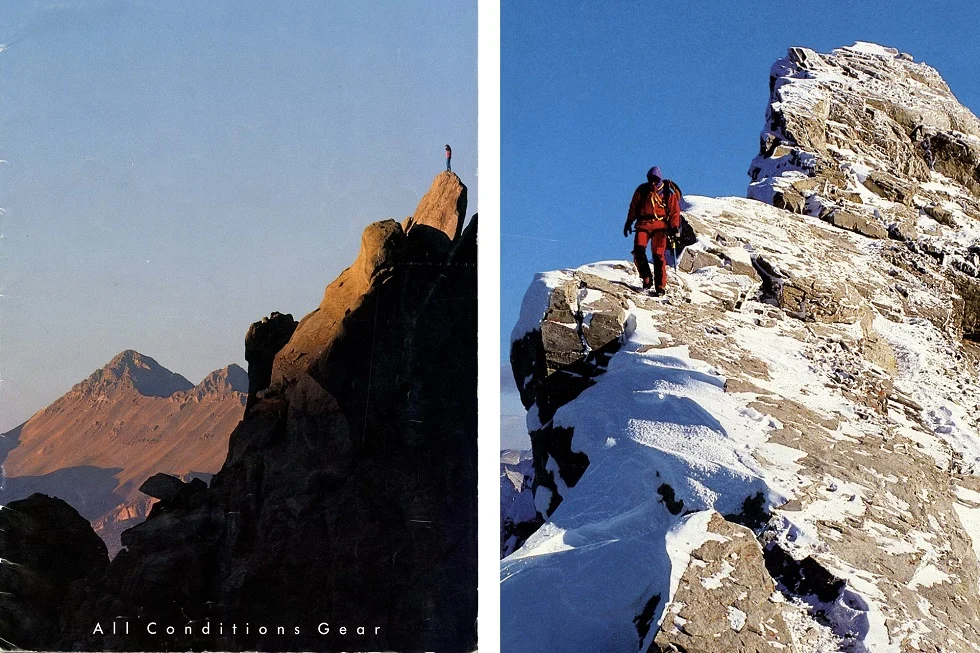
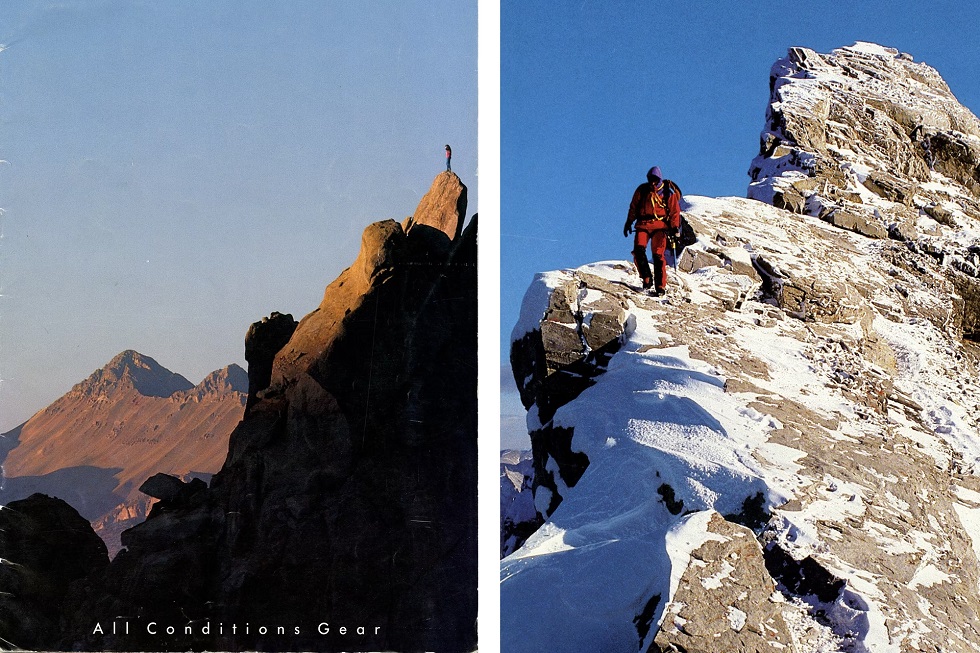
By the mid-1980s, Nike possessed a robust portfolio of outdoor footwear and apparel concepts operating without a unifying banner. In 1987, a dedicated team led by Tom Clarke and Kirk Richardson—a lifelong mountaineer—was tasked with consolidating these disparate threads. Recognizing that legacy European brands dominated the market with rigid, specialized, heavy equipment, Nike identified an opening for athletic gear engineered for dynamic movement across diverse weather conditions.
The division solidified around four core principles: high performance, durability, versatility, and functional excellence, housing footwear and apparel under a single operational roof. The nomenclature itself was discovered organically; the phrase "All Conditions Gear" was already utilized by Nike Running for a minor line of year-round apparel.
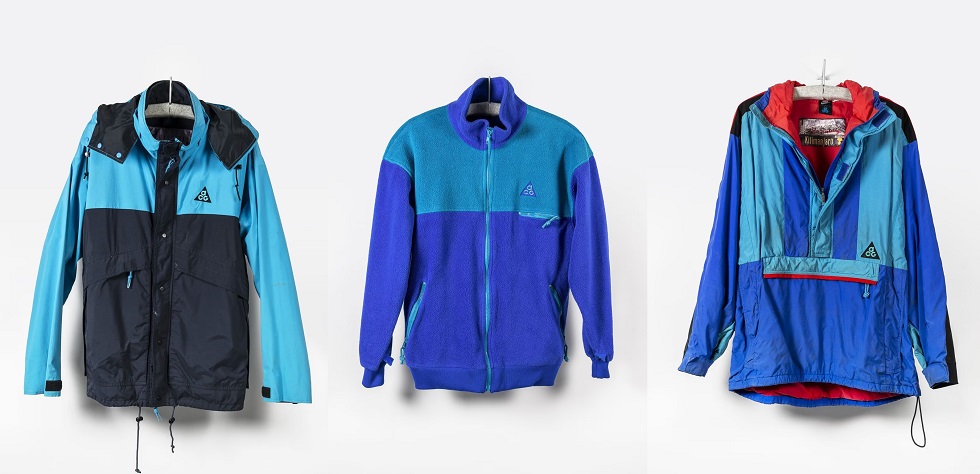
In 1989, ACG was officially launched. The debut marketing campaign brought climbers to Moab’s Castleton Tower, establishing a self-aware, adventurous tone epitomized by slogans like, "all conditions gear, and all conditions means all conditions." The autumn collection featured the Air Wildwood and the Lava High, complemented by GORE-TEX and fleece outerwear bearing names honoring global peaks, such as the Huascarán jacket and the Kilimanjaro anorak.
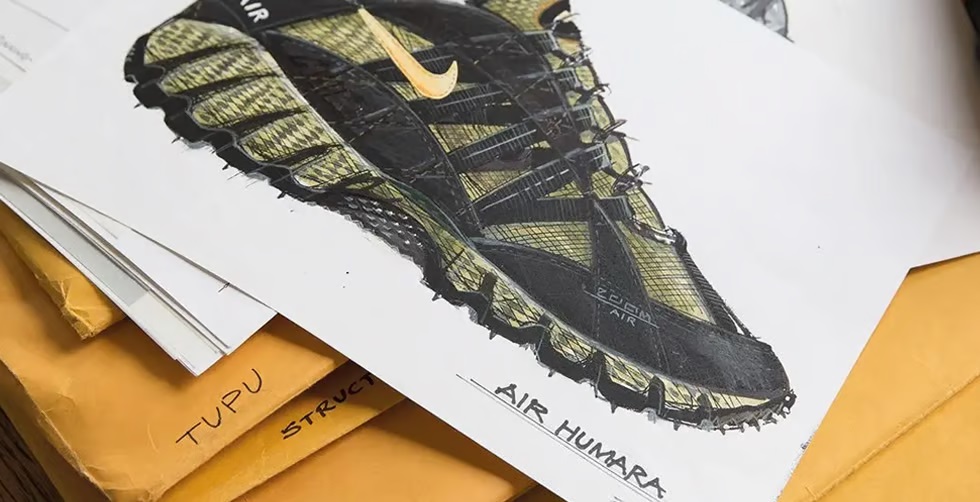
The 1990s represented the creative zenith of ACG, anchored by iconic footwear innovations. In 1991, Tinker Hatfield designed the Air Mowabb, named after Moab, Utah. Fusing the Air Huarache with the Wildwood, incorporating moccasin-inspired elements, a neoprene bootie, and an innovative speckled midsole, the Mowabb established a visual language that reverberated across Nike’s broader catalog for decades. Subsequent hits included the 1993 Air Deschutz sandal, the 1994 Air Moc, the rugged Air Mada, and Peter Fogg’s engineered Air Humara.
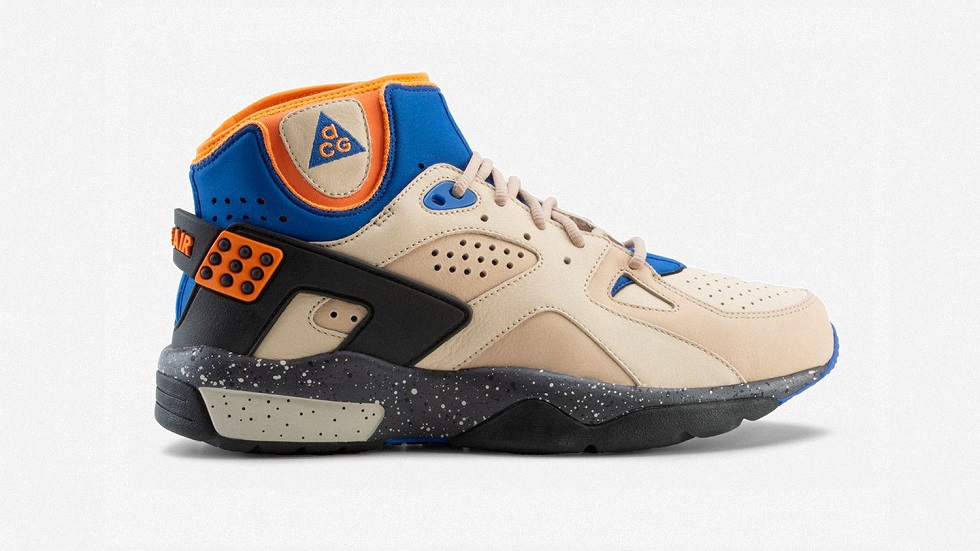
However, this boundary-erasing design ethos created a distinct challenge: the market increasingly adopted technical outdoor gear as everyday streetwear. Long before the term "gorpcore" was coined in 2017 by fashion writer Jason Chen, ACG had successfully bridged the gap between remote wilderness utility and urban street culture.
The Quiet Years and the Errolson Hugh Era
Following its peak, ACG entered a prolonged period of dormancy, nearly vanishing from the market by 2008 as production dwindled to a negligible footprint.
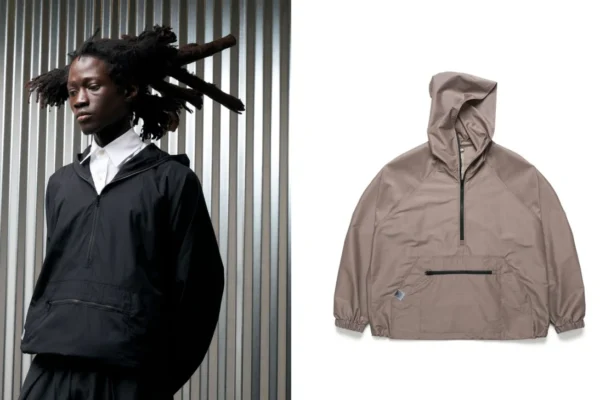
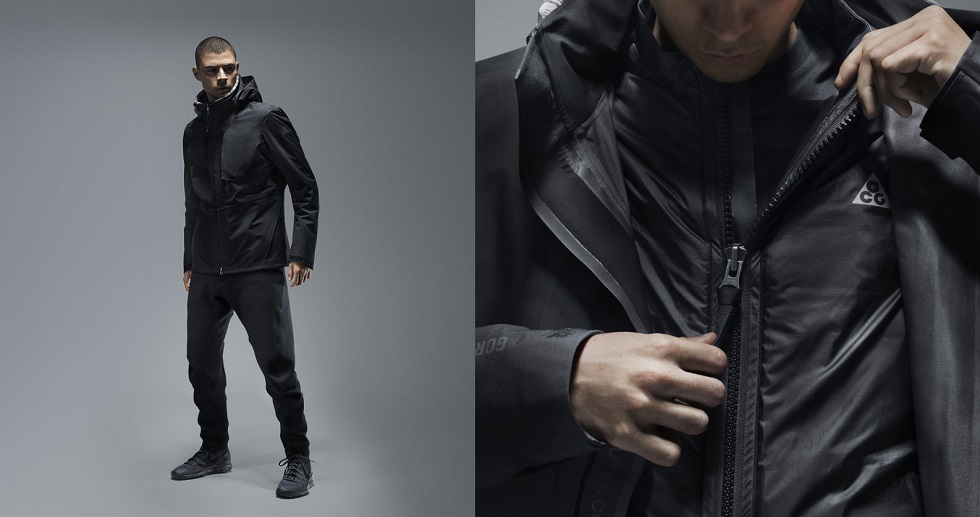
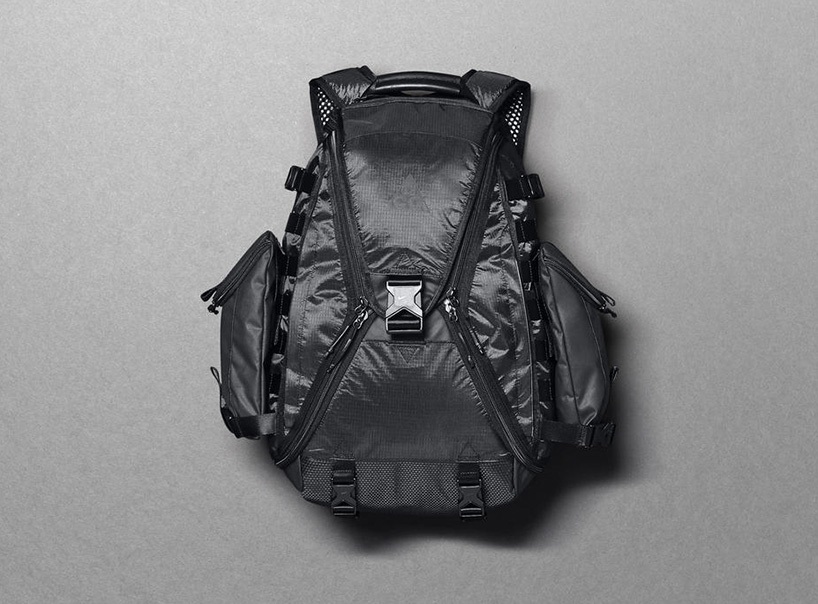
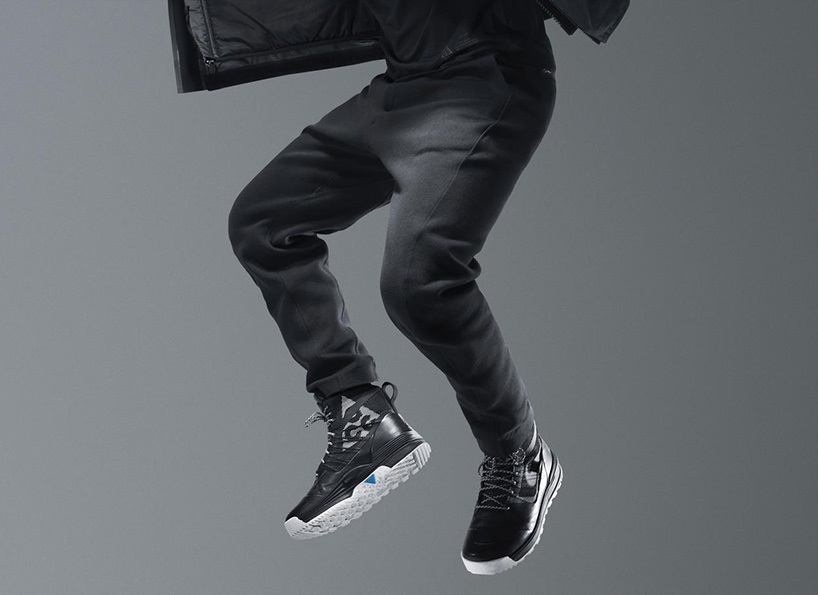
The division experienced a dramatic rebirth in December 2014 when CEO Mark Parker enlisted Errolson Hugh, co-founder of Berlin-based techwear label Acronym, to resurrect the line under the NikeLab ACG banner. Reimagined under the ethos of "sport utility for the city," the vibrant colorways of the 1990s were replaced by tactical black aesthetics, three-layer GORE-TEX membranes, fully taped seams, modular 2-in-1 systems, and the urban-centric Responder backpack.
Hugh’s tenure successfully defined a new generation of techwear design, cementing NikeLab ACG as a critical darling. Ironically, a brand originally engineered for the wilderness achieved some of its most influential cultural resonance precisely when it fully embraced the urban environment.
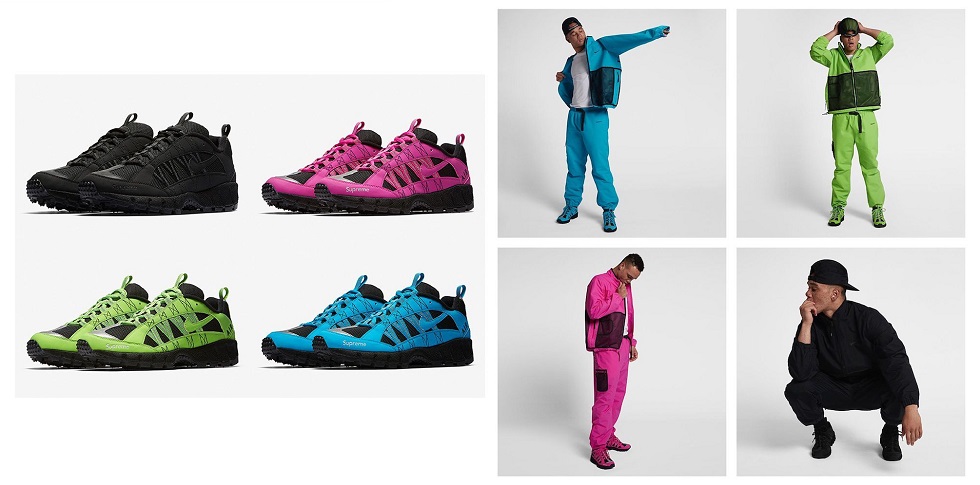
When Hugh’s partnership concluded in 2018, Nike shifted ACG back toward a retro sportswear direction under senior creative director James Arizumi. Heritage models like the Air Mada, Torre Mid, and Goadome were reintroduced, accompanied by high-profile collaborations with Comme des Garçons and Supreme.
The Wholesale Retraction and Market Vulnerability
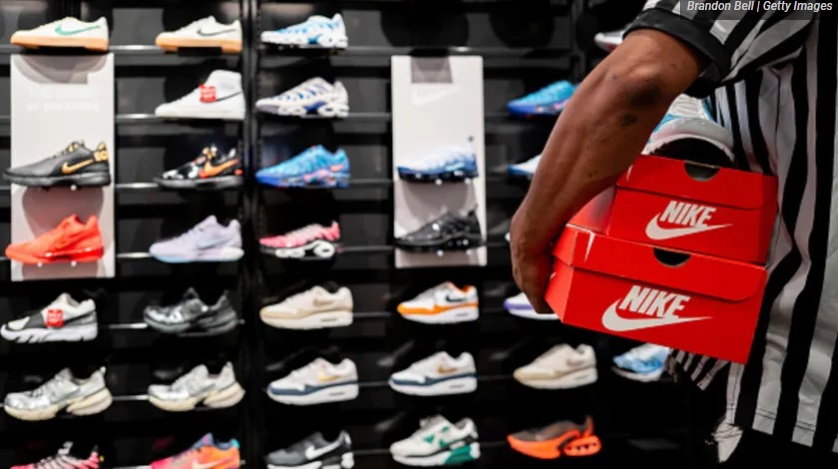
While ACG navigated its cultural renaissance, broader corporate strategy shifts at Nike created unforeseen vulnerabilities. Under former CEO John Donahoe beginning in 2020, Nike systematically reduced its footprint across wholesale retail partners—including Foot Locker and Dick’s Sporting Goods—to prioritize direct-to-consumer digital channels and proprietary storefronts.
While direct sales initially surged, the post-pandemic normalization of retail traffic in 2021 exposed the strategy’s limitations. Analysts noted that pulling premier inventory from multi-brand shelves created a vacuum rapidly filled by emerging competitors such as On and Hoka, particularly as consumer participation in running and outdoor recreation experienced historic post-lockdown growth.
The resulting financial pressure culminated in the summer of 2024, when Nike experienced its steepest single-day share price decline, shedding roughly $28 billion in market capitalization. Following Donahoe’s departure in October 2024, 32-year Nike veteran Elliott Hill returned as CEO, immediately signaling a strategic pivot to restore core athletic innovation and rebuild wholesale relationships.
The 2026 Relaunch and Modern Recommitment
Capitalizing on this strategic realignment, Nike formally reintroduced ACG on February 2, 2026, as a dedicated outdoor-performance brand centered explicitly on trail running, hiking, and technical exploration. Scott LeClair, Vice President and General Manager of ACG, defined the move as "a recommitment to all conditions," consolidating the legacy Nike Trail initiative directly into the ACG umbrella.
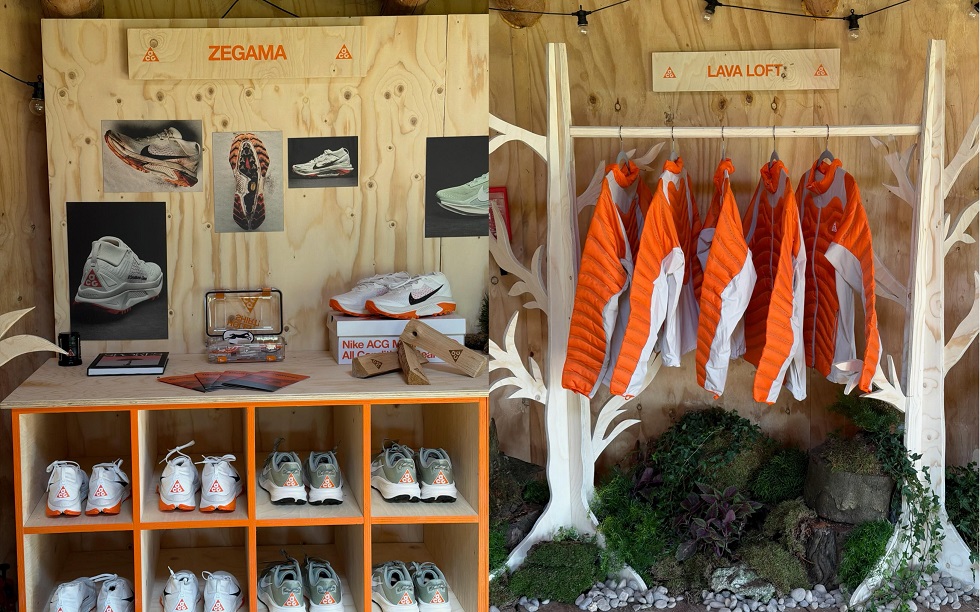
The product lineup was overhauled to reflect serious performance metrics, highlighted by the Ultrafly and Zegama trail shoes, the Radical AirFlow racing top, the Lava Loft down jacket, and the specialized GOAT pack vest system. Furthermore, the introduction of the Picklejus big-mountain trail shoe—built around a proprietary outsole compound dubbed GOATEK—signaled a strategic effort to reduce reliance on third-party suppliers like Vibram for grip technology.
To validate these products, the All Conditions Racing Department expanded its athlete roster to over two decades-deep testing corps across Japan, Korea, and the United States. Prototypes undergo thousands of miles of rigorous, unmarked field testing before commercial release.
Beyond product innovation, Nike executed experiential marketing campaigns to reconnect with the outdoor community. During the Milan Winter Olympics, the brand operated the "All Conditions Express"—a customized orange heritage train running from Milano Centrale into the Orobic Alps, complete with mobile gear labs and mountain-refuge-inspired café cars. Similar experiential activations were deployed globally, alongside substantial financial investments in the trail community, including a record $150,000 prize purse at the Broken Arrow Skyrace at Palisades Tahoe and the opening of flagship ACG Base Camps internationally.
The Path Forward: Rebuilding Trust on the Trail
Despite these extensive operational and marketing investments, industry analysts and seasoned trail runners maintain a pragmatic stance. The trail community possesses a notoriously discerning memory, and establishing technical credibility among ultra-runners requires sustained, uncompromised performance over time rather than transient marketing spectacles.
Furthermore, the dual identity of ACG—straddling the boundary between technical outdoor utility and high-fashion streetwear, underscored by concurrent collaborations with entities like Cactus Plant Flea Market—remains an inherent tension within the brand’s ecosystem.
Ultimately, ACG’s enduring advantage lies in its authentic origin story: a pair of ruined running shoes sent back in a postal box from K2 by climbers who refused to wait for specialized gear to exist. As ACG enters its next chapter, its long-term success will not be measured by corporate pivots or experiential trains, but by the same fundamental metric that defined its accidental birth—proven performance, earned one grueling mile off-trail at a time.