The sudden dissolution of Bark River Knives, a prominent fixture in the American semi-production knife market for decades, has sent shockwaves through the outdoor gear industry and the metallurgical community. The Michigan-based company, led by founder Mike Stewart, recently confirmed it would be ceasing operations following a series of mounting controversies ranging from manufacturing defects to serious allegations of consumer fraud and trademark infringement. While the company’s exit marks the end of a prolific era in fixed-blade production, the circumstances surrounding its downfall provide a critical case study in the intersection of engineering failures, legal compliance, and the ethics of material representation. The closure is not merely a business failure but a culmination of documented design flaws and the admission of deceptive labeling practices that have prompted a broader discussion on transparency within the American manufacturing sector.

The Chronology of Decline and the Mislabeling Scandal
The trajectory toward Bark River’s closure accelerated significantly following reports that the company had intentionally mislabeled the origin and composition of its products. Central to this controversy is the admission by Mike Stewart that Bark River Knives had been purchasing pre-formed knife blanks produced in China, performing minor finishing work in Michigan, and subsequently stamping the blades with "CPM-154" and "Made in USA." This practice represents a dual violation of federal standards and intellectual property rights. Under the Federal Trade Commission (FTC) "Made in USA" Enforcement Policy Statement, for a product to carry an unqualified "Made in USA" label, it must be "all or virtually all" made in the United States. The FTC specifically notes that if the core component of a product—in this case, the steel blade blank—is imported, the product cannot legally be marketed as American-made without a clear qualification, such as "Made in USA with Chinese components."
Furthermore, the labeling of these Chinese blanks as "CPM-154" constitutes a significant misrepresentation of material science. CPM-154 is a specific particle metallurgy steel produced by Crucible Industries in the United States. It is a premium version of 154CM steel, refined through a proprietary process to ensure a finer carbide distribution and superior toughness. By applying this trademarked name to generic Chinese-sourced steel, Bark River not only misled consumers regarding the performance characteristics of the knives but also infringed upon the trademarks of Crucible Industries. Stewart’s defense—that the Chinese steel performed "almost as well" in internal testing—is viewed by metallurgists as irrelevant. In the precision tool industry, chemical composition and heat-treatment consistency are the benchmarks of value; substituting a premium alloy with a generic equivalent while maintaining the premium price point is considered a fundamental breach of consumer trust.

Metallurgical Failure Analysis: The Scout Model Incident
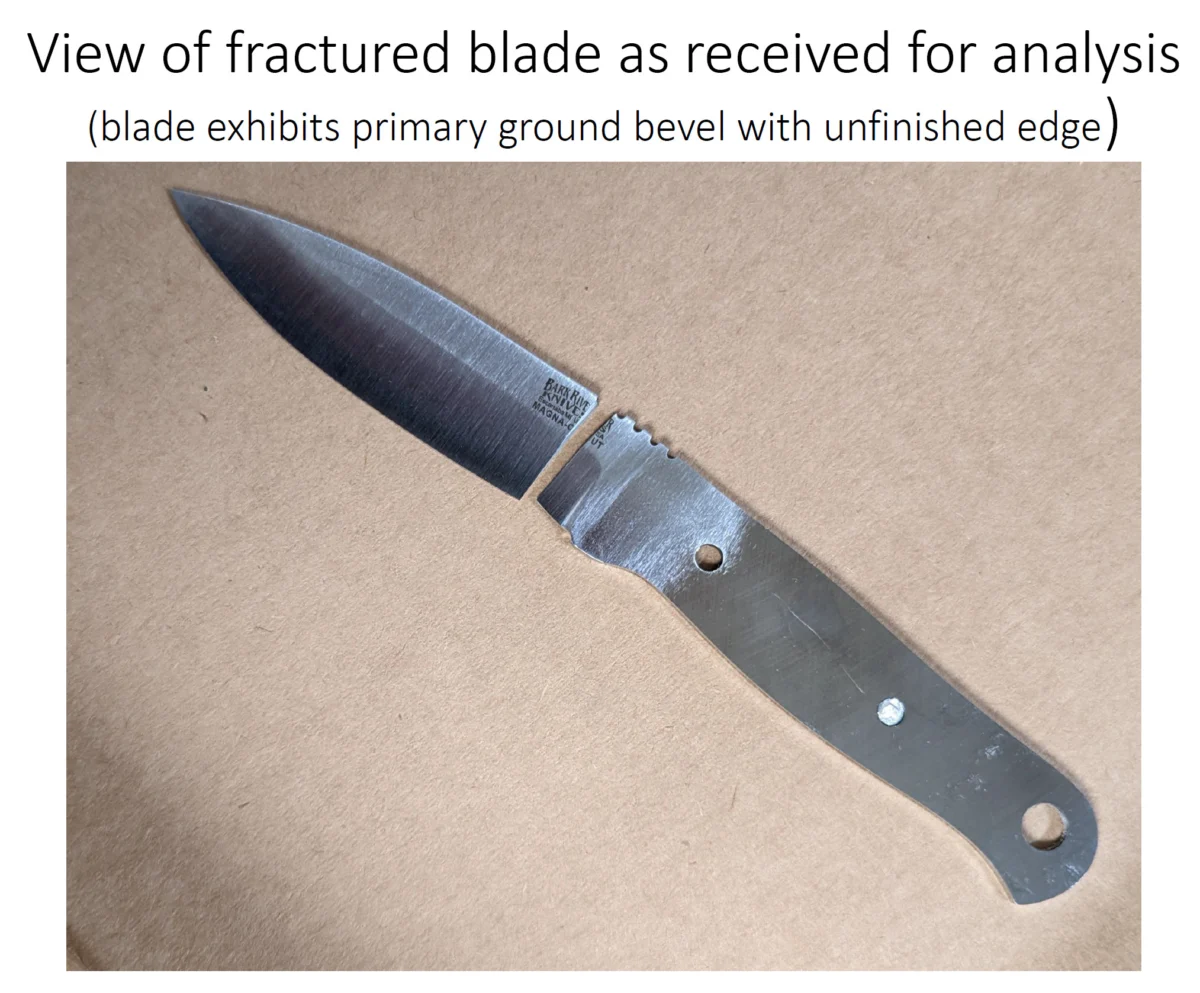
The technical reputation of Bark River began to erode publicly in 2022 following a high-profile failure of their "Scout" model, which was manufactured using CPM MagnaCut steel. During a field test conducted by the prominent YouTube channel Dutch Bushcraft Knives (DBK), the blade snapped cleanly across the spine during a standard batoning procedure—a common bushcraft task involving striking the spine of a knife to split wood. Bark River’s initial response attributed the failure to a "steel inclusion," a non-metallic impurity within the alloy. However, independent metallurgical analysis contradicted this claim.
A subsequent investigation into a separate failure of the same model, conducted by independent metallurgist Gary Maddock at the request of Niagara Specialty Metals, revealed a deeper systemic issue: poor mechanical design leading to catastrophic stress concentrations. Maddock’s report identified that the knife broke precisely at the "jimping"—the small notches ground into the spine of the blade to provide thumb grip. In engineering terms, these notches acted as "stress risers." When a blade is subjected to bending forces, stress is not distributed evenly; it concentrates at sharp internal corners or areas of reduced cross-sectional area. The Bark River Scout featured deep, sharp-angled jimping that significantly weakened the spine.

Furthermore, the manufacturing process left the surface of the jimping extremely rough. Whether cut via laser or waterjet, the perimeter of the blade blanks exhibited micro-discontinuities. In high-performance steels like MagnaCut, which are hardened to 60+ HRC (Rockwell Hardness Scale), these surface imperfections act as initiation points for cracks. Because Bark River did not polish or radius the interior of the jimping notches, the combination of a sharp geometric design and a rough surface finish created a "perfect storm" for mechanical failure under load.
The MagnaCut Corrosion Controversy
Another significant blow to the brand’s credibility involved the performance of its MagnaCut offerings. Developed by Dr. Larrin Thomas, CPM MagnaCut was engineered specifically to provide an unprecedented balance of high toughness, high wear resistance, and extreme corrosion resistance. Despite the steel’s reputation for being virtually rust-proof in standard environments, numerous Bark River customers reported that their MagnaCut blades were staining and pitting with minimal exposure to moisture.

Mike Stewart publicly challenged the steel’s classification, stating that he did not believe MagnaCut should be labeled as a "true stainless steel." This claim stands in direct opposition to the metallurgical data provided by Crucible Industries and independent researchers. Stainless steel is traditionally defined as having at least 10.5% chromium. MagnaCut contains 10.7% chromium, but more importantly, it is designed so that the chromium remains "in solution" within the iron matrix rather than forming chromium carbides. This "chromium in solution" is what creates the passive oxide layer that prevents rust.
Experts suggest the corrosion issues reported by Bark River users were likely not a fault of the steel itself, but rather a result of manufacturing contamination. If a manufacturer uses the same grinding belts for carbon steel (which rusts easily) and stainless steel, microscopic particles of carbon steel can become embedded in the surface of the stainless blade. These particles then oxidize, creating "tea staining" that appears to be the blade rusting, but is actually the external contamination corroding. Additionally, the lack of an acid passivation step—a standard industrial process using citric or nitric acid to remove free iron from the surface of stainless steel—may have contributed to the poor environmental resistance observed in these specific knives.

Industry Verification and Distributor Reactions
In the wake of the mislabeling admission, major knife distributors took immediate action to protect consumers and their own reputations. KnivesShipFree and DLT Trading, two of the largest retailers of Bark River products, initiated independent testing of their remaining inventory. Using X-Ray Fluorescence (XRF) analyzers, also known as Positive Metal Identification (PMI) tools, these distributors sought to verify if other models were mislabeled.
While early rumors suggested that Bark River’s MagnaCut might also be a substitute, XRF testing performed by Niagara Specialty Metals and independent labs largely confirmed that the MagnaCut stock was genuine. The mislabeling appears to have been isolated to the specific batches of CPM-154 blanks sourced from China. However, the damage to the brand was irreversible. The revelation that the owner of a major American knife company knowingly circumvented FTC labeling laws and used trademarked steel names for generic imports decimated the brand’s standing in the enthusiast community.

Broader Impact and Lessons for the Industry
The closure of Bark River Knives serves as a cautionary tale for the broader cutlery and tool industry. It highlights the necessity of rigorous design testing, especially when utilizing modern "super steels." High-performance alloys like MagnaCut or CPM-4V offer incredible properties, but they are not a substitute for sound mechanical engineering. Designers must account for stress concentrations and ensure that manufacturing processes, such as laser cutting, do not leave brittle Heat Affected Zones (HAZ) or rough surface finishes that compromise the integrity of the tool.
From a business perspective, the Bark River situation underscores the legal and ethical risks of "shadow sourcing." In an era of globalized supply chains, the temptation to reduce costs by importing blanks while maintaining a "Made in USA" price point is high, but the regulatory and reputational consequences of discovery are terminal. The FTC has signaled an increased willingness to pursue "Made in USA" fraud, and the knife-buying public, now armed with metallurgical data and independent testing tools, is more capable than ever of holding manufacturers accountable.

As Bark River winds down its operations, the focus has shifted to the numerous creditors and service providers who claim they are owed substantial sums by the company and its leadership. For the consumer, the legacy of Bark River will likely be defined by a shift in purchasing behavior: a move away from brand loyalty based on heritage and toward a demand for verifiable transparency in materials, origin, and engineering standards. The collapse of the firm marks a pivot point for the industry, where metallurgical science and honest labeling are no longer optional "extras" but the fundamental requirements for survival in a sophisticated market.