







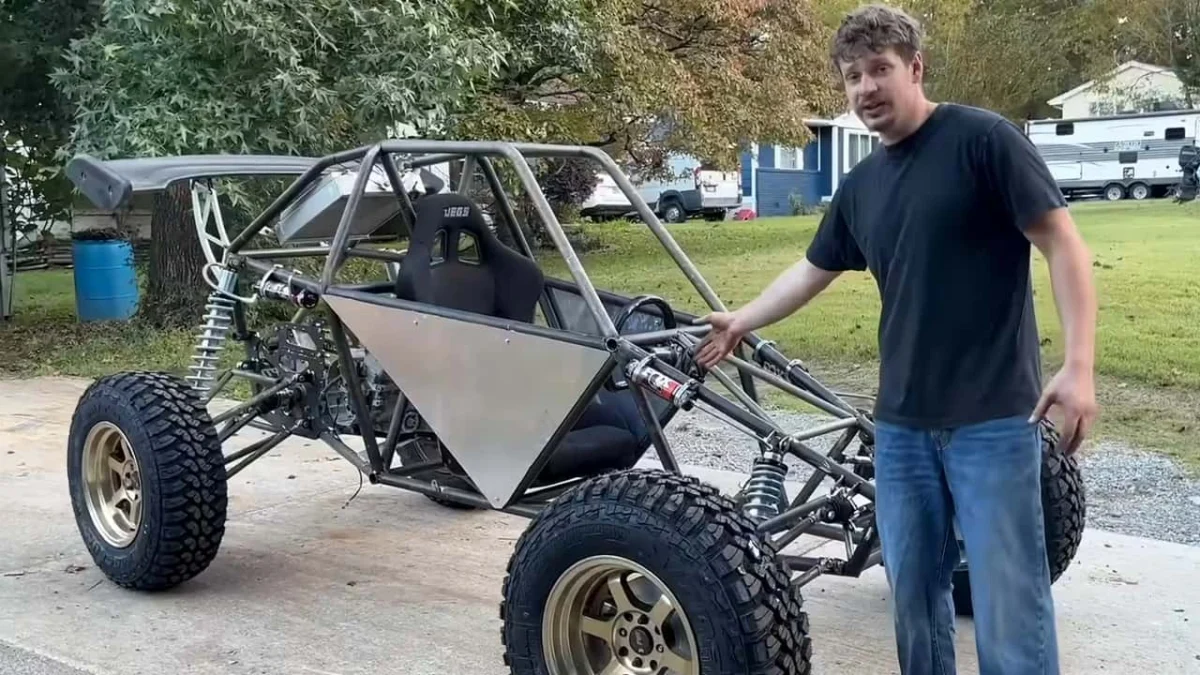
A Crosskart, in its most fundamental form, is a high-performance, tube-frame vehicle designed for off-road agility, typically utilizing a lightweight chassis paired with a high-revving motorcycle engine. While these machines are standard fare in European rallycross and autocross circuits, they are rarely seen on public roads. YouTuber and automotive fabricator Vasiliy Builds is currently challenging the conventional boundaries of this vehicle class by constructing a bespoke, turbocharged Crosskart designed to deliver an unprecedented 300 horsepower while meeting the rigorous requirements for street-legal operation.
The project represents a significant departure from standard Crosskart design philosophies. By integrating trophy-truck-grade long-travel suspension, a turbocharged powerplant, and active aerodynamic elements, the builder is attempting to create a hybrid machine that can theoretically outperform modern supercars in terms of power-to-weight ratio.
The Engineering Foundation and Powertrain Specifications
At the heart of this project is the Suzuki Hayabusa engine, a powerplant widely regarded in the automotive community as a "mythical" unit due to its extreme reliability at high RPMs and its immense tuning potential. In its stock configuration, the Gen-1 or Gen-2 Hayabusa engine produces approximately 175 to 197 horsepower. However, Vasiliy Builds is integrating a custom turbocharger setup to push the output to 300 horsepower.
To put this in perspective, a 300-horsepower output in a chassis that is expected to weigh under 1,000 pounds (454 kg) results in a power-to-weight ratio of roughly 0.3 horsepower per pound. For context, this exceeds the power-to-weight ratio of many high-end production supercars, including the Porsche 911 GT3 and the Ferrari 488 GTB. The mechanical challenge lies in packaging this immense force into a compact, tube-frame chassis that must also accommodate a sophisticated suspension system capable of handling the forces generated by such a light, high-power vehicle.
Chronology of Development
The construction of this machine follows a systematic, iterative process common in advanced fabrication. The initial phase focused on the geometry of the Chromoly steel tube frame, which was engineered to provide the necessary rigidity for high-speed off-road maneuvers while maintaining a low center of gravity.
Following the chassis fabrication, the project transitioned into the suspension development phase. Unlike standard karts, which often feature minimal suspension travel, this build utilizes a long-travel setup inspired by desert racing vehicles. This transition allows the kart to absorb high-impact landings and navigate uneven terrain at speeds that would typically destabilize a traditional go-kart.
The current phase involves the integration of the turbocharged drivetrain and the electrical systems required for street-legal compliance. The latter is a complex undertaking, requiring the addition of turn signals, headlights, tail lamps, mirrors, and an emissions-compliant exhaust system—components rarely found on purpose-built competition karts.
Supporting Technical Data and Market Context
The Crosskart category originally gained prominence in the 1980s as a cost-effective entry point into motorsport. Traditionally, these vehicles are powered by 600cc or 750cc engines. By choosing the 1,300cc Suzuki Hayabusa engine, Vasiliy Builds is moving into the "Superkart" territory, where the primary constraint is not power, but traction and driver skill.
The integration of "active aero" is perhaps the most unconventional aspect of this build. In professional racing, active aerodynamics—such as movable wings or flaps—are used to adjust downforce based on vehicle speed and steering input. Implementing this on a DIY project suggests a high level of sophistication, aimed at keeping the lightweight machine planted on the tarmac during high-speed cornering, thereby mitigating the inherent instability of a short-wheelbase, high-power vehicle.
Challenges in Street-Legal Certification
Transitioning a tube-frame off-road vehicle into a street-legal machine involves navigating a complex web of Department of Transportation (DOT) and state-level safety regulations. For a vehicle to be registered as a "specially constructed vehicle" or "custom-built car," it must typically meet specific lighting, braking, and safety glass standards.
The primary hurdle for this specific build is the lack of a traditional crash structure, which makes obtaining a VIN and title a significant administrative and engineering challenge. However, the precedent exists; many home-built "Exocet" style cars and sand rails have successfully navigated these regulations by utilizing donor vehicle frames or obtaining individual safety certifications. If successful, this Crosskart would be one of the few machines in its class capable of being driven from a highway to a rugged mountain trail without the need for a trailer.
Broader Implications for the DIY Automotive Community
The project underscores a growing trend in the automotive enthusiast community: the rise of the "mega-build" YouTube creator. By documenting the failures and successes of such complex fabrication, these builders are democratizing advanced engineering concepts.
From an industry perspective, this build highlights the evolution of the "kit car" market. While major manufacturers are moving toward electrification, there remains a passionate segment of the hobbyist population that continues to push internal combustion engines to their absolute limits. The use of a motorcycle engine in a car chassis is a well-established practice—famously utilized by companies like Caterham and Ariel—but doing so at the 300-horsepower threshold in a kart-sized chassis remains a rare feat of engineering.
Analysis of Potential Performance Metrics
If the project hits its target of 300 horsepower and sub-1,000-pound weight, the performance metrics will likely be extreme. Based on physical calculations for similar power-to-weight ratios, the vehicle could theoretically achieve a 0-60 mph time in the sub-2.5-second range, provided the tires can find sufficient grip.
The main limiting factor for such a build is not the engine, but the drivetrain’s ability to handle the torque. The use of a motorcycle sequential transmission requires a robust clutch and chain-drive system, which are prone to wear under high-stress conditions. Furthermore, the handling characteristics of a vehicle with such a high power-to-weight ratio are notoriously unforgiving. The "active aero" system will likely be critical in preventing the front end from becoming too light during rapid acceleration.
Conclusion and Future Outlook
The Vasiliy Builds project is a testament to the capabilities of modern fabrication tools—such as CNC plasma cutters, TIG welders, and 3D modeling software—when placed in the hands of a skilled enthusiast. While the primary goal is the creation of a "radical machine," the secondary achievement is the pushing of the mechanical envelope.
As the build progresses, the automotive community will be watching to see if the machine can effectively balance its dual nature as an off-road beast and a road-going vehicle. If the builder can successfully navigate the registration process and ensure the reliability of the turbocharged Hayabusa engine, this Crosskart will stand as a benchmark for custom vehicle fabrication in the digital age. The successful integration of active aero and street-legal compliance would set a new standard for what a hobbyist can achieve outside of a professional racing shop, potentially inspiring a new wave of high-performance custom builds that blend the agility of a kart with the ferocity of a superbike.