










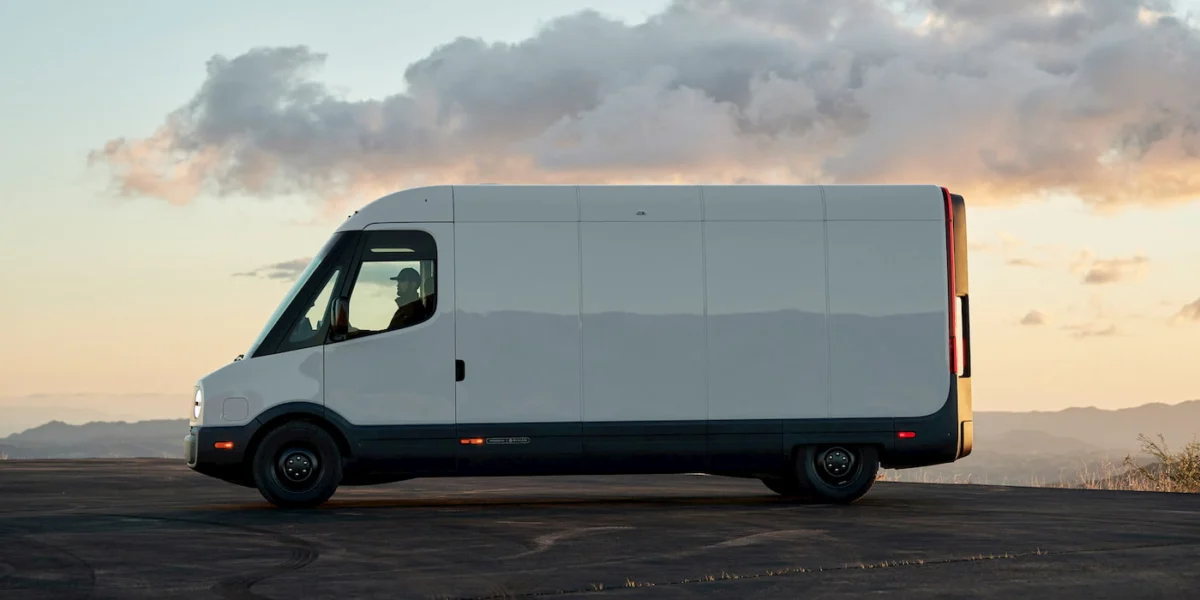
Rivian Automotive has officially launched its first substantial hardware overhaul for its electric commercial van lineup since production commenced in 2021. The prominent electric vehicle manufacturer confirmed in its third-quarter shareholder presentation that customer deliveries of the newly engineered variants began in early October. This long-awaited update introduces a higher-capacity lithium iron phosphate (LFP) battery pack, providing approximately a 30 percent increase in driving range, alongside a newly developed dual-motor all-wheel-drive (AWD) configuration.
For years, Rivian’s Electric Delivery Van (EDV) family—anchored primarily by its massive contract with retail giant Amazon—faced operational boundaries due to a constrained driving range capped at roughly 160 miles per charge. While this specification proved adequate for dense urban postal and package delivery routes, it restricted the vehicle’s viability for extended rural and suburban logistical frameworks. The introduction of the 129 kWh battery pack and all-wheel-drive capability represents a pivotal engineering milestone designed to directly resolve these operational limitations, positioning Rivian to aggressively court a broader spectrum of commercial and municipal fleet customers across North America.
Evolution of the Rivian Electric Delivery Van Lineup
The trajectory of Rivian’s commercial vehicle program dates back to 2019, when Amazon placed an order for 100,000 custom electric delivery vans as part of its Climate Pledge initiative. Production officially began in late 2021 at Rivian’s manufacturing facility in Normal, Illinois. Throughout the initial years of deployment, the fleet relied exclusively on a front-wheel-drive architecture paired with a 100 kWh LFP battery pack, achieving a maximum EPA-rated range of approximately 160 miles.
Whispers of an impending powertrain and energy storage upgrade first surfaced in late 2025. During Rivian’s fourth-quarter stakeholder communications, executives acknowledged that the company was actively developing a larger energy storage solution and an all-wheel-drive layout to expand EDV route coverage within Amazon’s burgeoning delivery network. This announcement arrived on the heels of significant scaling milestones, including a 50 percent year-over-year expansion of Amazon’s active Rivian van fleet throughout 2025.
By September 2026, regulatory filings with the Environmental Protection Agency (EPA) for the 2027 model-year EDV 700 confirmed the arrival of a new 129 kWh usable LFP battery pack. This represents an approximate 29 percent increase in total onboard energy capacity compared to the legacy 100 kWh configuration, aligning closely with Rivian’s public assertions of a 30 percent boost in total driving radius. Deliveries of these enhanced variants formally commenced in October 2026, marking the first major hardware refresh for the platform in five years.

Technical Specifications and Performance Metrics
The architectural improvements are specifically integrated into Rivian’s larger commercial offering, the EDV 700, which boasts 652 cubic feet of dedicated cargo volume. Conversely, the smaller EDV 500 variant maintains its existing front-wheel-drive powertrain and battery architecture.
According to technical documentation and official disclosures, the upgraded EDV 700 is now available in two distinct configurations: an extended-range front-wheel-drive model and a performance-oriented dual-motor all-wheel-drive variant.
The front-wheel-drive iteration leverages the full capacity of the new 129 kWh LFP battery pack. When applying Rivian’s stated 30 percent range improvement to the legacy 160-mile baseline, the front-wheel-drive model is projected to achieve a real-world driving radius of approximately 208 miles on a single charge.
The dual-motor all-wheel-drive variant introduces a secondary electric motor to the rear axle, significantly improving traction and dynamic handling in adverse weather conditions. While the dual-motor setup incurs a slight efficiency penalty—yielding a roughly 23 percent net gain in range over the legacy model according to preliminary EPA testing data—it delivers an estimated real-world operating range of 195 to 200 miles.
Transportation and logistics analysts note that trading away a marginal percentage of potential absolute range in exchange for the safety and capability of all-wheel-drive is a highly favorable compromise for commercial operators. Rural and mountainous delivery routes frequently expose vehicles to unpaved surfaces, mud, gravel, and heavy winter snowpacks—environments where a fully loaded front-wheel-drive commercial vehicle traditionally encounters severe traction deficits.
Strategic Implications and Market Positioning

Rivian’s timing for the hardware refresh aligns with a rapidly evolving commercial electric vehicle landscape in North America. For years, the commercial van division operated almost entirely as an exclusive supplier to Amazon, following the expiration of the exclusivity agreement in late 2023. Although Amazon remains the primary stakeholder and largest operator of Rivian vans, recent industry sightings suggest a diversification of the customer base. Automotive observers recently spotted a Rivian electric delivery van wrapped in Walmart+ livery on a transport carrier in Indiana, though neither corporation has formally announced a definitive supply agreement.
The broader competitive environment for full-size electric commercial vans has experienced considerable turbulence and contraction. General Motors officially wound down production of its BrightDrop electric commercial vans in Ontario, Canada, while commercial EV startup Canoo faced corporate bankruptcy. These exits have significantly thinned the competitive field, leaving Ford Motor Company’s E-Transit as Rivian’s principal rival in the full-size electric van segment within the United States market.
By expanding the operational range of the EDV 700 to the 200-mile threshold and introducing all-wheel-drive capabilities, Rivian has effectively eliminated the primary barrier preventing utility companies, telecommunications providers, regional courier services, and municipal fleets from adopting its platform. Many of these prospective enterprise customers operate outside of dense metropolitan grids, requiring reliable vehicle performance across dispersed rural territories without the guarantee of midday recharging infrastructure.
Economic and Industry Outlook
The introduction of the upgraded EDV platform arrives as fleet operators face mounting economic pressures to electrify their logistics networks while maintaining operational continuity. Fleet managers consistently emphasize that vehicle downtime and range anxiety are the two most prohibitive factors when transitioning from internal combustion engine vehicles to battery-electric alternatives.
By achieving the 200-mile operational benchmark originally promised when commercial deliveries first commenced in 2022, Rivian has restored confidence in the technical roadmap of its commercial division. Furthermore, the selection of lithium iron phosphate (LFP) chemistry for the larger 129 kWh pack offers distinct financial and safety advantages over nickel-cobalt-manganese alternatives. LFP batteries are inherently more thermally stable, less susceptible to degradation under intensive daily commercial cycling cycles, and significantly cheaper to manufacture, shielding both Rivian and its enterprise clients from extreme commodity price fluctuations.
As Rivian transitions from its initial product validation phase into full-scale commercial diversification, the success of the 2027 EDV 700 will largely depend on its ability to convert casual market interest from major non-Amazon retailers and logistics firms into firm purchase orders. With production lines fully optimized at the Normal, Illinois facility and regulatory certifications secured, Rivian is well-positioned to capture an expanding share of the commercial fleet electrification market as corporate sustainability mandates accelerate toward the end of the decade.