The modern era of digital cinematography has long been dominated by an arms race for technical supremacy: larger sensors, higher resolutions, wider dynamic ranges, and heavier cinema rigs. However, a significant paradigm shift is quietly underway across documentary filmmaking, corporate storytelling, and journalistic profiling. Industry veterans are beginning to realize that the most formidable challenge in capturing a compelling interview is not technical capability, but psychological barrier. For non-performers—lawyers, entrepreneurs, artists, and academics unaccustomed to being filmed—the physical and psychological footprint of a traditional multi-thousand-dollar cinema setup often triggers an involuntary performance anxiety. This realization has sparked a growing movement among working professionals: leveraging the unprecedented power of next-generation ultra-compact and pocket-sized cameras to scale up production coverage technically while simultaneously scaling down the psychological pressure in the room.
The Psychological Toll of the Traditional Cinema Rig
When evaluating production equipment, filmmakers have historically focused on metrics that serve the camera operator and the editor: lens sharpness, color science, low-light performance, and rigging flexibility. Yet, after decades of capturing real-world subjects who lack media training, a critical question emerges regarding the inverse relationship between equipment scale and subject authenticity.
When a subject is seated opposite a massive cinema camera rigged with matte boxes, external monitors, follow-focus motors, and a spiderweb of cables, the message communicated to them is immediate and sobering: a formal, high-stakes performance is expected. This realization frequently induces an immediate physiological and psychological shift. Subjects routinely adopt more rigid postures, alter the natural timbre of their voices, deliver overly polished or defensive statements, and unconsciously monitor their own physical gestures.
For documentarians and corporate profile producers, this hyper-awareness is counterproductive. The most revealing moments in an interview—the hesitant pause before a candid realization, the imperfect phrasing that reveals genuine personality, or the reflective silence following a complex question—are easily suppressed when a subject feels intimidated by an imposing production apparatus. Consequently, modern videographers are increasingly tasked with finding ways to make the production infrastructure effectively disappear without sacrificing the multi-angle coverage required by modern editing standards.
Technological Evolution of Pocket-Sized Cameras
This strategic shift in production philosophy has only recently become viable due to rapid advancements in sensor technology and image processing. Historically, opting for smaller cameras meant accepting severe compromises in image quality, low-light handling, dynamic range, and lens selection. Early pocket cameras or action devices frequently produced clipped highlights, muddy color profiles, and noisy shadows that immediately disqualified them from professional broadcast or high-end corporate applications.
Over recent years, however, the performance gap between large-sensor mirrorless systems and high-end pocket cameras has narrowed considerably. Modern compact systems are now capable of capturing high-bitrate video, highly accurate skin tones, and remarkably clean images in challenging lighting environments. Furthermore, many current pocket cameras offer built-in stabilization and versatile focal lengths, allowing operators to secure both wide establishing angles and tighter, more flattering portrait framing without physically crowding the subject’s personal space.
This technological parity has liberated directors from the binary choice between image quality and discretion. Once a pocket camera’s image output crosses the threshold of professional acceptability, production teams can evaluate gear based on alternative parameters: setup time, spatial footprint, and, crucially, how the equipment influences human behavior.
The Multi-Camera Paradox: More Coverage, Less Intimidation
A central innovation in this methodology is the application of a multi-camera setup utilizing ultra-compact bodies. Conventionally, adding cameras to a production inherently amplifies its perceived scale. Introducing a second or third cinema body usually means additional tripods, more operators, increased cable clutter, and a heavier environment for the interviewee to navigate psychologically.
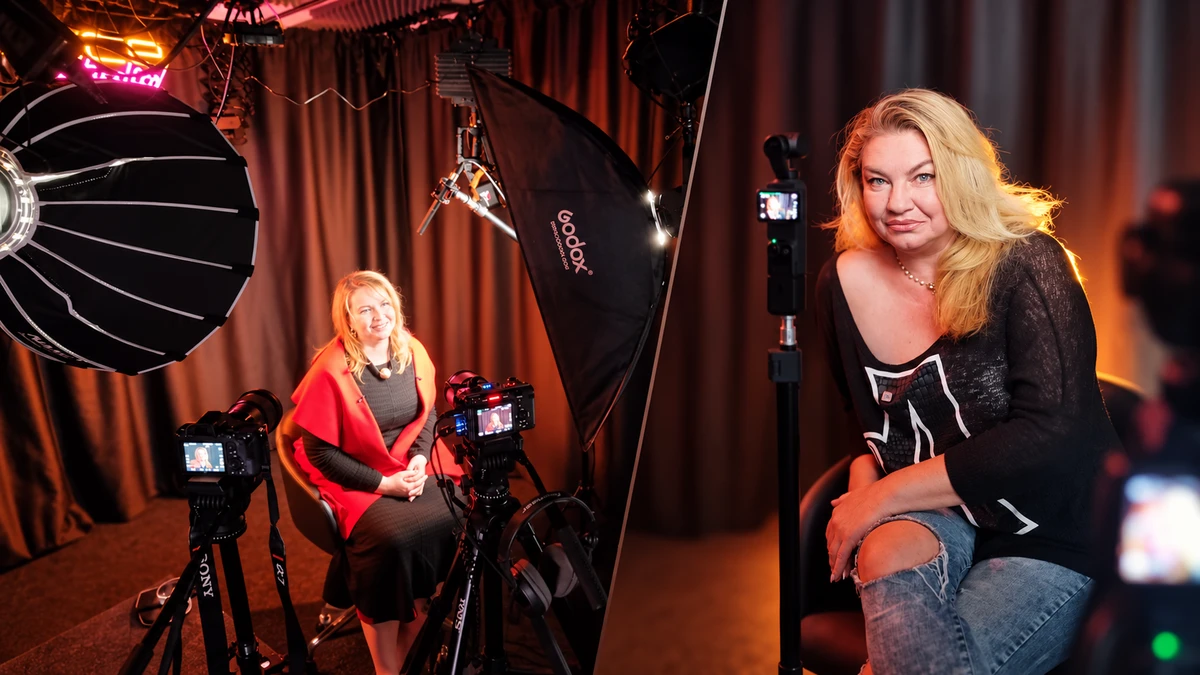
By contrast, deploying a network of three tiny, stationary pocket cameras fundamentally alters this dynamic. A primary camera can be positioned subtly near the interviewer’s axis, a second can capture a tight or profile angle from a discreet distance, and a third can establish environmental context from a wider perspective.
From the editorial standpoint, the production benefits from robust, professional multi-camera coverage that allows seamless cuts, pacing adjustments, and reaction tracking during post-production. From the perspective of the interviewee, however, the room remains largely unobstructed. Without towering camera bodies or operators peering directly through bulky viewfinders, subjects are far more likely to forget the recording apparatus and engage in a natural, unscripted conversation.
Economic and Logistical Implications for the Industry
Beyond psychological benefits, the adoption of ultra-compact multi-camera workflows carries significant economic and logistical advantages for production companies and independent media creators alike. Traditional corporate video profiles often involve substantial overhead: heavy transport, extensive lighting packages, extended crew requirements, and complex load-in times. For small-business owners, regional professionals, or individual artists seeking high-end video profiles, the financial and temporal overhead of a full-scale commercial production can quickly become disproportionate to the actual scope of the project.
By streamlining the equipment footprint, production teams can drastically reduce setup and teardown times, travel overhead, and crew requirements. This efficiency allows boutique production houses to offer competitive pricing models for premium video profiles without compromising the intellectual rigor, lighting design, or audio fidelity of the final piece. As industry analysts note, "cheap production" and "small production" are distinct concepts; reducing the physical machinery in the room frequently liberates the director to focus entirely on lighting, audio clarity, and substantive interpersonal engagement.
Industry Response and Future Outlook
Reactions from established cinematographers and documentary directors regarding the miniaturization trend have been mixed yet increasingly pragmatic. Industry veterans emphasize that heavy cinema rigs remain indispensable for narrative feature films, complex commercial shoots with extensive visual effects, and productions requiring rigorous manual lens changes or specialized cinema-grade monitoring.
Nevertheless, consensus is growing that the traditional cinema package is not universally applicable, particularly within the domain of documentary journalism and unscripted executive profiling. As production agencies continue to experiment with minimalist multi-camera topologies, the baseline definition of "production value" is evolving. The metric of success is shifting away from purely technical perfection toward psychological efficacy—raising a fundamental question for modern directors: If a massive rig delivers a technically pristine image, but a discreet pocket setup allows a subject to reveal their authentic self, which approach has truly succeeded in capturing the better interview?