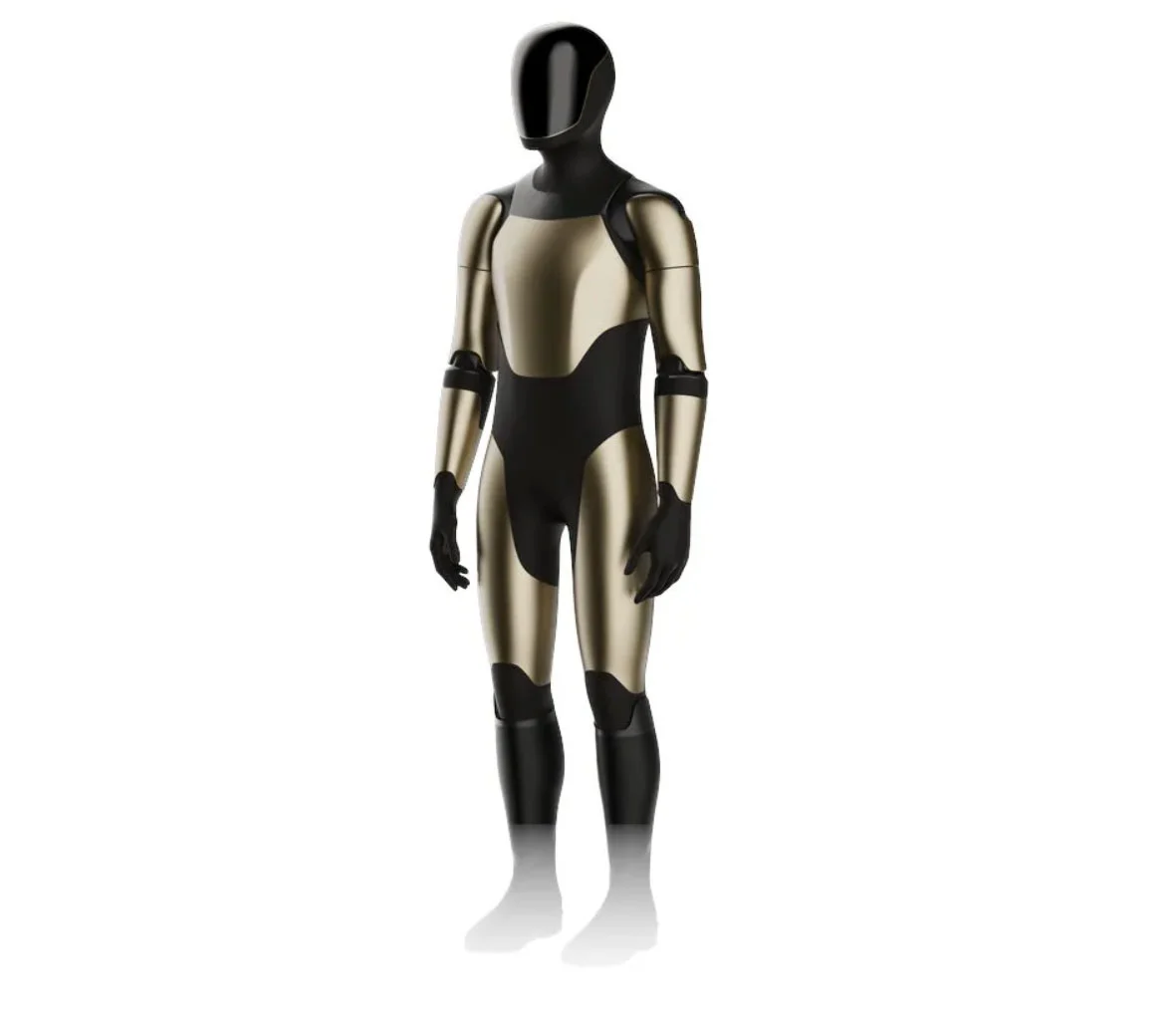
New high-resolution imagery discovered within the source code of Tesla’s official Android mobile application has provided the clearest look yet at the next iteration of the company’s humanoid robotic platform, the Optimus Gen 3. The files, identified by diligent data miners as “robot_closeup_gen3.png,” “robot_home_full_body_gen3.png,” and “robot_home_inactive_gen3.png,” reveal a significant departure from the utilitarian, exposed-cable aesthetic of previous prototypes. The latest design features a sophisticated champagne-gold torso and matte-black protective plating covering the knee and shin joints, signaling a pivot toward a more polished, consumer-facing product identity.
This visual evolution suggests that Tesla is transitioning from the laboratory-centric “proof-of-concept” phase into a design language optimized for commercial manufacturing. By enclosing sensitive actuators and wiring beneath sleek panels, the Gen 3 design not only improves the aesthetic profile of the robot but also addresses practical concerns regarding safety, maintenance, and durability in industrial environments.
The Evolution of the Tesla Bot
To understand the significance of the Gen 3 leak, one must look at the rapid, iterative trajectory of Tesla’s robotics program. The journey began in August 2021 during the inaugural Tesla AI Day, where Elon Musk unveiled the concept of the “Tesla Bot,” then known as Optimus. At that time, the project was little more than a concept rendered in graphics, accompanied by a performer dressed in a robot suit.
By September 2022, Tesla debuted “Bumblebee,” the first functional prototype. Bumblebee was raw and industrial, characterized by visible internal components, dangling wiring, and a heavy, deliberate gait. It was a functional machine designed to demonstrate that the company could integrate Tesla’s proprietary FSD (Full Self-Driving) silicon and neural network architecture into a bipedal form factor.
The transition to Optimus Gen 2, showcased in late 2023 and early 2024, represented a massive leap in engineering. Gen 2 featured a lighter frame, improved hand dexterity, and smoother, more fluid movement, largely thanks to Tesla-designed actuators and sensors. However, Gen 2 remained an engineering marvel rather than a mass-produced tool. The emergence of the Gen 3 imagery—found tucked away in an assets/mock folder of the Tesla app—indicates that the company is now prioritizing the “productization” of the platform.
Technical Implications of the Gen 3 Design
The primary distinction between the Gen 3 images and its predecessors lies in the coverage of the robotic limbs. In previous iterations, the exposed joints were necessary for engineers to monitor mechanical stress, heat dissipation, and sensor feedback in real-time. The move to a covered, champagne-gold chassis suggests that Tesla has reached a level of confidence in its mechanical reliability that allows for protective shielding.
Industry analysts note that this design shift is essential for industrial adoption. Robots operating in factories alongside human workers require safety certifications that often mandate the enclosure of pinch points and moving parts to prevent workplace accidents. By hardening the exterior, Tesla is effectively positioning the Optimus Gen 3 for deployment in its own gigafactories, where the robots are intended to handle repetitive, ergonomic-straining tasks such as sorting, lifting, and assembly.
Furthermore, the choice of a refined, metallic aesthetic suggests that Tesla is keeping an eye on the eventual consumer market. While current focus is strictly internal, the shift from “lab-build” to “finished product” is a hallmark of Tesla’s strategy to transition hardware from experimental status to a scalable commercial good.
Chronology of the Tesla Robotics Program
The following timeline outlines the major milestones in the development of the Optimus platform:
- August 2021: Elon Musk announces the Tesla Bot at AI Day, outlining a vision for a humanoid robot built on AI and FSD hardware.
- September 2022: Tesla reveals the “Bumblebee” prototype, showcasing the ability to walk and perform basic tasks.
- December 2023: Introduction of Optimus Gen 2, featuring a 30% increase in walking speed, improved hand dexterity, and significant weight reduction.
- May 2026: Tesla demonstrates Gen 2 advancements at the AWE (Augmented World Expo) in Shanghai, signaling a shift toward international manufacturing and supply chain integration.
- September 2026: Data miners uncover Gen 3 assets within the official Tesla mobile app, revealing a new design language.
Official Stance and Market Expectations
Despite the excitement generated by the leak, Tesla has maintained a disciplined silence regarding the specific technical specifications of the Gen 3 unit. The company’s official communication remains focused on the pragmatic applications of the technology. During the AWE 2026 event in Shanghai, Tesla representatives reiterated that while the Gen 3 design displayed in promotional materials is the current target, the final production unit may undergo further refinements based on real-world testing.
Tesla’s stated goal is to achieve mass production by the end of 2026, with an emphasis on internal deployment first. The company has invested heavily in production capacity at its Fremont, California, and Texas facilities to accommodate the assembly lines required for the humanoid units.
There has been persistent, albeit soft, speculation regarding consumer availability by late 2027. However, observers caution that these timelines are aspirational. The complexity of humanoid robotics—particularly in areas of battery density, AI cognition, and motor longevity—remains a significant barrier to entry. While the Gen 3 imagery provides a window into the future of the product, it is not a guarantee of immediate market arrival.
The Broader Economic Context
The development of Optimus is happening against a backdrop of increasing labor shortages and a growing demand for automated solutions in manufacturing. Tesla’s strategy is to integrate these robots into a workflow that is already data-rich and highly automated. Unlike competitors who often focus on specialized, single-purpose robotics, Tesla’s approach is to build a general-purpose AI brain that can be swapped into a variety of form factors.
The potential impact of a successful Gen 3 rollout is substantial. If Tesla can scale production, the cost per unit could eventually drop to a level where it becomes economically viable for other manufacturers to purchase them, effectively creating a new asset class for industrial labor. However, the path to such a reality is fraught with challenges, including the need for robust software that can handle unstructured, human-centric environments.
Analysis of the "Leak"
The location of these images—inside the assets/mock folder of a production-grade application—is a point of interest for cybersecurity and software development experts. Developers often place placeholder assets in mock folders to test interface scalability before an official rollout. The fact that these images are labeled “Gen 3” and possess a high degree of fidelity suggests that the design is past the conceptual sketch stage and is likely already being used in internal simulations or as part of the company’s internal training data software.
As of September 24, 2026, Tesla has not issued a formal denial of the imagery, nor have they released a statement verifying the technical specifications of the Gen 3. For now, the images serve as the most credible evidence of Tesla’s design trajectory, signaling that the company is committed to moving away from the "exposed" prototype aesthetic.
Conclusion
The leaked images of the Tesla Optimus Gen 3 represent a pivotal moment in the company’s robotics roadmap. By moving toward a more polished, industrial-grade exterior, Tesla is signaling that the era of laboratory experimentation is drawing to a close. While the path to mass-market availability remains long and complex, the Gen 3 design is a clear indicator that the technology is maturing. As Tesla continues to refine its hardware and scale its production capabilities, the integration of humanoid robotics into the workforce—starting with its own gigafactories—remains the immediate priority for the company. Observers and stakeholders alike will be watching closely for the next official demonstration, which will likely serve as the definitive confirmation of these design shifts.