











Deploying large language models (LLMs) into production environments presents a complex economic and engineering challenge. As user adoption surges, organizations frequently encounter performance degradation characterized by swollen queue lengths, saturated memory capacities, and hardware idling while waiting for memory bandwidth. Inference optimization—the strategic application of software and hardware acceleration techniques—has consequently emerged as a critical discipline for artificial intelligence engineering teams. However, because different optimization strategies target distinct physical bottlenecks, selecting the wrong technique can introduce unnecessary architectural complexity without yielding performance gains.
To resolve this challenge, infrastructure architects and machine learning engineers increasingly rely on systematic decision-tree frameworks to map workload characteristics directly to the most appropriate optimization methods. By evaluating six core parameters—ranging from model footprints to traffic concurrency and memory fragmentation—engineering groups can systematically diagnose performance constraints and deploy targeted remedies.
Understanding the Anatomy of LLM Inference Bottlenecks
The operational dynamics of transformer-based architectures differ significantly from traditional deep learning models. LLM inference operates in two distinct phases: the prefill phase, which processes the input prompt in parallel and exhibits compute-bound characteristics, and the decode phase, which generates output tokens sequentially and is predominantly memory-bandwidth bound.
During the decode phase, the hardware must read the entire model weight matrix and the Key-Value (KV) cache from high-bandwidth memory (HBM) to the processor for every single token generated. Consequently, memory capacity and access speed dictate generation throughput far more frequently than raw floating-point operations per second (FLOPS).
Optimization techniques are engineered to exploit specific operational assumptions. For instance, quantization, model sparsity, and distillation assume that a model’s parameter footprint exceeds the available hardware memory or latency budget, making a controlled trade-off against model accuracy acceptable. Conversely, prefix caching assumes that a significant proportion of incoming traffic shares identical initial token sequences—such as static system prompts or historical chat contexts—rendering the recomputation of those tokens redundant.
Chronology and Evolution of Serving Optimization Strategies
The evolution of LLM serving infrastructure has transitioned through distinct phases over recent years, driven by the exponential growth of model parameters and context lengths.
During the early adoption phase of large models like GPT-3 and early open-source alternatives, deployment relied heavily on naive, static batching mechanisms inherited from traditional computer vision and NLP pipelines. These systems forced incoming requests to wait for rigid batch boundaries, resulting in severe GPU underutilization when processing sequences of disparate lengths.
The introduction of continuous (or in-flight) batching marked a pivotal turning point in late 2022 and early 2023. By allowing completed sequences to exit a batch immediately and new requests to join dynamically without waiting for boundary alignment, continuous batching dramatically improved hardware utilization. Shortly thereafter, the introduction of PagedAttention addressed the chronic issue of KV cache memory fragmentation. By drawing inspiration from traditional operating system virtual memory paging, PagedAttention eliminated the need for contiguous memory blocks per request, enabling substantially higher concurrency levels on identical hardware.
By 2024 and 2025, optimization strategies expanded to architectural disaggregation. Industry pioneers began decoupling the prefill and decode phases onto dedicated physical hardware pools. This separation prevented massive input prompts from starving real-time token generation loops, thereby stabilizing time-to-first-token (TTFT) and inter-token latency (ITL) metrics at enterprise scale.
Step-by-Step Decision Framework for Production Workloads
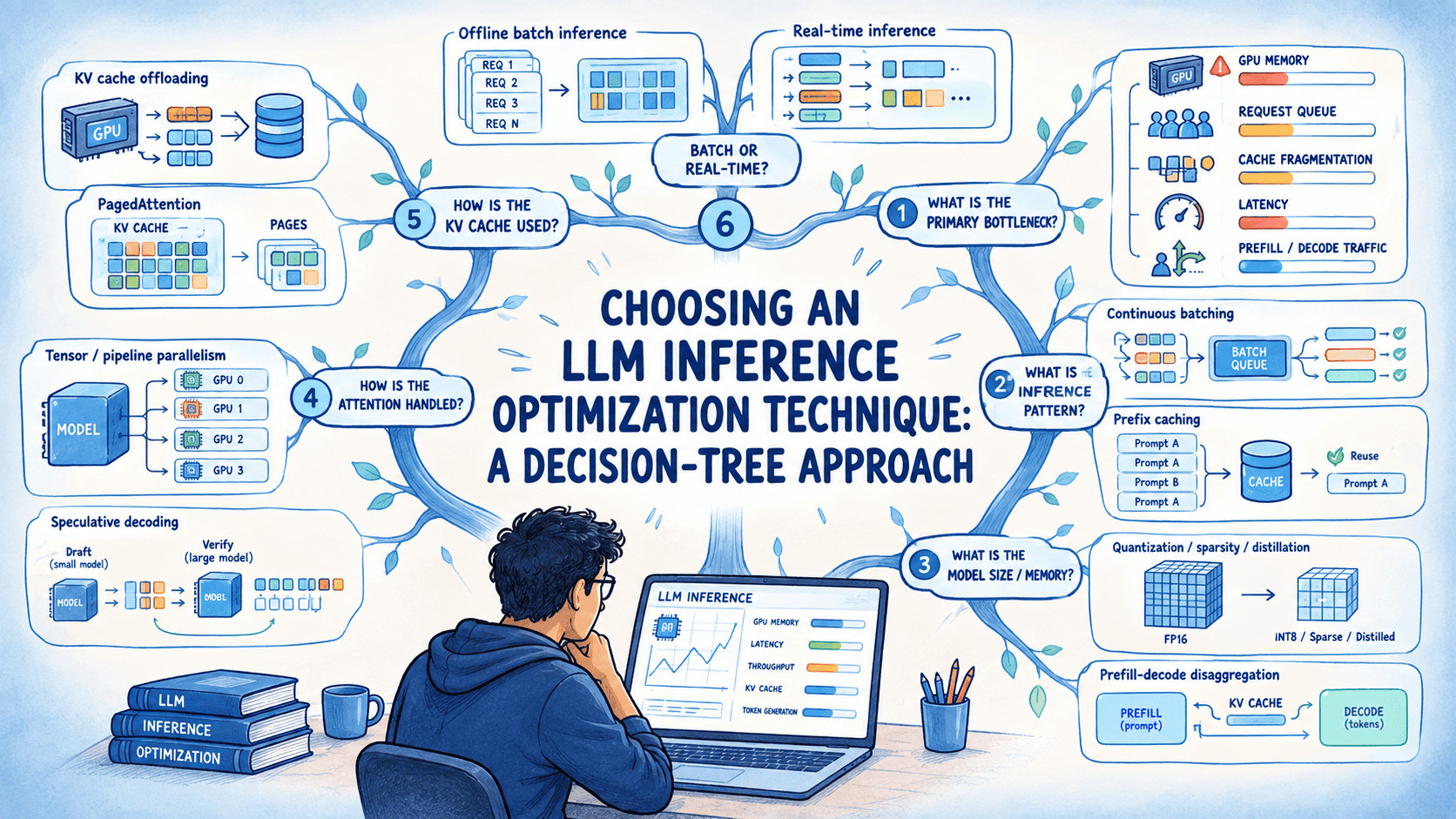
To determine the optimal intervention for a specific production deployment, engineers must navigate a structured, six-stage diagnostic sequence.
-
Model Footprint and Hardware Capacity Assessment
The primary evaluation asks whether the model fits comfortably within the target hardware’s memory while leaving adequate headroom for the KV cache. If a model barely fits into HBM, the system cannot maintain a functional batch size regardless of scheduling efficiency. Under such conditions, practitioners must implement model-level compression techniques, including post-training quantization (PTQ), weight-only quantization (e.g., INT4 or INT8 formats), structural sparsity, or knowledge distillation. These interventions reduce the memory footprint prior to runtime execution, though engineering teams must continuously audit outputs for degradation in task-specific accuracy. -
Prompt Structure and Redundancy Analysis
If hardware capacity is sufficient, the evaluation proceeds to examine traffic semantics. Applications heavily reliant on retrieval-augmented generation (RAG), conversational agents, or multi-turn chat interfaces frequently retransmit identical contextual blocks. When traffic features high semantic overlap in initial token sequences, prefix caching becomes the highest-leverage optimization. By maintaining the calculated KV cache for static prefixes in memory, the serving engine bypasses redundant matrix multiplications entirely. Maximizing this technique requires disciplined prompt engineering, specifically front-loading static system instructions and placing dynamic user variables at the termination of the prompt string. -
Traffic Concurrency and Length Variance
When prompts are unique, the focus shifts to traffic patterns and generation length variance. Production environments frequently mix brief classification requests with extensive code generation tasks. Without advanced scheduling, naive batching forces fast requests to idle while waiting for long generations to conclude. Continuous batching solves this by dynamically altering the batch composition at every generation step. Because most modern serving frameworks—such as vLLM, TensorRT-LLM, and TGI—enable continuous batching by default, systems engineers primarily need to verify configuration parameters rather than implement custom scheduling layers. -
KV Cache Memory Management and Fragmentation
Memory inefficiencies can manifest even when concurrency appears stable. If serving engines reserve rigid, maximum-length contiguous memory blocks for every incoming request, unutilized space accumulates as internal fragmentation. If telemetry indicates that memory allocation caps batch sizes prematurely, deploying PagedAttention or equivalent block-allocated memory management is essential. This technique maps non-contiguous physical memory blocks to virtual contiguous sequences, reclaiming wasted capacity and significantly expanding maximum concurrent user thresholds. -
Latency Sensitivity Versus Throughput Priorities
When memory constraints and batching dynamics are fully optimized, engineers must evaluate latency objectives. If the primary key performance indicator (KPI) is minimizing per-token latency for interactive, single-user streaming interfaces, speculative decoding offers a compelling pathway. This approach employs a lightweight auxiliary draft model to generate several prospective tokens concurrently, which the primary model then verifies in a single parallelized forward pass. If the draft model maintains a high acceptance rate, overall generation latency decreases. However, if the draft model’s predictions are frequently rejected, the verification overhead degrades overall performance, necessitating fallback to standard execution paths. -
Scale-Dependent Disaggregation Architecture
At enterprise scale, heavy prefill workloads can severely disrupt real-time token generation for concurrent users. When incoming requests feature exceptionally long input contexts that contend directly with active decode loops on the same accelerators, prefill-decode disaggregation becomes necessary. By partitioning the serving cluster into specialized prefill nodes and dedicated decode nodes, infrastructure teams can isolate computational burdens. Prefill nodes process incoming prompts and transmit the computed KV cache over high-speed interconnects to decode nodes. While this architecture introduces network serialization overhead and routing complexity, it remains indispensable for massive deployments maintaining strict service-level agreements (SLAs) for both time-to-first-token and inter-token latency.
Technical Implications and Operational Pitfalls
Deploying these optimizations incorrectly can introduce subtle performance regressions rather than improvements. Industry case studies highlight several recurring pitfalls in production environments:
- Zero Prefix Cache Hit Rates: Often caused by non-deterministic JSON serialization or dynamic timestamps embedded early in the prompt string. Engineers must enforce strict key ordering and front-load static content to secure cache utility.
- Quantization Discrepancies: Quantizing model weights while leaving activations at full precision can yield negligible throughput improvements if the hardware continuously executes expensive type-conversion operations during the compute cycle. Profiling memory versus compute bottlenecks prior to deployment prevents misallocated engineering effort.
- Premature Disaggregation: Implementing prefill-decode separation on small-scale workloads or cache-heavy environments typically increases end-to-end latency due to inter-node communication overhead. Disaggregation should strictly be reserved for deployments exceeding specific traffic volume thresholds where queue contention is empirically proven to harm SLAs.
Broader Industry Impact and Future Outlook
As foundational models continue to scale—accompanied by expanding context windows scaling from tens of thousands to millions of tokens—inference optimization has evolved from an ad-hoc engineering task into a core pillar of cloud-native AI architecture. The convergence of algorithmic compression, hardware-aware scheduling, and disaggregated cluster topologies is progressively lowering the total cost of ownership (TCO) for enterprise generative AI deployments.
Ultimately, mastering LLM inference is not a search for a single universal acceleration flag, but rather the disciplined alignment of software optimization strategies with the specific empirical bottlenecks of a given production workload. By applying rigorous decision-tree methodologies, engineering teams can maximize hardware utilization, control infrastructure expenditures, and deliver responsive, reliable AI experiences at scale.