









The metallurgical community has recently turned its attention toward A-421, a novel stainless steel developed by Carpenter Technology and spearheaded by researcher Dr. Robert Buck. As interest grows following features on platforms like BladeHQ and technical demonstrations by TKell Knives, the industry is evaluating whether this material represents a genuine leap forward in edge retention, toughness, and corrosion resistance compared to established market leaders like MagnaCut. While the steel is currently moving from technical development into potential commercial applications, its unique chemical composition—specifically the reliance on titanium-based carbides—marks a distinct departure from traditional vanadium-heavy alloy design.
Historical Development and Patent Chronology
The lineage of A-421 is rooted in decades of metallurgical research focused on grain boundary management and martensitic structures. The developmental timeline began as early as 1994, when Dr. Robert Buck patented a creep-resistant, precipitation-dispersion-strengthened martensitic stainless steel. This early work introduced the concept of utilizing titanium additions to create fine-grained structures.
By 2005, the foundational A-21 alloy was patented. Designed primarily as a "stainless carburizing steel," A-21 was intended to offer superior corrosion resistance over previous high-carbon stainless steels by eliminating the formation of large chromium carbides. In 2024, the patent portfolio expanded with the formal introduction of A-421, a refinement of the A-21 chemistry intended for through-hardened knife blades. Unlike its predecessor, which was designed for surface-carburized parts, A-421 is engineered to maintain structural integrity and hardness throughout the entire cross-section of a blade, allowing for repeated sharpening without degradation of the core properties.

Metallurgical Composition and the Titanium Factor
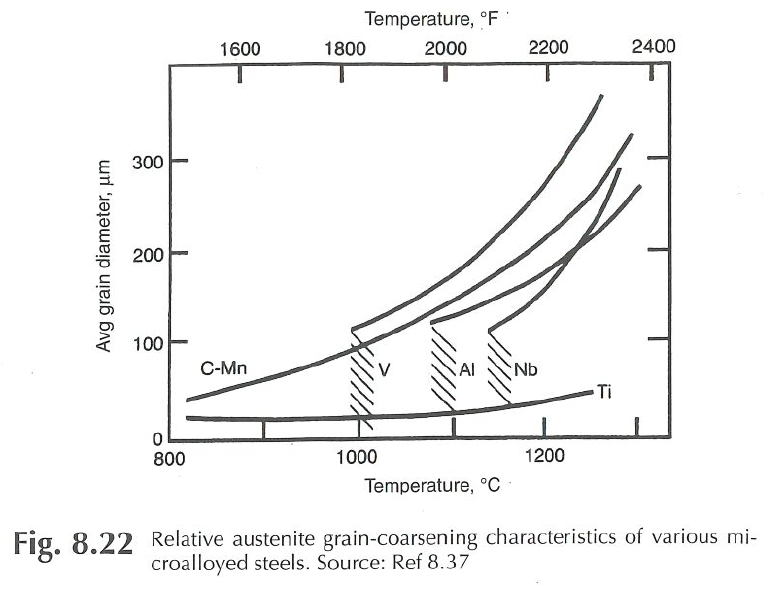
The primary differentiator in the A-421 alloy is the strategic use of titanium. In standard modern knife steels, vanadium and niobium are the preferred microalloying elements used to form hard, wear-resistant carbides. However, A-421 utilizes titanium to form titanium carbide (TiC).
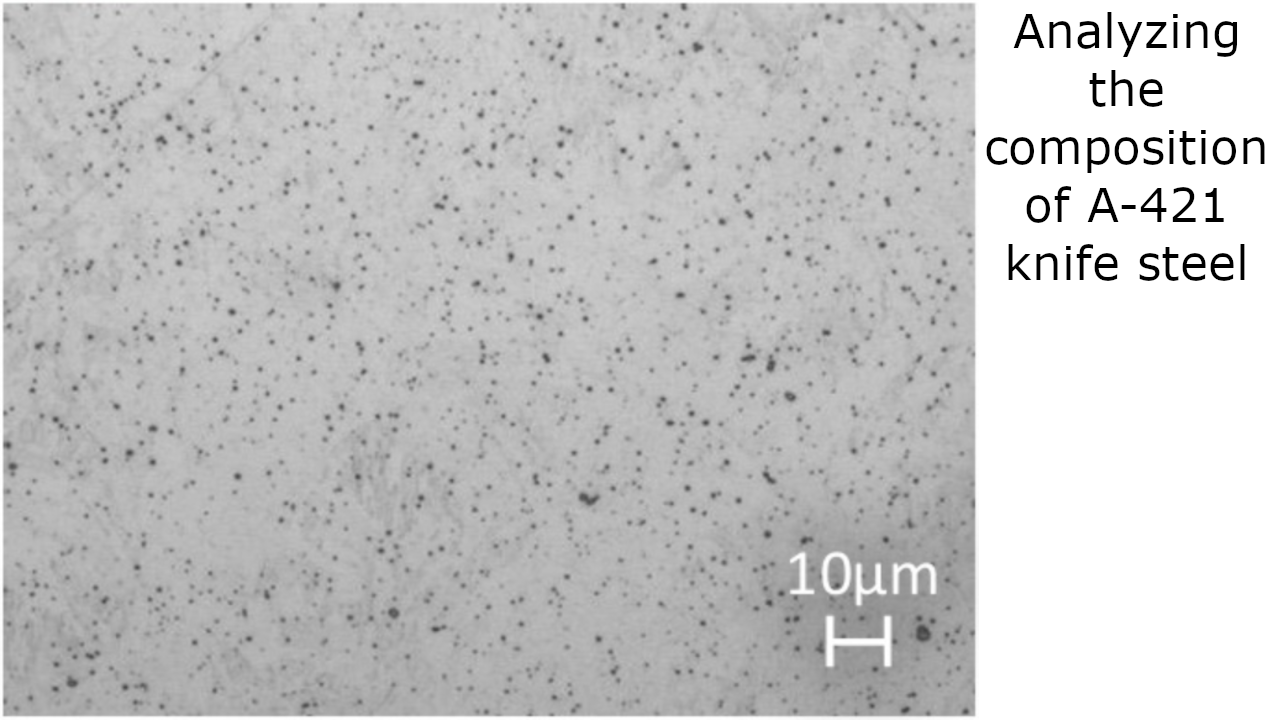
Titanium carbide is exceptionally hard, often exceeding the hardness of niobium carbide. According to internal technical data, the TiC particles in A-421 act as "pinning" agents for grain boundaries. By maintaining a dispersion of these fine, stable carbides, the steel resists grain growth even during high-temperature processing. This allows for a refined, fine-grained martensitic matrix that is critical for toughness.

The chemical composition of A-421 centers on a chromium target of approximately 10.75% to 11%. By keeping chromium levels at this threshold and avoiding the large chromium carbides found in older stainless steels, the alloy achieves a higher degree of "true" stainless performance. Furthermore, the inclusion of molybdenum and controlled micro-additions of vanadium and niobium suggests a complex, balanced approach to secondary hardening. Unlike older carburizing grades—such as Pyrowear 675 or CX13VDW—which relied heavily on vanadium, the titanium-centric approach of A-421 aims to maximize corrosion resistance without sacrificing the hardness required for premium cutlery.
Performance Analysis: Corrosion and Hardness
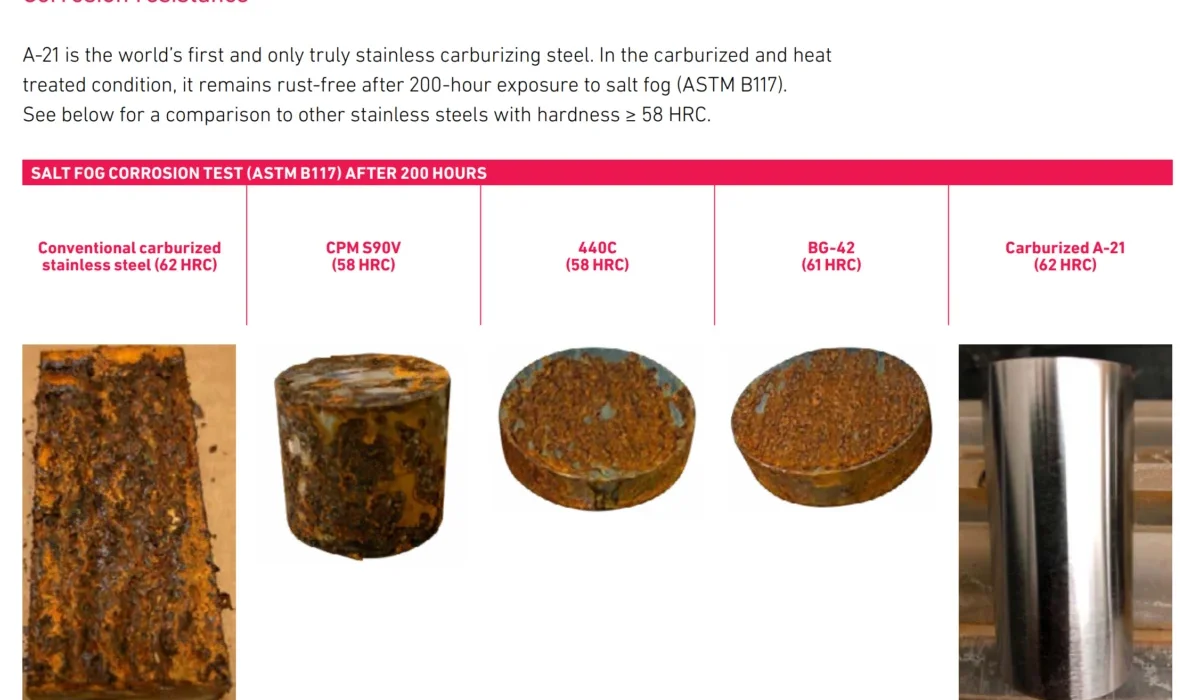
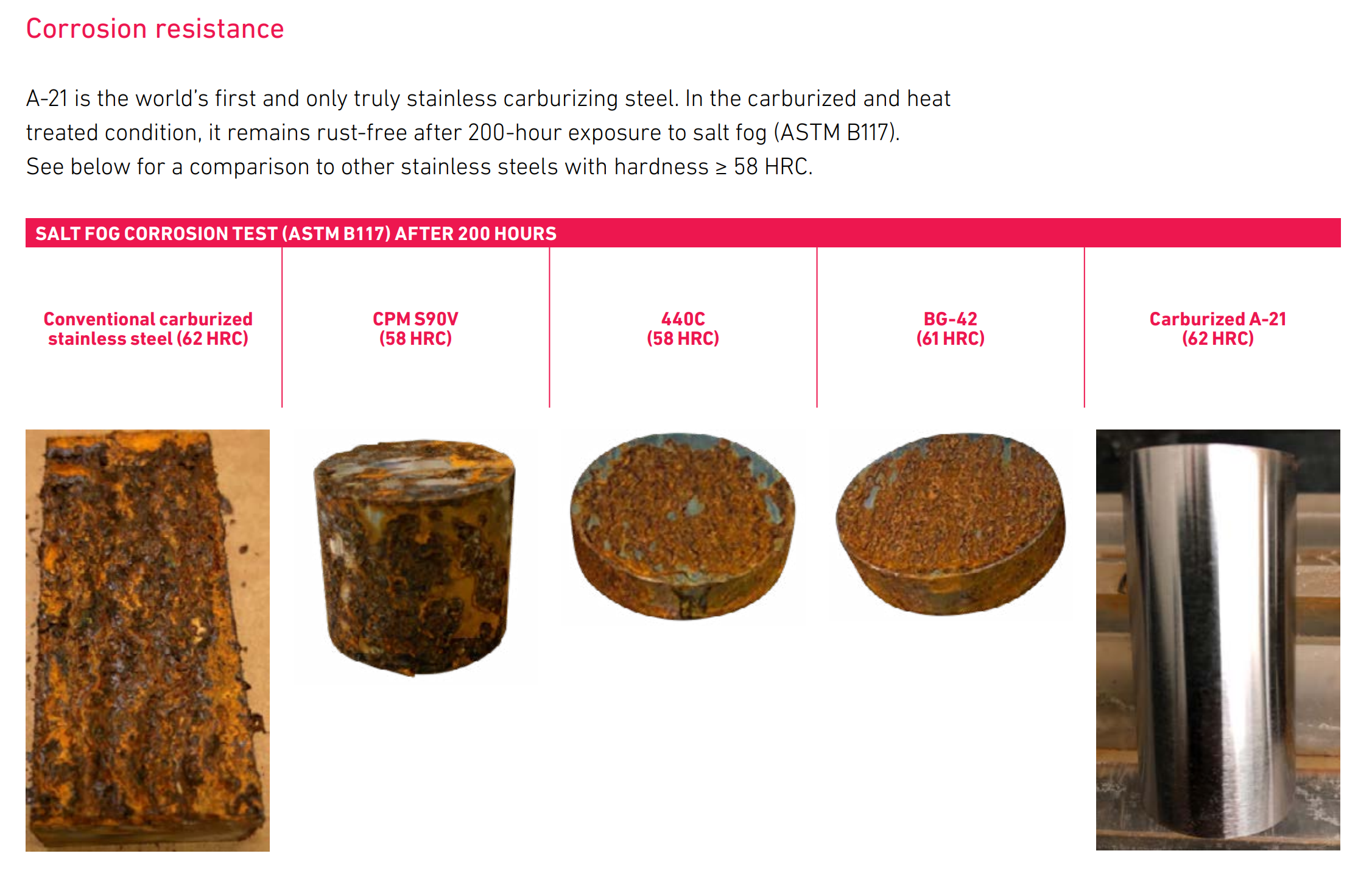
The primary appeal of A-421 lies in its purported corrosion resistance. Data provided by the developer shows that A-421 maintains a significant advantage over conventional high-carbon stainless steels in standardized corrosion testing. While comparisons to high-nitrogen steels like LC200N are currently limited, the current data suggests that A-421 occupies a middle ground: it provides the corrosion resistance of high-end stainless grades with a hardness potential exceeding 60 HRC.
However, the trade-off remains the overall volume of carbides. Thermodynamic modeling suggests that A-421 contains roughly 0.8% MC (metal carbide) volume fraction. For context, this is significantly lower than CPM-MagnaCut, which typically features approximately 8% MC volume fraction. Consequently, while the TiC particles provide sufficient hardness for edge stability, the low total carbide volume suggests that A-421 may not match the extreme wear resistance found in modern powder metallurgy (PM) steels designed for long-term edge retention. Instead, the steel is expected to behave similarly to AEB-L or 14C28N, offering a high-toughness, high-corrosion-resistance profile with moderate wear resistance.
Manufacturing Challenges: The Fine-Blanking Question
A critical factor for the widespread adoption of A-421 in the knife industry is its manufacturing viability, specifically regarding "fine-blanking." Fine-blanking is a high-precision, high-volume process essential for keeping production costs low for consumer-grade knives. For a steel to be successfully fine-blanked, it generally requires a relatively low annealed hardness.
Current reports indicate that A-421 possesses an annealed hardness in the range of 30 HRC, with lab-controlled samples reaching as low as 25 HRC. Industry standards for easily blankable steels, such as 420HC, often target significantly lower hardness levels (equivalent to 180-200 BHN). There is a growing consensus among metallurgical analysts that 30 HRC may be too high for standard fine-blanking equipment to process without excessive tool wear or premature cracking of the blanks. Unless the annealing processes are further optimized, A-421 may be restricted to more expensive manufacturing methods, such as waterjet or laser cutting, which could limit its use to mid-to-high-end custom and production knife lines.
Industry Implications and Future Outlook
The introduction of A-421 reflects a broader trend in the metallurgy industry: the move away from brute-force alloy content toward precision micro-alloying. By controlling the kinetics of titanium carbide formation, the developers have created a material that challenges the status quo of stainless steel design.

For the end-user, the implications are two-fold. First, A-421 offers a compelling alternative for environments where corrosion resistance is the primary requirement, such as marine or culinary applications, without the brittleness associated with older, high-chromium alloys. Second, the ability to achieve 62 HRC while maintaining a fine-grained structure offers a unique performance profile that could benefit thin-ground blades where edge stability is paramount.
However, the transition from patent to production is rarely seamless. The steel must now prove its performance in independent, long-term testing. While the "outstanding edge retention" mentioned in early promotional materials is promising, the scientific community remains cautious until direct CATRA (Cutlery and Allied Trades Research Association) testing data is released against industry benchmarks like MagnaCut, S35VN, and 14C28N.
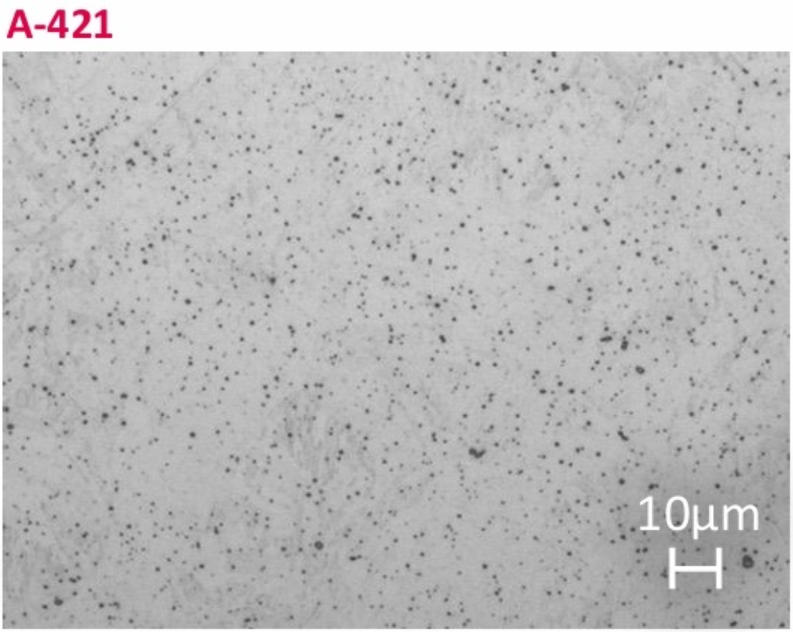
Furthermore, the shift from the initially proposed "sheet-carburizing" method to a conventional melt-addition process for carbon demonstrates the iterative nature of this steel’s development. Dr. Robert Buck’s assertion that careful processing can keep titanium carbide sizes in check is the lynchpin of the project. If these carbides can be kept consistently within the 1-4 micron range, A-421 could secure a niche as a premium, high-toughness, corrosion-resistant steel that bridges the gap between basic stainless cutlery and the high-alloyed PM steels that currently dominate the market.
As the industry waits for the first major production runs of A-421, the focus will remain on the interplay between the material’s refined grain structure and its real-world wear resistance. If the steel can deliver on its promise of high-hardness, high-toughness, and industry-leading corrosion resistance, it may well become a staple for manufacturers seeking to differentiate their offerings in an increasingly competitive cutlery market. The technical success of A-421 will ultimately be measured not just by its composition, but by its reliability under the stress of daily use and the efficiency with which it can be integrated into modern manufacturing workflows.