The landscape of robotic control has been fundamentally altered by the emergence of Vision-Language-Action (VLA) models, which bridge the gap between high-level human instructions and low-level robotic execution. However, the sheer scale of these models—often comprising billions of parameters—has traditionally relegated fine-tuning and experimentation to elite research institutions with massive compute clusters. A new technical workflow demonstrates that OpenVLA, a state-of-the-art 7-billion-parameter model, can be effectively fine-tuned using Low-Rank Adaptation (LoRA) on accessible cloud hardware like Google Colab. This methodology provides a reproducible, inspectable path for researchers to validate training pipelines before committing to large-scale robotic deployments.

The Architecture of OpenVLA and the Challenge of Scale
OpenVLA was introduced in June 2024 as an open-source, high-performance VLA model. It was pre-trained on the Open X-Embodiment dataset, a massive collection of 970,000 real-world robot demonstrations spanning diverse tasks and hardware configurations. The model is built upon the Prismatic Vision-Language Model framework, utilizing a Llama-2 7B backbone and a SigLIP vision encoder.
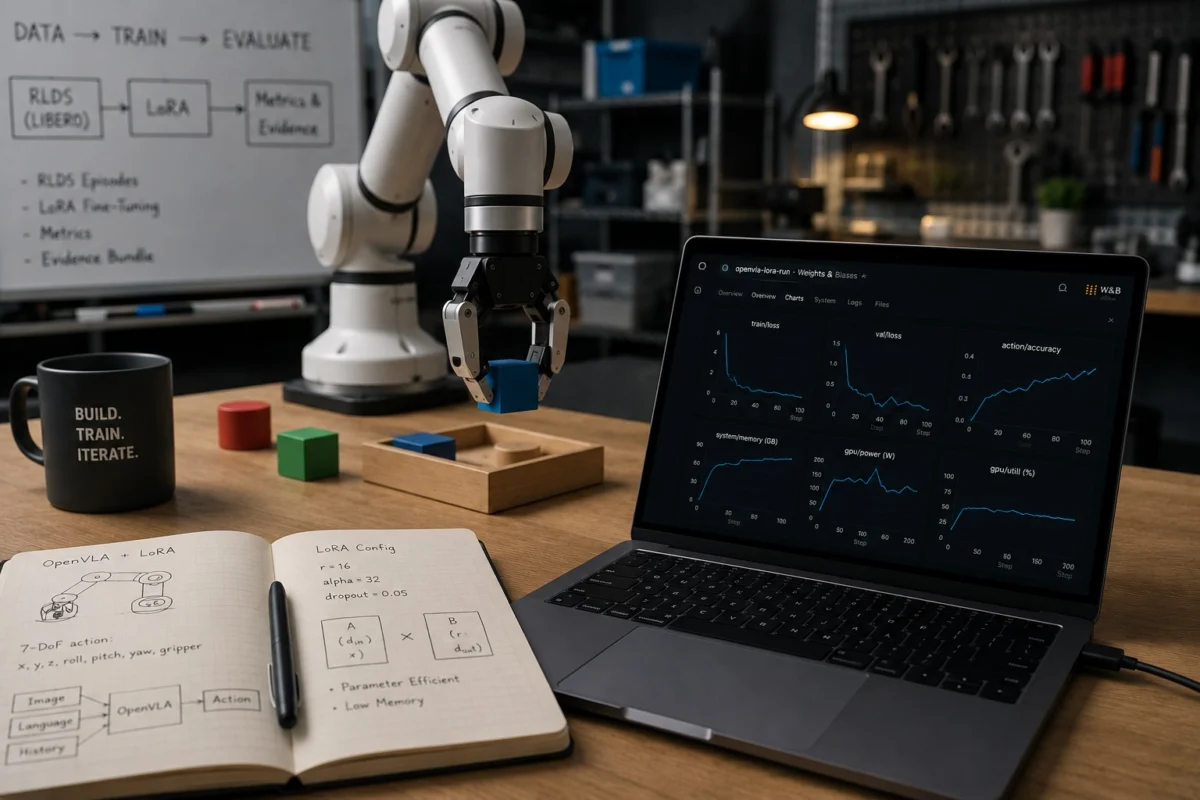
In a standard workflow, OpenVLA receives two primary inputs: a visual feed from the robot’s workspace and a natural-language instruction, such as “pick up the red block.” The model processes these inputs to predict the next discrete action the robot should take. These actions are represented as "tokens" within the model’s vocabulary, which are then decoded into normalized seven-degree-of-freedom (7-DoF) commands. These commands encompass the Cartesian coordinates (x, y, z), the orientation (roll, pitch, yaw), and the state of the gripper.

The primary barrier to entry for OpenVLA has been its 7-billion-parameter size. Full fine-tuning—the process of updating every weight in the model—requires significant Video Random Access Memory (VRAM), often exceeding the capacity of a single high-end GPU. This creates a "fragility" in experimental workflows where researchers may spend thousands of dollars on compute only to find that their dataset was improperly formatted or their hyperparameters were misaligned.
Low-Rank Adaptation: A Solution for Parameter Efficiency
To address the computational overhead, the documented workflow utilizes Low-Rank Adaptation (LoRA). This technique falls under the category of Parameter-Efficient Fine-Tuning (PEFT). Instead of modifying the entire weight matrix of the 7B model, LoRA freezes the original weights and injects trainable low-rank matrices into the transformer layers.

During the training process, only these small adapter weights are updated. According to the original OpenVLA research team, LoRA can match the performance of full fine-tuning while training as little as 1.4% of the total parameters. This reduction in trainable parameters leads to several critical advantages:
- Reduced VRAM Usage: It allows the model to be trained on a single NVIDIA A100 GPU (40GB or 80GB variants), which is available through Google Colab’s High-RAM tier.
- Smaller Checkpoints: Instead of saving a new 15GB model for every iteration, researchers only need to store the LoRA adapters, which are typically only a few hundred megabytes.
- Faster Iteration: The reduced memory footprint allows for larger batch sizes or faster gradient updates, shortening the feedback loop for experimental verification.
Chronology of the Reproducible Fine-Tuning Workflow
The experiment follows a strict chronological path designed for maximum transparency and verification. The process begins with the setup of a Google Colab environment using an A100 GPU. Because OpenVLA relies on specific, often older versions of machine learning libraries, the workflow utilizes two distinct Python virtual environments. One environment is dedicated to the training script to maintain dependency stability, while a second environment handles the synchronization of data to Weights & Biases (W&B), a popular experiment-tracking platform.

Once the environment is staged, the LIBERO (Lifelong Robot Learning) dataset is integrated. Specifically, the libero_spatial_no_noops split is used. This dataset is stored in the Robot Learning Dataset Standard (RLDS) format, which is the industry standard for organizing robotic demonstrations into episodes and timesteps. The "no_noops" designation is crucial; it filters out frames where the robot is stationary, ensuring the model learns from active movement rather than idle states.
The training command is then executed using torchrun. For a 100-step "smoke test," the hyperparameters are set conservatively: a LoRA rank of 32, a learning rate of 0.0005, and a physical batch size of 2. To ensure the model receives a stable learning signal, gradient accumulation is set to 8, resulting in an effective batch size of 16. This configuration allows the training to proceed on the A100 without triggering out-of-memory (OOM) errors while still simulating the dynamics of a larger training run.

Data Analysis and Verification of Results
The 100-step run serves as an integration validation. While 100 steps are insufficient to create a production-ready robot policy, they provide a wealth of data to confirm the pipeline’s integrity. Three primary metrics are monitored:
- Train Loss: This measures the cross-entropy error between the model’s predicted action tokens and the ground truth tokens from the LIBERO dataset. In the demonstrated run, the loss dropped sharply from 11 to approximately 3.4 within the first few steps, indicating that the LoRA adapters were successfully capturing the patterns of the task family.
- L1 Loss: This represents the mean absolute error of the continuous action values. A decrease in L1 loss (from 0.46 down to 0.22 in this instance) suggests that the decoded robot commands are becoming more aligned with human demonstrations.
- Action Accuracy: This metric tracks how often the model predicts the exact correct token. The run showed an improvement from 9% to nearly 28%, a significant delta for such a short duration.
Furthermore, system telemetry captured via W&B confirmed that the GPU was performing sustained work. The A100 operated at a power draw of 165 to 195 watts with a 40% utilization rate. This evidence is vital for "proof of work," ensuring that the notebook didn’t simply finish a script without actually performing the underlying tensor computations.

Addressing the Embodiment Shift
The broader necessity for this fine-tuning approach stems from what roboticists call "embodiment shift." While OpenVLA is powerful out of the box, its performance can degrade when introduced to a new environment. This shift occurs when there is a change in the robot’s physical body, such as a different gripper type, or a change in its sensors, such as a new camera angle or lighting condition.
Fine-tuning allows the model to adapt its pre-trained knowledge to these new variables. For example, if a robot is moved from a laboratory setting with overhead lighting to a factory floor with side-mounted cameras, a small LoRA fine-tune on a few dozen demonstrations in the new environment can recalibrate the model’s spatial understanding. The Colab-based workflow proves that this recalibration does not require a massive server farm, democratizing the ability to deploy VLAs in specialized settings.

Broader Impact and Implications for the Industry
The ability to run verifiable, small-scale tests on OpenVLA has significant implications for both academia and the robotics industry. In the past, the lack of a "middle ground" between simple simulations and full-scale deployments led to high failure rates in robotics projects. By providing a "compact baseline" that is reproducible and inspectable, this methodology introduces a new standard for transparency in AI research.
Industry analysts suggest that the democratization of VLA fine-tuning will accelerate the adoption of "generalist" robots in small and medium-sized enterprises (SMEs). When the cost and complexity of training a robot for a specific task decrease, the return on investment for automation becomes much more attractive. Moreover, the use of RLDS and W&B as an "audit trail" allows teams to collaborate more effectively, sharing not just the final model weights, but the entire history of how the model was derived.

Ultimately, the lesson of the OpenVLA LoRA experiment is one of methodological rigor. Before asking whether a fine-tuned robot model is "good" or "intelligent," researchers must first prove that the training run is real, measurable, and reproducible. This small-scale Colab workflow provides the foundation for that proof, ensuring that the next generation of robotic control is built on a verifiable and honest foundation. As the field moves toward more complex multi-modal models, these small, inspectable paths will be the essential building blocks for safe and reliable autonomous systems.