
Google has officially confirmed the long-awaited pre-order launch date for its next-generation laptop category, the Googlebook, setting the stage for a major shift in the personal computing landscape. Following an initial unveiling in May 2026, the tech giant has updated its official portal to signal that customers across the United States will be able to secure their devices starting September 21, 2026. This launch represents a strategic evolution for Google, moving beyond the traditional Chromebook model to embrace a new architecture defined by deep integration with Gemini Intelligence.
The announcement, which appeared as a promotional update on the official Googlebooks website, provides a definitive timeline for consumers while leaving several strategic details regarding manufacturing partners and specific product tiers for a forthcoming event. With a high-profile, in-person presentation scheduled for September 15 in New York City, the company is positioning itself to define the intersection of AI-native hardware and high-performance mobile computing.
A Chronology of the Googlebook Initiative
The road to the Googlebook began long before the May 2026 reveal. Industry analysts have noted that Google’s move to differentiate its hardware ecosystem has been in development for several years, following a period where the traditional Chromebook market faced increasing pressure from both Windows-based ultraportables and the rising efficiency of ARM-based hardware.
- Early 2025: Initial rumors surfaced regarding a "premium" Chrome-based project designed to compete directly with high-end ultrabooks by leveraging localized AI processing.
- May 2026: Google officially introduced the "Googlebook" category during its spring hardware showcase, emphasizing that these machines would not simply be "Chromebooks with AI," but rather hardware engineered from the ground up to support the Gemini large language model (LLM).
- Summer 2026: Leaks originating from the Chromium source code and hardware supply chain began to detail a wide variety of chassis designs, suggesting that the platform would be adopted by major OEMs rather than being a single-device experiment.
- September 15, 2026: An exclusive New York City event is set to provide the definitive specifications, pricing tiers, and a live demonstration of software features.
- September 21, 2026: The official start date for pre-orders in the United States market.
Hardware Partnerships and Technical Specifications
The success of the Googlebook platform relies heavily on the ecosystem of partners that have defined the success of the Chromebook over the last decade. Google has confirmed that the launch will be supported by a robust lineup of industry leaders, specifically naming Acer, ASUS, Dell, HP, and Lenovo. These manufacturers, having already mastered the thermal and structural demands of thin-and-light laptops, are expected to translate that expertise into the new Googlebook standard.
Technical specifications remain a subject of intense industry scrutiny. Based on recent documentation and hardware leaks, the Googlebook category will not be restricted to a single internal architecture. Instead, it appears that the platform will offer a diverse range of configurations. Early reports indicate that users can expect models powered by the latest generation of Intel processors, specifically those with integrated Neural Processing Units (NPUs) optimized for AI tasks. Furthermore, there is significant evidence suggesting a push into the Qualcomm Snapdragon platform, aligning with a broader industry trend toward high-efficiency, long-battery-life ARM-based Windows and Chrome devices.
The inclusion of substantial RAM allocations—likely starting at 16GB for base models—suggests that these devices are intended to handle the local processing demands of Gemini Intelligence without relying exclusively on cloud-based computation. This hybrid approach to AI is considered vital for maintaining performance parity with high-end workstations.

The Gemini Intelligence Advantage
The core differentiator of the Googlebook is its foundational reliance on Gemini Intelligence. Unlike standard laptops that treat AI as an add-on application, the Googlebook is designed to integrate Gemini into the operating system kernel. This means that system-level commands, file management, and even hardware-level power distribution could be managed or optimized by the AI model in real time.
One of the most anticipated features is the "Magic Pointer." While specific functional details remain under wraps, industry insiders believe this tool will utilize advanced computer vision and predictive intent models to assist users in navigation, interface interaction, and automated workflow completion. By leveraging the low-latency processing capabilities of the onboard NPUs, the Magic Pointer is expected to offer a level of precision that standard cursor software cannot achieve.
Furthermore, deep integration with Android smartphones is a key pillar of the Googlebook strategy. The anticipated "Phone-Link 2.0" functionality is expected to allow for seamless transition of tasks, shared clipboard history, and instant cross-device AI context-sharing. If successful, this could create a walled garden experience that challenges the continuity features currently offered by Apple’s macOS and iOS ecosystem.
Market Implications and Competitive Positioning
The launch of the Googlebook represents a calculated move to capture a premium segment of the laptop market that has historically eluded the Chromebook brand. By introducing a new category, Google is effectively distancing its high-end AI devices from the "budget-friendly" stigma that has long characterized its educational and entry-level laptop offerings.
From a macroeconomic perspective, this move signals that Google is no longer content to let third-party OEMs dictate the user experience. By setting strict hardware requirements—such as minimum NPU performance and memory benchmarks—Google is ensuring that the "Googlebook" branding carries a guarantee of quality and performance consistency.
Analysts at major financial institutions have pointed out that this strategy places Google in direct competition with Microsoft’s "Copilot+ PC" initiative. While Microsoft has taken a software-first approach to integrating AI into the Windows ecosystem, Google’s strategy is vertical, controlling the hardware certification, the operating system, and the primary AI engine. This level of control is necessary to compete with Apple’s M-series silicon integration, which currently sets the industry standard for performance-per-watt.
Economic Analysis of the Launch
The decision to limit the initial pre-order phase to the United States suggests a phased rollout strategy designed to manage supply chain logistics and monitor initial user feedback before a global expansion. By launching on September 21, Google positions itself strategically ahead of the critical Q4 holiday shopping season, a period where consumer electronics spending traditionally reaches its peak.
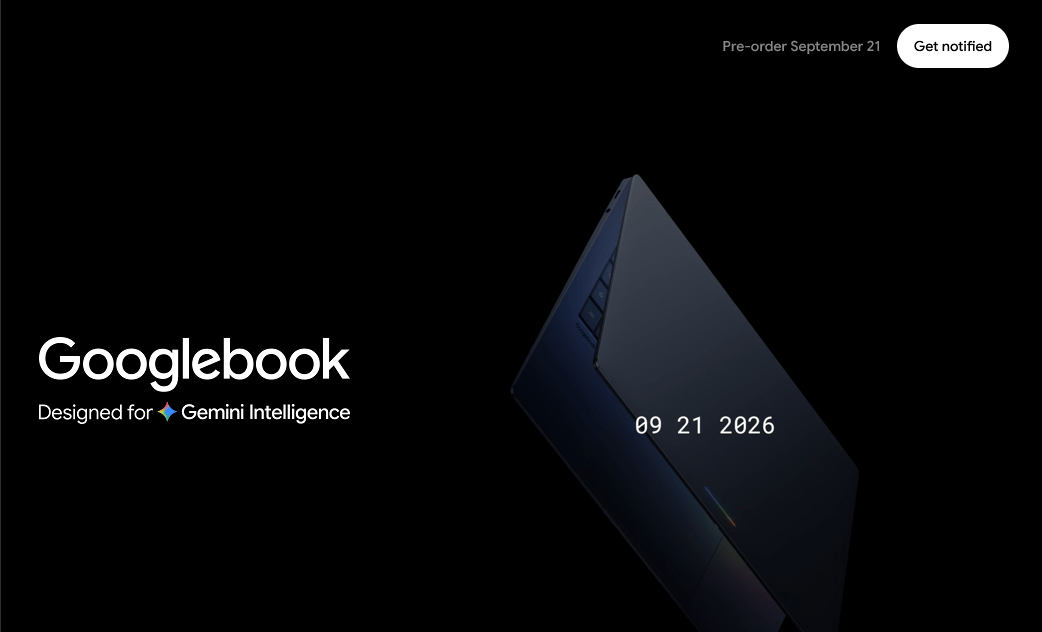
Pricing remains the most significant unknown. If Google aims to capture the premium market, it must ensure that the price-to-performance ratio justifies a transition from existing high-end ultrabooks. Current estimates suggest a tiered pricing structure:
- Essential Tier ($799–$999): Focused on students and professional office users, likely featuring Snapdragon or mid-range Intel processors.
- Professional Tier ($1,299–$1,599): Aimed at creative professionals and developers, requiring higher RAM and robust thermal management.
- Elite Tier ($1,999+): The flagship category, likely featuring premium materials and top-of-the-line processor configurations.
Future Outlook and Upcoming Announcements
As the tech industry turns its attention to the September 15 event in New York, the primary focus will be on the "Chromium platform" developments that have been tracked throughout the summer. These developments hint at a modular approach to software updates, where AI features can be pushed to the hardware independently of the OS version.
Google’s spokesperson noted that the upcoming presentation would not only cover hardware but would also introduce a new developer SDK for the Googlebook. This will allow third-party software developers to tap into the Gemini integration, potentially opening up a new marketplace of AI-first applications designed specifically for this hardware category.
The introduction of the Googlebook is more than a product release; it is an infrastructure play. As the computing world shifts toward localized generative AI, Google is positioning its hardware to be the primary vessel for that technology. Whether the consumer market is ready to embrace this new, AI-centric paradigm of personal computing will be the defining question of the final quarter of 2026. For now, the hardware manufacturers, developers, and consumers wait for the September 15 disclosure to see if the reality of the Googlebook can match the ambitious vision presented by the company.
As the September 21 pre-order date approaches, the industry expectation is that Google will leverage its dominant search and AI presence to drive high adoption rates, signaling to the market that the era of the "smart" laptop has officially arrived. With the backing of the biggest names in the laptop manufacturing sector, the Googlebook is poised to become the most significant disruption in the PC market in over a decade.