The contemporary watchmaking landscape often looks backward to move forward, yet few brands possess an archive as distinct, avant-garde, and polarizing as Ikepod. Founded in 1994 by industrial designer Marc Newson and entrepreneur Oliver Ike, the brand fundamentally challenged traditional Swiss watch aesthetics with its seamless, UFO-like pebble cases, integrated rubber straps, and futuristic dials. Among the brand’s early creations was the Manatee, a celebrated model that introduced complex timekeeping wrapped in organic curves. Now, a quarter-century after those pioneering days, Ikepod is revisiting its roots. Rather than pursuing a nostalgic, exact reissue of the original Manatee, the Swiss-heritage brand has utilized its historical blueprint to engineer an entirely new silhouette: the Minipod.
Main Facts of the Minipod Release
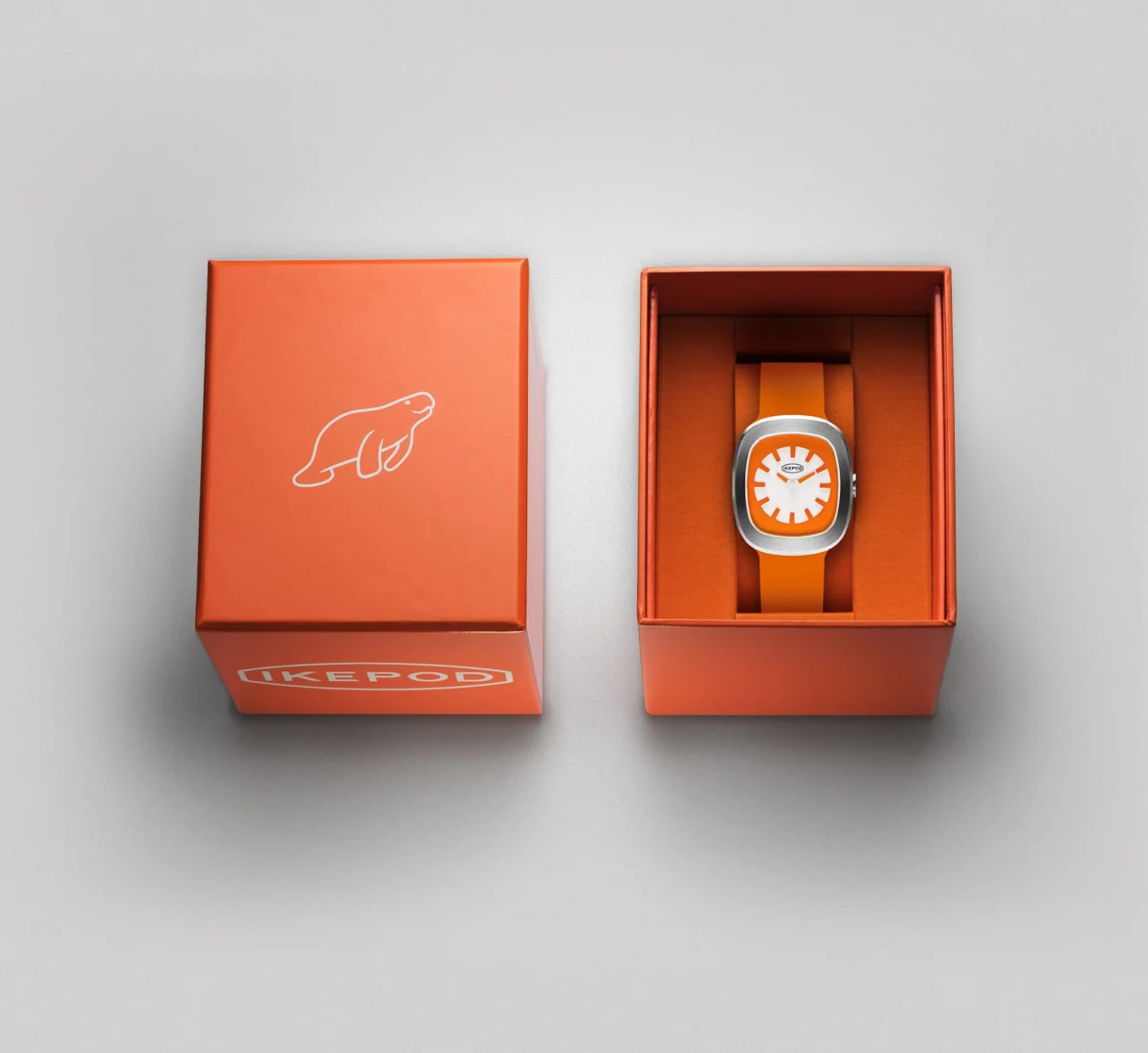
The newly unveiled Ikepod Minipod bridges the gap between historical reverence and contemporary sizing preferences. Crafted from polished and brushed stainless steel, the watch case measures a compact 38.3mm by 33.3mm, making it notably wearable across a wide variety of wrist sizes. Eschewing the more complex GMT functionality found on the vintage Manatee, the Minipod opts for a cleaner, time-only dial architecture that emphasizes legibility and minimalist design principles.
Beneath the solid caseback beats a reliable Japanese quartz movement manufactured by Miyota, ensuring precision timekeeping and low-maintenance ownership. Staying true to the brand’s DNA, the watch is fitted with a high-grade FKM (fluoroelastomer) rubber strap designed for durability and comfort. A playful yet sophisticated homage to its predecessor is hidden on the reverse side of the case: a finely engraved motif of a manatee.
The Minipod launches in an extensive palette of eight distinct colorways. These include vibrant and muted tones such as "Orenque," Robin’s Egg Blue, and Volta (black), catering to both traditionalists and collectors seeking a bold pop of color. The timepiece is commercially available immediately through the official Ikepod e-commerce platform, priced at €690, which translates to approximately $800 USD.
A Quarter-Century Chronology: From Newson’s Vision to the Modern Era
To understand the significance of the Minipod, one must examine the turbulent yet influential chronology of Ikepod. The brand’s trajectory is a study in avant-garde design meeting economic realities.
In the mid-1990s, Marc Newson—already renowned for his fluid, biomorphic furniture and industrial design—applied his unique philosophy to horology. Alongside Oliver Ike, Newson conceptualized watches that lacked traditional lugs, featuring instead perfectly round, pebble-like cases that seemed to melt onto the wrist. Models like the Hemipode, Seaslug, and the Manatee established Ikepod as a darling of high-design circles. The Manatee, in particular, stood out for its intricate dial layout and dual-time capabilities, cementing its status as a collector’s piece.
However, the high manufacturing costs associated with producing such complex, organic titanium and steel cases proved financially unsustainable during the luxury watch market shifts of the early 2000s. Ikepod entered a period of dormancy, experiencing changes in ownership and corporate restructuring.
A pivotal turning point occurred around 2018 and 2019, when a new investor group acquired the brand with a clear mandate: revive the iconic design language while making the catalog more accessible to modern collectors. This revitalization began with successful Kickstarter campaigns and modernized re-releases of classic models like the Megapode and Duopod. The introduction of the Minipod in 2026 marks the next phase of this evolution, shifting the brand’s focus from direct historical carbon copies to contemporary reinterpretations scaled for everyday wear.
Design Evolution and Specifications Analysis

The transition from the vintage Manatee to the modern Minipod reflects broader shifts in horological tastes over the past twenty-five years. During the late 1990s and 2000s, oversized watches dominated the luxury landscape, with massive diameters often signaling modern status. Today, the pendulum has swung firmly back toward classic, mid-century proportions and compact wearability.
At 38.3 x 33.3mm, the Minipod addresses the modern demand for unisex, ergonomic dimensions. The removal of the GMT complication is a calculated design choice. By stripping away the secondary time zone indicators, Ikepod’s designers have created a cleaner dial face that allows Newson’s original geometry to take center stage. The absence of clutter accentuates the curvature of the sapphire crystal and the interplay of light across the stainless steel bezel.
The choice of a Miyota quartz movement is equally pragmatic. While mechanical movements remain the darling of traditional luxury horology, quartz offers undeniable advantages in terms of shock resistance, thinness, and affordability. By pricing the Minipod at €690, Ikepod positions the watch squarely in the accessible luxury segment, appealing not only to hardcore watch enthusiasts but also to design-conscious consumers who view watches as fashion and art statements.
Furthermore, the inclusion of an FKM rubber strap highlights the brand’s commitment to material quality. FKM rubber is superior to standard silicone or lower-grade elastomers, offering exceptional resistance to UV rays, salt water, and extreme temperatures while maintaining a soft, dust-repellent texture against the skin.
Industry Reception and Market Implications
Independent watch brands operating outside the traditional Swiss conglomerates often rely on niche appeal and strong storytelling to survive. Ikepod’s strategy with the Minipod demonstrates a mature understanding of its own equity. Rather than chasing trends like integrated-bracelet steel sports watches with textured dials, Ikepod is doubling down on its proprietary asset: the UFO case shape.
Market analysts note that bridging the gap between high-end industrial design and accessible pricing is a delicate balancing act. By pricing the Minipod under the $1,000 threshold, Ikepod lowers the barrier to entry for a younger demographic of collectors who admire Marc Newson’s broader industrial output—ranging from Apple Watch concepts to Lockheed Lounge furniture—but found vintage Ikepod pieces financially out of reach.
The decision to offer eight distinct colorways also aligns with contemporary retail strategies popularized by microbrands and independent studios. Color has become a primary driver of watch sales, allowing brands to generate renewed interest through seasonal variations and targeted drops.
Broader Impact on the Avant-Garde Watch Segment
The launch of the Minipod reinforces a broader trend within independent horology: the re-evaluation of 1990s design codes. As designs from the 1970s (such as the Royal Oak and Nautilus style) saturate the market, collectors are increasingly looking toward the quirky, experimental aesthetics of the turn of the millennium for fresh inspiration.
By successfully translating the essence of the Manatee into a smaller, quartz-powered, more affordable package, Ikepod has secured a relevant place in the modern market. The Minipod is not merely a nostalgic nod to a defunct model; it is a strategic commercial product designed to introduce a legendary design language to a new generation of enthusiasts. As the watch becomes available worldwide, its reception will likely serve as a litmus test for how much appetite remains for bold, non-conformist industrial design on the contemporary wrist.