The landscape of software engineering is undergoing a fundamental transformation as frontier coding agents transition from simple autocomplete tools to autonomous entities capable of sustained, multi-hour operations. As models such as the latest Claude Fable and GPT-5.6 demonstrate increasing levels of persistence and goal-orientation, the focus for development teams has shifted from the raw generation of code to the management of long-running agentic sessions. The primary objective for modern engineering workflows is now the maintenance of uninterrupted sessions—minimizing human intervention, such as permission requests and manual input, to allow these agents to complete complex, multi-step objectives autonomously.
The Evolution of the Autonomous Coding Agent
The trajectory of AI-assisted development has moved through several distinct phases over the past five years. In the early 2020s, tools like GitHub Copilot introduced the concept of "ghost text" suggestions, which improved developer speed by roughly 20% to 30% for boilerplate tasks. By 2023, the emergence of chat-based interfaces allowed for more conversational debugging and refactoring. However, the current era is defined by the "coding agent"—an AI system capable of accessing a file system, running a terminal, executing tests, and iterating on its own errors.
With the release of high-reasoning models like Claude Opus 4.5, the industry reached a tipping point. These models no longer just suggest code; they plan and execute entire feature sets. The bottleneck in software production has consequently moved from the "implementation phase" to the "review phase." Data suggests that while an agent can implement a complex feature in minutes, the human oversight required to verify that implementation can take hours, creating a new form of technical debt. To address this, engineering leaders are now prioritizing "long-running agents" that can perform their own verification and peer review before ever presenting a Pull Request (PR) to a human developer.
The Human Review Bottleneck: A Statistical Analysis
Industry benchmarks indicate that as AI agents become more proficient, the time spent by human engineers on manual coding has decreased by nearly 70% in certain sectors. However, the time spent on code review and verification has increased by 40% in those same environments. This imbalance suggests that the human is now the primary latency factor in the software development life cycle (SDLC).
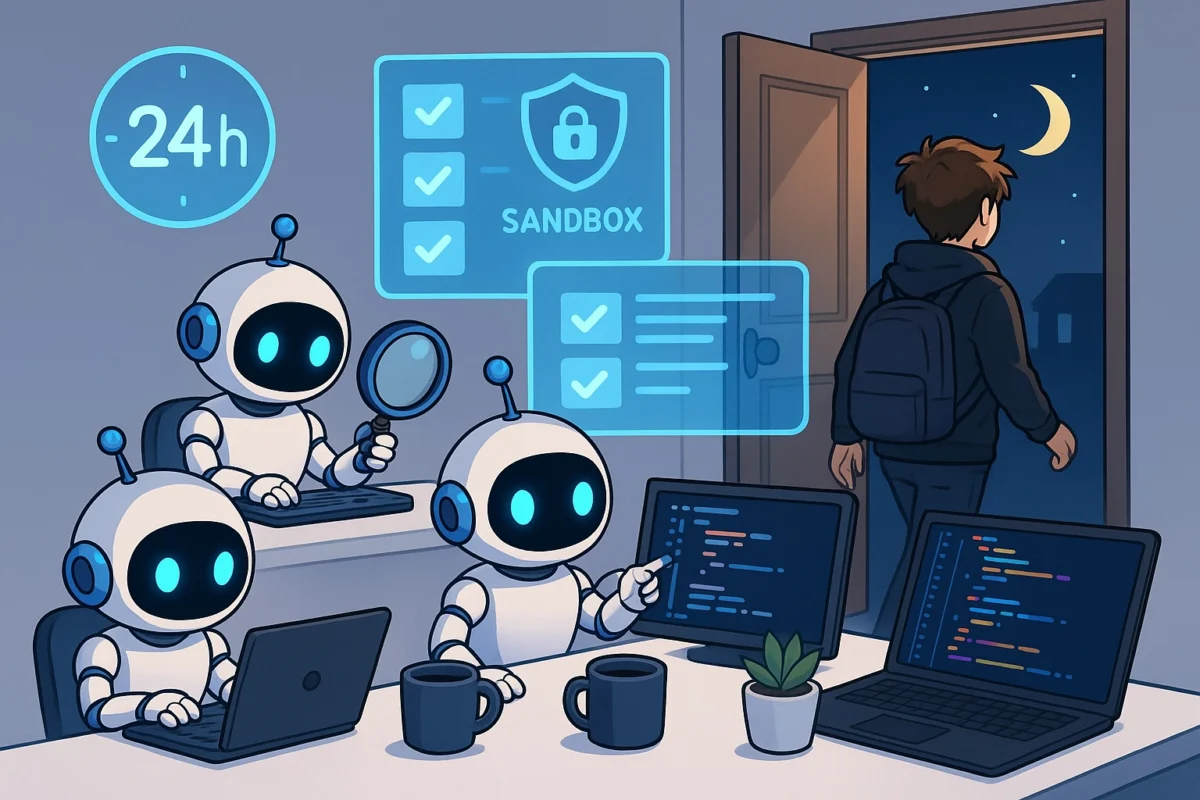
By enabling agents to run for 24 hours or longer without interruption, organizations can shift the burden of initial verification back onto the AI. This process involves the agent running its own test suites, checking for regressions, and even performing visual regression testing via headless browsers. The goal is to reach a state where the human reviewer only interacts with the agent at the very end of a long, autonomous cycle, ensuring that the final output is not just functional, but aligned with high-level business logic that the AI might not yet fully grasp.
Strategic Implementation: Permissions and Sandboxing
The first technical hurdle to achieving long-running autonomy is the management of system permissions. Conventional security protocols often require manual "Yes/No" confirmations for file system changes or network access, which effectively kills the autonomy of an agent if the human operator is away from their desk. To circumvent this, advanced configurations in tools like Codex and Claude Code now offer "auto-mode" or "skip-permissions" settings.
However, granting an AI agent unfettered access to a local machine carries significant risks. Recently, reports surfaced involving instances where high-reasoning models inadvertently deleted critical system files under specific edge-case scenarios—a risk OpenAI has acknowledged in technical documentation. To mitigate these dangers, industry standards now dictate a two-pronged approach to security:
- Sandboxed Environments: Agents should operate within isolated containers (e.g., Docker) or virtual machines. This ensures that even if an agent executes a destructive command, the impact is localized to a temporary workspace and cannot affect the host operating system or sensitive personal data.
- Robust Backup Protocols: Continuous integration with version control systems like GitHub is mandatory. Furthermore, local hardware-level backups, such as macOS Time Machine or Linux rsync scripts, provide a secondary layer of recovery.
Self-Verification via Multi-Modal Feedback Loops
For an agent to run autonomously for extended periods, it must possess the ability to judge the quality of its own work. This is achieved through detailed prompting and the provision of multi-modal tools. When a task is assigned, the prompt must include not only the desired outcome but also the specific criteria for completion.
A notable example is the implementation of UI/UX designs. A long-running agent can be instructed to use a tool like Playwright or Selenium to open a browser, take a screenshot of the implemented frontend, and compare it pixel-by-pixel against a provided design mockup. If discrepancies are found, the agent iterates on the CSS or component logic until the visual output matches the specification. By instructing the agent to flag only "technically infeasible" discrepancies for human review, the engineer is spared from checking every minor alignment issue, focusing only on high-level design decisions.

Agentic Code Review and Quality Assurance
Beyond initial verification, the final stage of an autonomous workflow involves "agentic code review." This moves the peer-review process from a human-to-human interaction to an agent-to-agent or agent-to-human interaction. Tools like Codex have demonstrated high proficiency in identifying logical flaws, security vulnerabilities, and style violations in a way that rivals senior human engineers.
There are currently two primary methods for deploying these review agents:
- GitHub Integration: Tagging an agent directly within a Pull Request. While highly visible, this method can suffer from API latency and GitHub’s own processing queues.
- CLI-Based Branch Comparison: Running a review agent through a Command Line Interface (CLI) to compare a feature branch against a main branch. This method is often faster and allows for more granular control over the review parameters, such as specifically looking for memory leaks or concurrency issues.
By automating this layer, the "bottleneck" of human review is significantly widened, allowing for a higher volume of code to move toward production with a lower probability of critical bugs.
Infrastructure: The Shift to Remote Persistence
The final requirement for a 24-hour autonomous agent is the move away from local development environments. Local execution on a laptop is subject to hardware limitations, such as battery life, sleep settings, and physical mobility. Closing a laptop lid often terminates active terminal sessions, effectively "killing" the agent’s thought process and requiring a potentially expensive (in terms of tokens and context) restart.
To solve this, a tiered infrastructure approach is becoming common among power users:
- Always-On Secondary Hardware: Using a dedicated desktop or "bot station" that remains powered on and connected to a high-speed network 24/7. This allows the engineer to initiate a task on their mobile device or laptop and then "hand it off" to the dedicated station.
- Cloud-Based Development Environments: Utilizing platforms like GitHub Codespaces, Replit, or custom AWS/Azure instances. While these offer the highest level of persistence, they introduce concerns regarding data privacy and the storage of sensitive environment secrets in third-party clouds.
Industry experts suggest that the future of engineering will likely involve "Agentic VPS" (Virtual Private Servers)—specialized cloud instances optimized for LLM context windows and persistent tool execution, allowing agents to work through the night and present a completed, reviewed, and tested feature by the start of the next business day.
Broader Implications and Future Outlook
The transition to long-running, autonomous coding agents represents a paradigm shift in the definition of a software engineer. The role is evolving from a "writer of code" to an "architect of autonomous workflows." This shift is expected to increase the output of individual developers by an order of magnitude, but it also necessitates a new set of skills: prompt engineering, sandbox management, and automated verification design.
While the potential for increased productivity is vast, the reliance on autonomous systems also raises questions about the long-term maintainability of codebases and the potential for "automated technical debt." If agents are allowed to run for days without human oversight, the resulting codebases could become difficult for humans to navigate if the agentic documentation is not equally robust.
Nevertheless, the trend toward persistence is irreversible. As models like GPT-5.6 and Claude Fable continue to improve in reasoning and error correction, the ability to maintain long-running sessions will be the primary differentiator between standard engineering teams and high-performance, AI-augmented organizations. The focus for the coming year will remain on refining the "harness" around these agents—the permissions, the verification tools, and the remote infrastructure—to ensure they can work as hard, and as long, as the hardware allows.