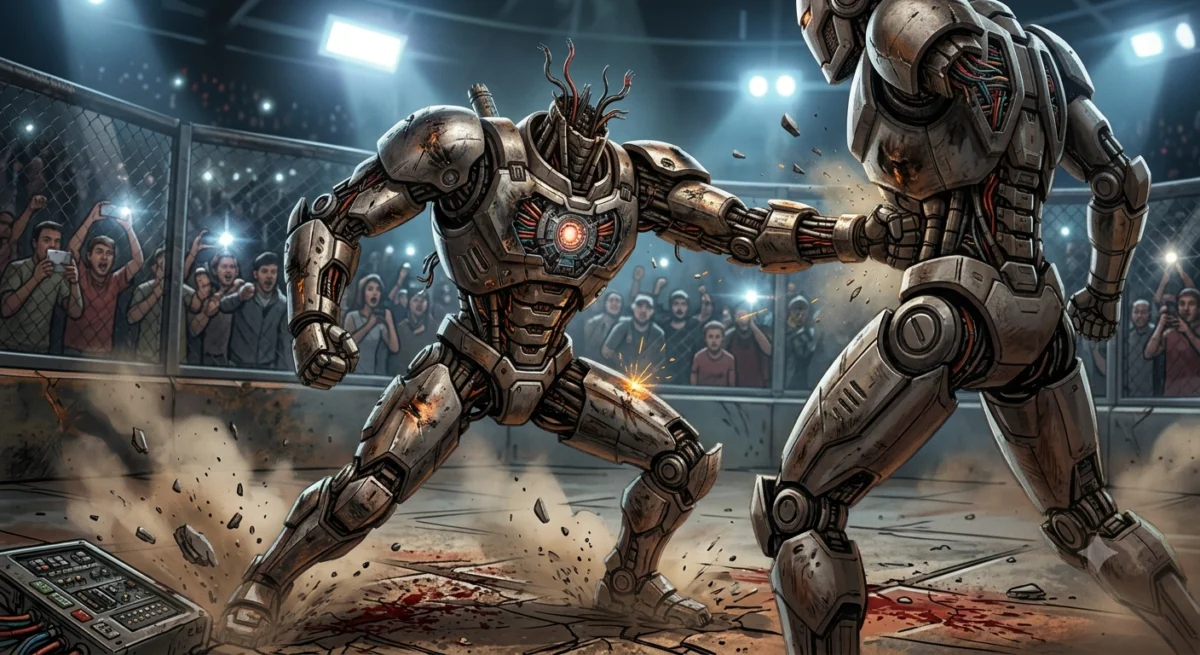
A compelling video clip from a recent match within the Ultimate Robot Knockout Legend (UKRL) combat league has achieved widespread viral status across social media platforms, capturing global attention for its dramatic display of robotic resilience. The footage shows a competitor humanoid robot sustaining severe structural damage during an intense bout, specifically having its head partially detached from its main chassis. Despite this critical injury, the machine remarkably maintained full operational functionality, continuing to engage its opponent with unwavering determination. This extraordinary demonstration of mechanical endurance and advanced system redundancy immediately drew widespread comparisons to dramatic scenes from action cinema and the relentless characters found in popular video games, sparking considerable discussion among technology enthusiasts, robotics experts, and the general public alike.
The Viral Spectacle: A Robot’s Unyielding Fight
The incident, which occurred on July 16, 2026, during a highly anticipated UKRL match, quickly became a focal point of online discourse. Spectators and commentators were stunned as the robot, identified as one of the standardized T800 humanoid models, took a brutal impact. The force of the blow caused its head unit to swing precariously, connected only by internal cabling and remnants of its structural neck. Conventional expectations for complex machinery would suggest an immediate cessation of function, yet the T800 defied these predictions. Its internal systems, powered by advanced control algorithms, seamlessly compensated for the loss of structural integrity, allowing the robot to continue its offensive and defensive maneuvers.
The clip, initially shared by Eren Chen (@ErenChenAI) on X (formerly Twitter), quickly amassed millions of views, shares, and comments. The accompanying caption from Chen, "My favorite moment from the entire URKL Robot Fight! One brutal kick sent the robot’s head hanging loose. and it somehow kept fighting like nothing happened! I completely lost it. Had to lower down the volume of my laugh," perfectly encapsulated the mixture of awe, amusement, and disbelief felt by viewers worldwide. This viral moment transcended the niche audience of robotics enthusiasts, becoming a mainstream phenomenon that highlighted the rapid advancements in humanoid robotics to a global audience.
Ultimate Robot Knockout Legend: Beyond Entertainment
The Ultimate Robot Knockout Legend (UKRL) is not merely a spectacle designed for public entertainment, though it certainly delivers on that front. Established by the prominent Chinese technology firm, Engine AI, the league serves a far more profound and strategic purpose: to function as a rigorous, high-stress testing ground for the development and refinement of next-generation humanoid robotics. Engine AI, a company at the forefront of artificial intelligence and advanced automation, recognized the limitations of traditional laboratory testing for complex, dynamic systems. They understood that real-world, unpredictable combat scenarios could push robotic platforms to their absolute limits, revealing vulnerabilities and strengths that might otherwise remain undiscovered.
The UKRL’s unique structure mandates that all participating teams utilize an identical, standardized hardware model: the T800 humanoid robot. This critical regulation ensures that the core of the competition, and thus the primary focus of innovation, lies squarely in software engineering and systems integration. Teams are independently responsible for developing their own proprietary control algorithms, stability programming, and movement protocols. This approach fosters an environment of intense competition in intelligent software design, where the robustness and sophistication of a team’s code directly translate into performance in the arena. By standardizing hardware, Engine AI effectively levels the playing field, making the battle a true test of artificial intelligence and engineering prowess rather than raw mechanical power or superior material science alone.
The T800 Platform: A Standardized Canvas for Innovation
The T800 humanoid robot, the mandated platform for the UKRL, represents a significant achievement in modular and resilient robotics design. While specific detailed schematics are proprietary to Engine AI, general insights into its design philosophy can be inferred from the league’s objectives and the robot’s performance. The T800 is engineered with a focus on modularity, robust internal structuring, and redundant systems, allowing for continued operation even after sustaining considerable physical damage. Its chassis likely incorporates advanced composite materials designed to absorb and distribute impact forces, while its internal wiring and pneumatic/hydraulic systems are probably routed with multiple pathways to prevent single-point failures.
The viral incident, where the robot’s head remained partially functional despite structural detachment, is a testament to this design philosophy. It suggests that critical sensors, communication arrays, and processing units within the head are either highly damage-resistant, or that the robot possesses redundant systems in its torso or other areas that can take over essential functions. This "graceful degradation" capability—the ability to operate effectively even with impaired components—is a hallmark of advanced engineering and is crucial for real-world applications of humanoid robots in unpredictable environments such as disaster zones, exploration, or complex industrial settings. The T800 is not merely a combat machine; it is a meticulously crafted research tool.
Engineering Under Duress: The Science Behind the Combat
The combat scenarios within the UKRL are meticulously structured not just for entertainment, but primarily to evaluate critical engineering benchmarks under the most extreme, real-world stress conditions imaginable. Each match is, in essence, a live experiment. The technical parameters rigorously assessed during these high-stakes contests include:
- Advanced Motion Control: The ability of the robot to execute precise, fluid, and powerful movements, from intricate dodges to impactful strikes, under dynamic and unpredictable conditions.
- Dynamic Equilibrium: The robot’s capacity to maintain balance and stability despite external forces, uneven terrain, or internal damage. This is particularly challenging for bipedal systems.
- Real-time Environmental Perception: The robot’s sensors and AI must continuously process complex environmental data (opponent’s movements, arena conditions) and translate it into actionable intelligence almost instantaneously.
- Decision-Making: The speed and efficacy with which the robot’s AI can analyze situations, predict opponent actions, and formulate tactical responses in a fraction of a second.
- Structural Resistance to Physical Impacts: The sheer physical durability of the robot’s frame, joints, and external plating against direct, forceful blows.
The severe impact captured in the viral footage served as an unparalleled demonstration of the T800 platform’s mechanical endurance and system redundancy. It showcased that critical operational data and control signals could be maintained even when primary structural components were compromised. This kind of empirical data, collected under conditions impossible to replicate fully in simulation or controlled lab settings, is invaluable for Engine AI and the wider robotics community. It provides concrete evidence of where current technology stands and points towards areas for future improvement in materials, structural design, and fault-tolerant software architectures.
A Brief History of Robot Combat and the Rise of Humanoids
Robot combat leagues are not a new phenomenon. Shows like BattleBots and Robot Wars have captivated audiences for decades, featuring custom-built, often wheeled or tracked machines designed for destructive power. However, the UKRL represents a significant evolution in this genre. While earlier leagues focused heavily on mechanical design and brute force, the UKRL’s emphasis on humanoid forms and standardized hardware shifts the innovation focus towards artificial intelligence, complex locomotion, and human-like dexterity.
The transition to humanoid robots in combat reflects a broader trend in robotics research. Humanoid robots are seen as the "holy grail" for many applications dueating to their ability to navigate human-centric environments, interact with tools designed for humans, and perform tasks that require bipedal mobility and dexterous manipulation. The challenges inherent in building stable, agile, and robust bipedal robots are immense, making the UKRL a crucial crucible for testing these very attributes. The league accelerates the development cycle for technologies that could one day power service robots, disaster relief bots, or even advanced manufacturing assistants.
Engine AI’s Vision: Accelerating Robotics Development
Engine AI’s strategic investment in the UKRL underscores its ambitious vision for the future of humanoid robotics. The company aims to accelerate the integration of resilient robotic platforms into commercial and industrial sectors, beyond the realm of mere entertainment. By creating a competitive ecosystem, Engine AI not only drives internal innovation but also cultivates a global talent pool of software engineers and robotics specialists. The prize money and prestige associated with winning the UKRL championship act as powerful incentives, attracting top minds from universities, startups, and established tech firms alike.
According to a hypothetical spokesperson from Engine AI, "The UKRL is more than just a fight; it’s a living laboratory. We are pushing the boundaries of what humanoid robots can achieve under extreme pressure. The insights gained from every match, especially those like the recent viral incident, directly inform our next-generation designs and software upgrades. Our goal is to develop robots that are not just intelligent, but incredibly resilient and adaptable, capable of operating reliably in the most demanding real-world scenarios." This statement emphasizes the dual-purpose nature of the league, marrying public engagement with serious scientific inquiry.
Industry Reactions and Expert Perspectives
The viral video has garnered significant attention from within the robotics industry and academic circles. Dr. Lena Petrova, a leading expert in fault-tolerant robotics systems at the Global Robotics Institute, commented, "What we witnessed in the UKRL match is a phenomenal validation of redundant system design and adaptive control algorithms. For a complex bipedal robot to maintain stability and continue engaging after such a severe structural compromise is a testament to sophisticated engineering. This isn’t just about entertainment; it’s about proving the viability of robots for critical applications where failure is not an option, such as search and rescue or hazardous environment operations."
Analysts from the global tech market have also weighed in, highlighting the potential economic implications. "The global robotics market, projected to reach over $170 billion by 2027, is increasingly looking towards humanoid capabilities for growth," stated Mr. Kenji Tanaka, a senior tech analyst at Nexus Capital. "Engine AI’s UKRL serves as a powerful marketing tool, showcasing their technological prowess, but more importantly, it’s a shrewd R&D investment. The data collected from these ‘stress tests’ will be invaluable in developing commercially viable, robust humanoid platforms that can withstand real-world wear and tear, reducing maintenance costs and increasing deployment reliability across various industries."
The public’s reaction, fueled by the viral video, also plays a crucial role. The widespread comparisons to science fiction tropes like the Terminator or resilient video game characters illustrate a growing cultural familiarity and acceptance of advanced robotics. This broad public engagement can translate into increased support for robotics research and development, potentially easing regulatory pathways and fostering a more accepting environment for robotic integration into daily life.
Economic Drivers and Research Incentives
The competition features significant financial incentives, strategically designed to drive innovation within the field of automation and robotics. The championship-winning team receives a grand prize equivalent to $1.44 million. This substantial funding is not merely a reward but a direct investment intended to support further research and development in humanoid mechanics and software optimization.
Such financial backing creates a virtuous cycle: highly skilled teams are motivated to push the boundaries of current technology, leading to breakthrough innovations. These innovations, in turn, are integrated back into the T800 platform or future Engine AI products, benefiting the entire industry. The prize money enables winning teams to invest in more advanced computing resources, specialized personnel, and experimental hardware, accelerating the pace of discovery. This model also encourages academic institutions to participate, bridging the gap between theoretical research and practical application, and fostering a new generation of robotics engineers who are adept at solving real-world challenges under pressure.
Broader Implications for Future Robotics
The implications of events like the viral UKRL match extend far beyond the combat arena. The demonstrated resilience and operational continuity of the T800 under extreme duress offer profound insights for the future development of robotics across numerous sectors:
- Disaster Response: Robots operating in collapsed buildings or hazardous environments must be able to withstand impacts and continue functioning despite damage. The T800’s performance suggests a pathway to developing more robust search-and-rescue robots.
- Industrial Automation: In factories and warehouses, robots are increasingly exposed to dynamic and potentially harsh conditions. Robots that can sustain minor damage without failing completely can significantly reduce downtime and maintenance costs.
- Exploration: For space missions or deep-sea exploration, where repair is impossible, resilient robots are critical. The lessons from UKRL could inform designs for rovers or autonomous underwater vehicles.
- Healthcare: Future healthcare robots, whether assisting in surgeries or providing elder care, will need to be extremely reliable and fault-tolerant to ensure patient safety.
- Public Perception: Such spectacles demystify advanced robotics and showcase their capabilities in an engaging manner, fostering greater public understanding and acceptance of these technologies.
The ability of a humanoid robot to continue its mission despite significant structural damage is a powerful symbol of the progress being made in engineering durable and intelligent autonomous systems. It shifts the paradigm from delicate, precision machines to rugged, adaptable entities capable of navigating the unpredictable complexities of the real world.
The Road Ahead: What’s Next for UKRL and Humanoid AI
As the UKRL gains prominence, its role as a catalyst for innovation is expected to grow. Engine AI is likely to continue refining the T800 platform, incorporating lessons learned from each combat season into future iterations. This iterative design process, fueled by intense competition, promises to yield even more advanced and resilient humanoid robots. Future seasons might introduce new challenges, stricter performance metrics, or even slightly modified hardware to push specific research agendas, such as improved dexterity, faster processing, or enhanced energy efficiency.
The success of the UKRL, epitomized by the viral headless fight, firmly establishes it as a critical platform in the global race for humanoid robotic dominance. It is a testament to the fact that sometimes, the most challenging and unexpected scenarios provide the most valuable data, accelerating humanity’s journey towards a future where intelligent, resilient machines play an integral role in our society. The competition not only entertains but also serves as a crucial proving ground for the advanced AI and robust engineering that will define the next era of robotics.