











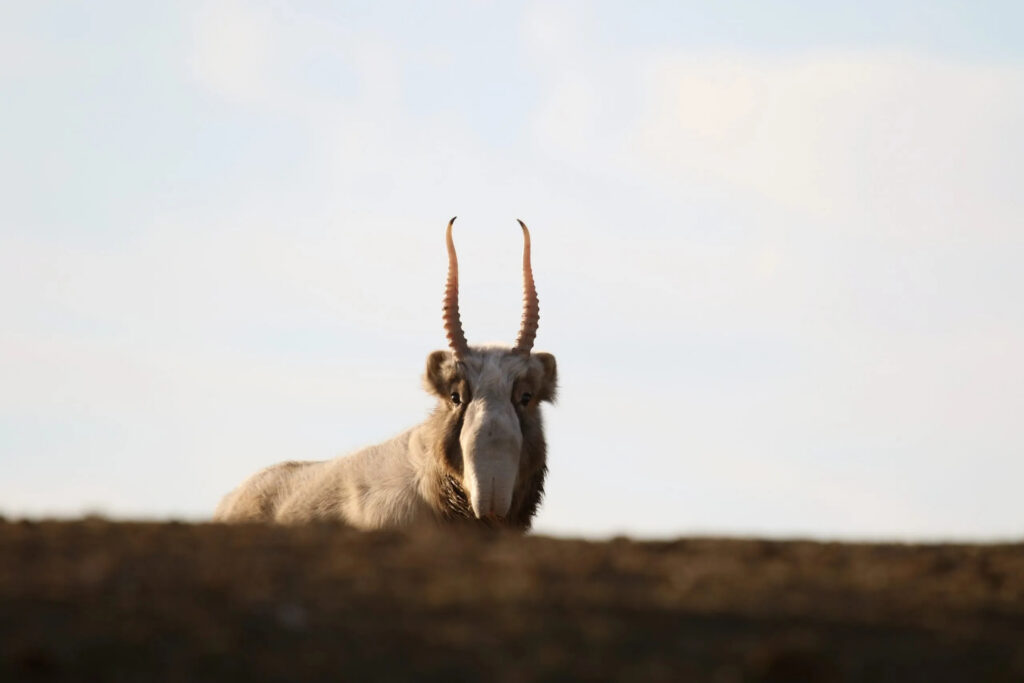
The rugged landscapes of western Kazakhstan serve as the stage for one of the most remarkable wildlife monitoring efforts in modern conservation. Across the windswept Eurasian steppe, researchers from the Association for the Conservation of Biodiversity of Kazakhstan (ACBK) navigate extreme weather conditions and remote terrain to audit the migratory patterns of the saiga antelope. These prehistoric ungulates, distinguished by their unique, elongated snouts and ringed horns, represent a vanishing link to Pleistocene ecosystems. As rapid industrialization, border fencing, and linear infrastructure encroach upon their ancestral migration routes, government agencies, conservationists, and cross-border partners are racing to implement targeted mitigations to secure the survival of a nomadic species that has roamed Central Asia for millennia.
Historical Context and Evolutionary Resilience
The saiga antelope belongs to a select group of megafauna that survived the late Pleistocene extinction event approximately 12,000 years ago. Sharing landscapes with woolly mammoths, saber-toothed cats, and giant Irish elk, saigas outlived their prehistoric contemporaries through high reproductive rates and exceptional adaptability. Historically, their range extended from the foothills of the Caucasus Mountains across the vast Eurasian steppe all the way to Mongolia.
For early human civilizations, the seasonal movements of saiga herds served as vital navigational indicators across an otherwise featureless terrain. Archaeological evidence indicates that nomadic human populations in the region—whose traditions date back to the Early Iron Age and are reflected in the Turkic etymology of the word "Kazakh," meaning wanderer or vagabond—synchronized their own seasonal migrations with those of the wildlife. These ancient transit corridors eventually contributed to the establishment of the network of pathways known as the Silk Road, anchoring western Kazakhstan as a critical transcontinental crossroads along the Ural River, the natural boundary between Europe and Asia.
The 20th century, however, brought sweeping political and demographic shifts that disrupted these ancient rhythms. Under Soviet administration, mandatory sedentarization policies forced nomadic human populations into permanent agricultural settlements, effectively dismantling a lifestyle rooted in mobility. While human societies settled into urban centers and agrarian plots, the saiga antelope maintained its mandatory nomadic imperative, continuing to traverse vast distances across the continental interior.
The Mechanics and Vulnerabilities of Saiga Migration
Saiga survival depends entirely on unhindered mobility. Driven by seasonal shifts in climate and resource availability, the antelopes undertake massive migrations, congregating during the late autumn and early winter rutting seasons. During this critical period, males compete for dominance through physical displays, utilizing their oversized, flexible snouts—critical physiological adaptations designed to filter dust and warm frigid winter air before it reaches their lungs—to signal virility.
In recent decades, however, the expansion of linear infrastructure has severely fragmented these historical migration corridors. Modern development, including high-speed railways, paved highways, and impermeable border fences, has partitioned the once-continuous Eurasian steppe into isolated ecological islands.
Chronology of Infrastructure Impacts and Conservation Interventions
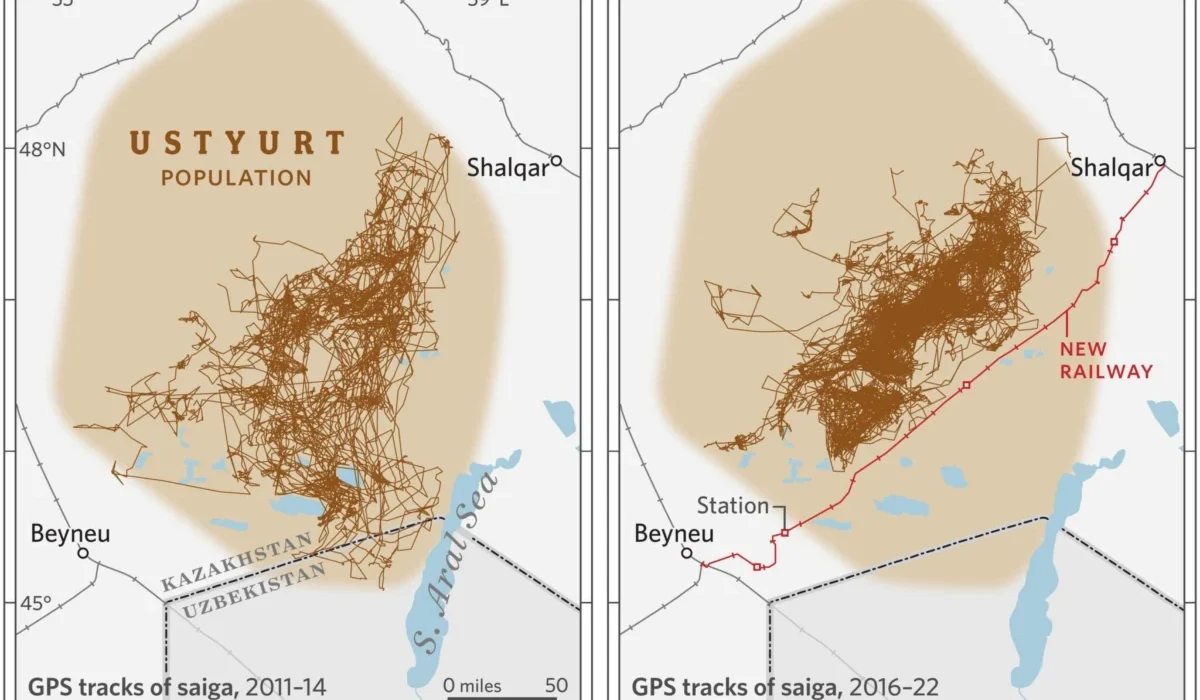
The detrimental impacts of linear infrastructure on saiga populations are well-documented by spatial tracking data.
- 2014: The construction of a major rail line in southern Kazakhstan and the border regions of Uzbekistan effectively severed traditional migration routes, preventing GPS-collared saiga herds from reaching historically reliable winter pastures in Uzbekistan.
- Post-2014 Analysis: Telemetry data revealed that migratory herds encountered physical blockages, resulting in disoriented movement patterns north of the tracks while vital water and forage resources withered to the south. This disruption threatens to erase the transmission of spatial knowledge across generations, a phenomenon conservation scientists compare to the loss of a language.
- Recent Years: Recognizing the existential threat posed by habitat fragmentation, the ACBK, in partnership with the Kazakh and Uzbek governments, initiated targeted structural modifications to restore ecological connectivity.
Official Responses and Mitigation Strategies
To address these barriers without halting regional economic development, conservationists and government ministries have introduced innovative engineering solutions tailored to the behavioral ecology of the saiga.
In Kazakhstan, conservation teams have collaborated with transportation authorities to design and construct saiga-friendly railway crossings. These interventions feature gently sloping dirt ramps that elevate ground level to match the height of railway tracks, creating an optical illusion of a natural break in the infrastructure. Additionally, strategically placed cattle-guard fences keep trains and ungulates safely separated while preserving the integrity of the crossing points.
Concurrently, international cooperation has yielded results along geopolitical boundaries. The ACBK worked alongside Uzbek authorities to redesign traditional barbed-wire border fences. By replacing solid barriers with X-shaped barricades that permit wildlife passage while prohibiting vehicular traffic, conservationists have successfully re-established permeability across international frontiers.
Broader Implications for Eurasian Biodiversity
The ongoing efforts to protect the saiga antelope carry profound implications for landscape-level conservation in Central Asia. As climate change alters precipitation patterns and agricultural pressures intensify, maintaining the ecological integrity of the Eurasian steppe is paramount. The saiga’s recovery serves as a bellwether for the health of grassland ecosystems globally, demonstrating that linear infrastructure and nomadic wildlife can coexist provided that systemic connectivity is intentionally restored. Through data-driven spatial planning, cross-border diplomacy, and targeted structural engineering, conservationists are working to ensure that the ancient drumbeat of saiga migration continues to resonate across the open plains of Central Asia for generations to come.