









The intersection of artificial intelligence and workforce readiness has reached a critical juncture in the global economy. As industries across sectors transition from exploratory digital transformation to aggressive AI integration, the demand for qualified practitioners has vastly outpaced traditional educational pipelines. In response to this widening skills gap, the premier online learning platform 365 Data Science has officially announced the return of its flagship Free Access Initiative. Scheduled to run from November 5 through November 20, 2026, beginning at 8:00 a.m. UTC, the program will strip away financial barriers, granting the global public unrestricted, complimentary access to its entire educational ecosystem.
This upcoming fifteen-day window represents far more than a temporary promotional event; it is the continuation of a meticulously designed educational mission that has evolved significantly over the past half-decade. By opening its virtual doors to aspiring data scientists, software engineers, and business analysts worldwide, 365 Data Science aims to democratize access to high-demand technical competencies. In an era where automated reasoning, predictive modeling, and autonomous agents dictate market competitiveness, the initiative serves as a vital bridge connecting eager learners with the sophisticated tools required to thrive in modern corporate and academic environments.
The Evolution and Institutional History of the Free Access Initiative
The genesis of this large-scale educational outreach traces back to the extraordinary disruptions of 2020. At the height of the global COVID-19 pandemic, educational institutions worldwide were forced to close their physical doors, and millions of professionals faced sudden career uncertainty or mandatory remote work structures. Recognizing an urgent societal need to support continuous professional development during a period of profound economic vulnerability, the leadership team at 365 Data Science conceptualized a short-term, zero-cost access period.
What began as an emergency response to a global crisis has since transformed into a permanent, highly anticipated annual tradition. Now entering its sixth consecutive year, the initiative has systematically scaled its infrastructure to accommodate exponential growth in user demand. Each iteration has refined the pedagogical approach, shifting from basic foundational data literacy toward advanced, highly specialized training modules encompassing machine learning operations, cloud deployment, and complex AI engineering frameworks.
The historical trajectory of the program underscores a rapidly accelerating public hunger for technical fluency. While initial campaigns attracted modest regional engagement, subsequent years demonstrated exponential international adoption. The organizational resilience required to maintain a platform capable of serving hundreds of thousands of concurrent users globally highlights the maturation of EdTech as a primary driver of workforce adaptation.
Record-Breaking Metrics and Global Reach in 2025
To fully contextualize the scope of the upcoming 2026 initiative, industry analysts frequently point to the watershed metrics achieved during the previous year’s campaign. The 2025 edition of the Free Access Initiative shattered all internal and historical benchmarks, cementing its status as one of the most successful online open-learning events in the data science sector.
During the designated open-access window in 2025, the platform recorded over 220,000 unique active users. This diverse cohort represented a truly global demographic, hailing from 216 distinct countries and territories, ranging from established technological hubs in North America and Western Europe to emerging digital economies across Southeast Asia, Sub-Saharan Africa, and Latin America. The sheer breadth of geographic participation illustrates a universal realization: technical upskilling is no longer confined to affluent nations but is viewed globally as an essential passport to economic mobility.

The intensity of engagement matched this unprecedented breadth. Collectively, participating learners logged an astounding 7.2 million minutes of educational content across the platform. This metric reflects a deep, sustained commitment by users who utilized the limited-time window to complete rigorous modules rather than merely browsing the catalog. Furthermore, successful completion of these modules translated into tangible professional credentials, with participants earning more than 36,000 verified certificates of completion. These credentials have since served as vital portfolio additions for individuals navigating highly competitive job markets.
Executive Perspectives: The Urgency of AI Engineering and Intelligent Agents
Behind the strategic expansion of the Free Access Initiative is a clear-eyed assessment of technological trends articulated by corporate leadership. Ned Krastev, Chief Executive Officer of 365 Data Science, has consistently highlighted the accelerating velocity at which artificial intelligence is rewriting the rules of global commerce.
Reflecting on the shifting landscape, Krastev noted that the artificial intelligence and data ecosystem is evolving at a pace previously unseen in technological history. This rapid acceleration is generating extraordinary career opportunities, but it simultaneously threatens to marginalize professionals who fail to adapt. According to Krastev, understanding the mechanics of how modern AI systems are conceptualized, built, deployed, and ethically integrated has transformed from a niche specialty into a fundamental baseline requirement for any data-driven profession.
Krastev further elaborated on the strategic pivot embedded within the platform’s current curriculum, emphasizing the transition from traditional descriptive analytics to generative and autonomous systems. Artificial intelligence is actively reshaping industries at an unprecedented pace, he observed. The core objective of 365 Data Science is to eliminate the friction between theoretical knowledge and practical execution. By empowering learners to develop not just basic data literacy, but rigorous, hands-on expertise in AI engineering and intelligent agents, the platform is actively shaping the definitive skills required of tomorrow’s technology leaders.
This philosophy directly addresses a persistent structural flaw in traditional higher education: the lag time between academic curricula and industry reality. While traditional universities often require years to update degree programs, fast-moving platforms like 365 Data Science can continuously recalibrate their offerings to reflect the latest advancements in large language models, neural network architectures, and automated agent workflows.
Comprehensive Curriculum and Practical Frameworks Available in 2026
During the upcoming fifteen-day open-access period, participants will experience unrestricted navigation across the entire 365 Data Science platform without encountering paywalls or feature restrictions. The curriculum is meticulously structured to serve learners across the entire proficiency spectrum, ranging from absolute beginners with no prior coding experience to seasoned software developers seeking specialized domain knowledge.
The platform houses a robust library consisting of more than 134 expert-led courses. These modules are organized into cohesive, career-focused learning paths designed to guide individuals step-by-step from foundational concepts to job-ready competence. Key instructional domains include:
- Fundamental Data Literacy: Essential mathematics, statistics, and introductory programming languages such as Python and R.
- Data Management and Manipulation: Comprehensive training in SQL, database architecture, data cleaning, and exploratory data analysis.
- Data Visualization and Business Intelligence: Practical applications utilizing industry-standard tools like Tableau, Power BI, and advanced Python visualization libraries.
- Machine Learning and Predictive Modeling: Supervised and unsupervised learning algorithms, model evaluation, and regression techniques.
- Advanced AI Engineering: Deep learning, natural language processing, computer vision, and the architecture of intelligent autonomous agents capable of reasoning, planning, and executing complex workflows.
To ensure that theoretical instruction translates effectively into practical competence, the platform integrates immersive, real-world project simulations. Rather than relying solely on multiple-choice assessments, learners engage with datasets and problem statements mirroring actual corporate scenarios. Newly introduced interactive exercises and guided coding challenges provide immediate feedback, reinforcing complex programming logic and ensuring concepts are thoroughly understood before participants advance to subsequent modules.

The Value of Verified Certifications in a Competitive Job Market
In the contemporary recruitment landscape, professional credentials serve as critical signaling mechanisms for hiring managers filtering through thousands of applicant resumes. The proliferation of online learning resources has made content widely available, but verified, verifiable proof of skill remains a valuable currency.
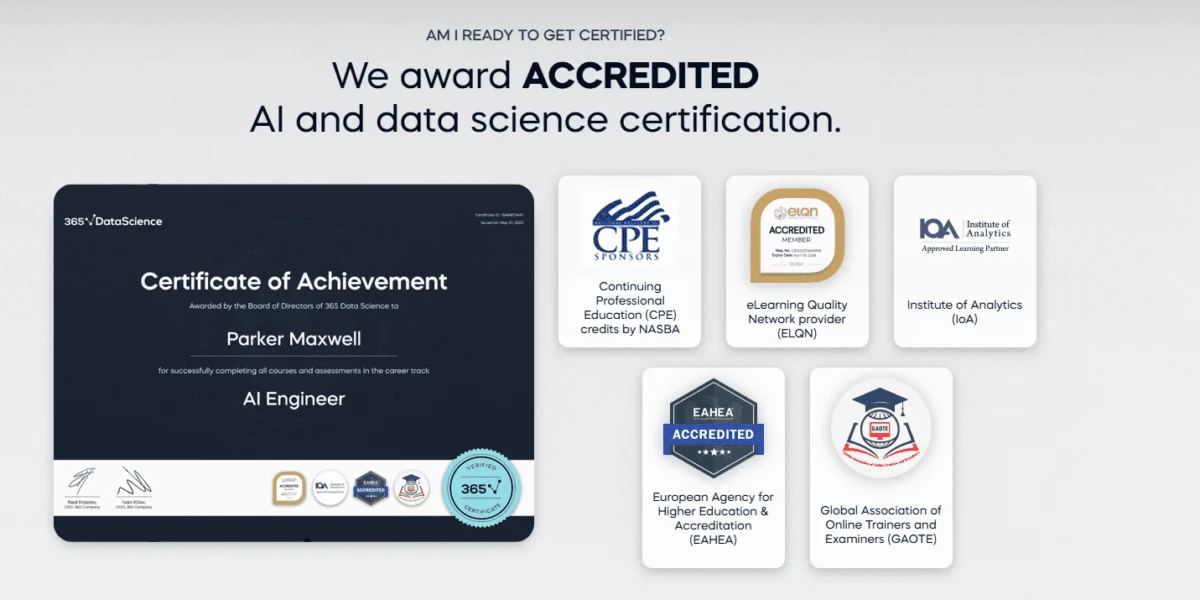
Through the Free Access Initiative, participants who successfully complete coursework and pass rigorous evaluations are awarded industry-recognized certificates at zero cost. These credentials carry substantial weight because they signify completion of structured, rigorous academic content rather than passive video consumption.
Industry analysts note that these certifications play a pivotal role in bridging the traditional gap between education and direct career advancement. For career changers—individuals pivoting from non-technical backgrounds into data science—possessing verifiable credentials in machine learning and data engineering provides tangible proof of competence to prospective employers. Furthermore, for professionals currently embedded in traditional tech roles, these certifications validate their ability to pivot alongside emerging technologies, thereby safeguarding their long-term career viability.
Broader Economic Implications and Industry Outlook
The decision by 365 Data Science to provide uninhibited access to its educational ecosystem arrives at a crucial moment for the global labor market. Economists and labor experts have increasingly warned of a widening "AI divide"—a scenario where organizations and individuals equipped with advanced technological tools pull dramatically ahead of those lacking access to modern training infrastructure.
By systematically dismantling the financial barriers associated with premium technical education, initiatives of this scale exert a profound leveling effect on the global talent pool. A self-taught programmer in a developing economy gains access to the exact same instructional frameworks, project simulations, and foundational theories as a student enrolled in an elite Western institution. This democratization of knowledge not only benefits individual learners seeking upward mobility but also feeds a desperately hungry global tech sector suffering from chronic talent shortages in specialized engineering domains.
Furthermore, the focus on intelligent agents and AI engineering reflects a fundamental shift in how human labor interacts with software architecture. As artificial intelligence transitions from passive analytical tools to active, autonomous agents capable of planning and execution, the modern workforce must evolve. Professionals are no longer evaluated merely on their ability to write code or query databases, but on their capacity to orchestrate, supervise, and optimize intelligent systems.
Preparations and Next Steps for Prospective Participants
With the open-access window officially scheduled to open on November 5, 2026, at 8:00 a.m. UTC and close on November 20, 2026, prospective participants are encouraged to prepare strategically to maximize the limited timeframe. Given the sheer volume of content available across the 134+ courses, educational advisors recommend that learners identify their specific career objectives prior to the launch date—whether that entails mastering SQL for business analytics, building a foundation in Python, or diving directly into advanced machine learning architectures.
As the corporate world continues to digitize at an accelerated pace, proactive upskilling has ceased to be an optional luxury and has become a mandatory professional strategy. The 2026 Free Access Initiative by 365 Data Science offers a risk-free, highly structured environment for individuals ready to stake their claim in the future of data and artificial intelligence.