








The PC hardware market is frequently fixated on flagship components, premium overclocking solutions, and high-margin graphics cards that often evade standard consumer budgets. Yet, mainstream computing relies heavily on entry-level hardware that balances cost-efficiency with daily reliability. Among the most requested products in modern enthusiast communities is the Cooler Master Hyper 212 EVO. Despite debuting a decade ago, the cooler remains a frequent subject of hardware inquiries and community recommendations. Evaluating the Hyper 212 EVO in a contemporary computing environment reveals how foundational thermal engineering holds up against modern thermal loads, newer iterations, and evolving motherboard standards.
Historical Context and Evolution of the Hyper 212 Line
Introduced to the market in 2011, the Cooler Master Hyper 212 series quickly established itself as the industry benchmark for budget-friendly aftermarket CPU cooling. At a time when stock box coolers provided by Intel and AMD were notoriously loud and inefficient, the Hyper 212 offered a viable alternative. It bridged the gap between stock solutions and high-end tower coolers from manufacturers like Noctua and be quiet! at a fraction of the cost, usually retailing between $30 and $35 USD.
Over the past ten years, Cooler Master has iterated on the design, releasing variants such as the Hyper 212 Black Edition and the more recent Hyper 212 EVO V2. These updates addressed historical pain points, including complex mounting mechanisms, memory clearance limitations, and acoustic profiles. However, the original Hyper 212 EVO has remained in production and widely available, prompting questions regarding whether legacy hardware can adequately cool modern multi-core processors.
Technical Specifications and Design Philosophy
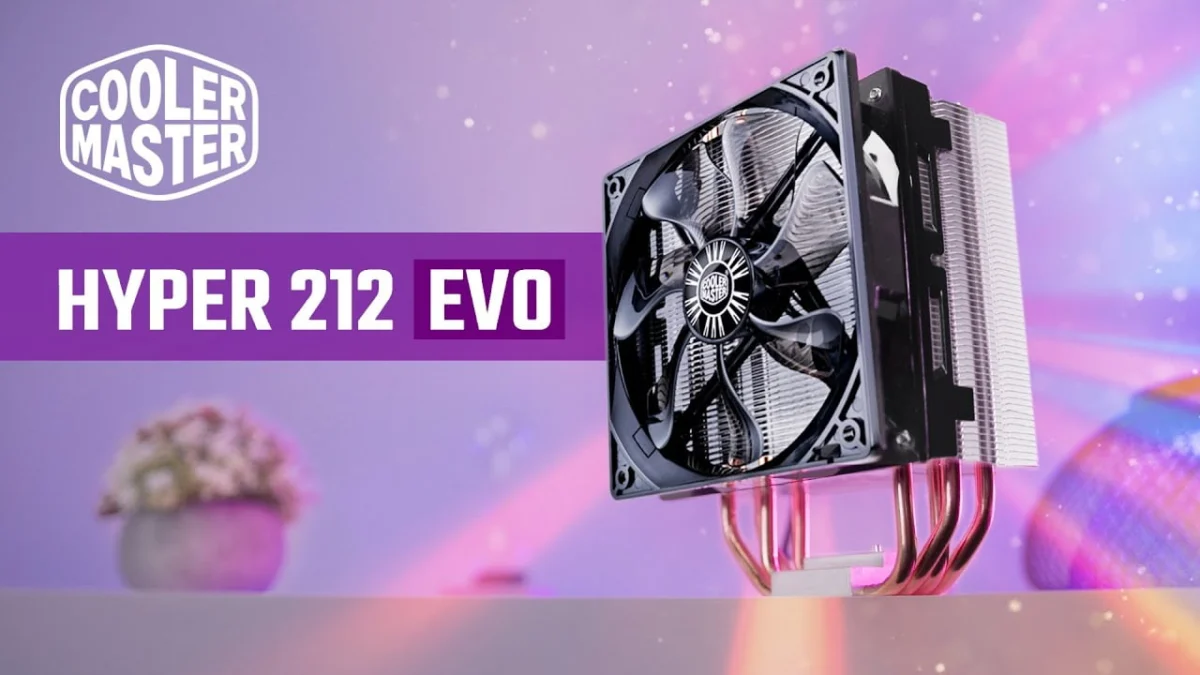
The original Hyper 212 EVO measures 120mm in width, 158.5mm in height, and 77mm in depth with its stock fan installed. Its physical footprint is designed to fit within standard mid-tower ATX chassis while offering significantly more surface area than stock box coolers.
At its core, the cooler utilizes Heatpipe Direct Technology (HDT), a design choice popularized in the early 2010s. HDT places copper heat pipes in direct contact with the CPU integrated heat spreader (IHS), facilitating rapid thermal transfer at lower heat loads. While higher-end modern air coolers have largely transitioned to solid copper base plates for even heat distribution across larger chiplets, HDT remains a cost-effective manufacturing method for entry-level heatsinks. These four copper heat pipes route heat upward into a dense aluminum fin array.
The included stock fan operates at a maximum speed of 2,000 RPM, producing an acoustic output of approximately 36 dBA. Eschewing modern trends of addressable RGB lighting, the original design prioritizes basic mechanical function, utilizing durable plastic fan clips rather than traditional metal wire brackets to secure the fan to the fin stack.
Comparative Analysis: Original vs. V2 and Black Edition
To understand the market position of the original Hyper 212 EVO, analysts must examine its sibling models. The Hyper 212 EVO V2 introduces a stepped-back heatpipe layout designed to improve memory compatibility, ensuring zero interference with RAM slots on standard motherboards. Additionally, the V2 incorporates Cooler Master’s updated SickleFlow fan series for improved airflow-to-noise ratios and features a completely redesigned, user-friendly mounting kit. Typically priced $15 to $20 higher than the legacy model, the V2 represents a modernized tier of budget cooling.
Conversely, the Hyper 212 Black Edition offers an aesthetic overhaul with a gunmetal dark finish, a larger base, and an upgraded fan, often retailing close to the original EVO’s price point during promotional sales. However, user feedback regarding the Black Edition often highlights frustration with its mounting hardware, leaving the original EVO’s simpler, albeit dated, plastic-clip mounting system as a point of division among builders.
Installation Challenges and Modern Hardware Realities
One of the most significant barriers for contemporary builders utilizing the original Hyper 212 EVO is its installation process. Designed a decade ago, the mounting mechanism relies on a multi-piece backplate, small threaded studs, and diminutive hardware nuts that complicate the installation procedure, particularly on modern AMD AM4 or Intel platforms.
The procedure requires holding the backplate, placing plastic washers, threading mounting studs, and securing loose nuts before attaching the heatsink crossbar. Without precise handling, components can easily shift, leading to uneven mounting pressure or prolonged installation times. Industry observers note that newer mounting kits, such as those implemented in the V2 revision, have largely resolved these ergonomic hurdles, making the legacy installation process a notable deterrent for novice builders.
Furthermore, physical dimensions present occasional compatibility challenges. While standard ATX motherboards with two memory modules experience no interference, populating all four DIMM slots or utilizing compact ITX form-factor motherboards can restrict the use of the final memory slot due to the overhang of the fan and fin stack.
Performance Benchmarks Under Controlled Thermal Loads
To evaluate the thermal efficacy of the Hyper 212 EVO in 2021 and beyond, testing methodologies often utilize modern multi-core processors, such as the AMD Ryzen 9 5950X, configured to specific wattage outputs within a closed chassis environment. This approach simulates various operational tiers:
- 95W Thermal Load: Represents lower- to mid-range processors operating at stock frequencies.
- 125W Thermal Load: Aligns with overclocked mid-range processors or high-end CPUs operating at stock speeds.
- 150W Thermal Load: Exceeds the intended design parameters of standard entry-level coolers.
When tested at a 95W thermal load, the Hyper 212 EVO demonstrates impressive capability. While premium alternatives like the Noctua NH-U12S achieve marginally lower temperatures at ultra-low fan speeds, the Hyper 212 EVO matches the cooling performance of more expensive units as fan speeds and noise thresholds increase. Furthermore, it consistently outperforms stock box coolers (such as the AMD Wraith series), which frequently push CPUs near thermal throttling thresholds (90°C) under sustained workloads.
At a 125W load, the limitations of the legacy design begin to emerge. The original cooler falls behind the Black Edition and high-end alternatives at lower fan speeds, requiring higher RPMs—and consequently higher noise levels—to maintain competitive temperatures. At the 150W threshold, the cooler becomes overwhelmed, underscoring its design intent as a replacement for stock solutions rather than a high-performance overclocking apparatus.
Modifying the original EVO with a modern SickleFlow fan (replicating the V2 configuration) yields a consistent temperature reduction of 2°C to 3°C at lower decibel levels during 95W testing. However, these gains plateau as thermal loads increase, indicating that fan upgrades offer incremental, rather than transformative, improvements to the aging heatsink architecture.
Market Implications and Consumer Value
The enduring relevance of the Cooler Master Hyper 212 EVO highlights a broader economic reality within the PC building ecosystem: baseline thermal engineering retains its utility across multiple hardware generations. Priced consistently between $30 and $35 USD, the cooler offers an accessible entry point for users seeking to reduce acoustic noise and lower operating temperatures compared to stock thermal solutions.
While the installation process requires patience and manufacturing standards have advanced significantly over the past ten years, the price-to-performance ratio remains a primary driver of its sustained market presence. For budget-conscious consumers operating within standard thermal parameters, the Hyper 212 EVO continues to provide functional utility, proving that efficient heat dissipation does not invariably require premium expenditure.