










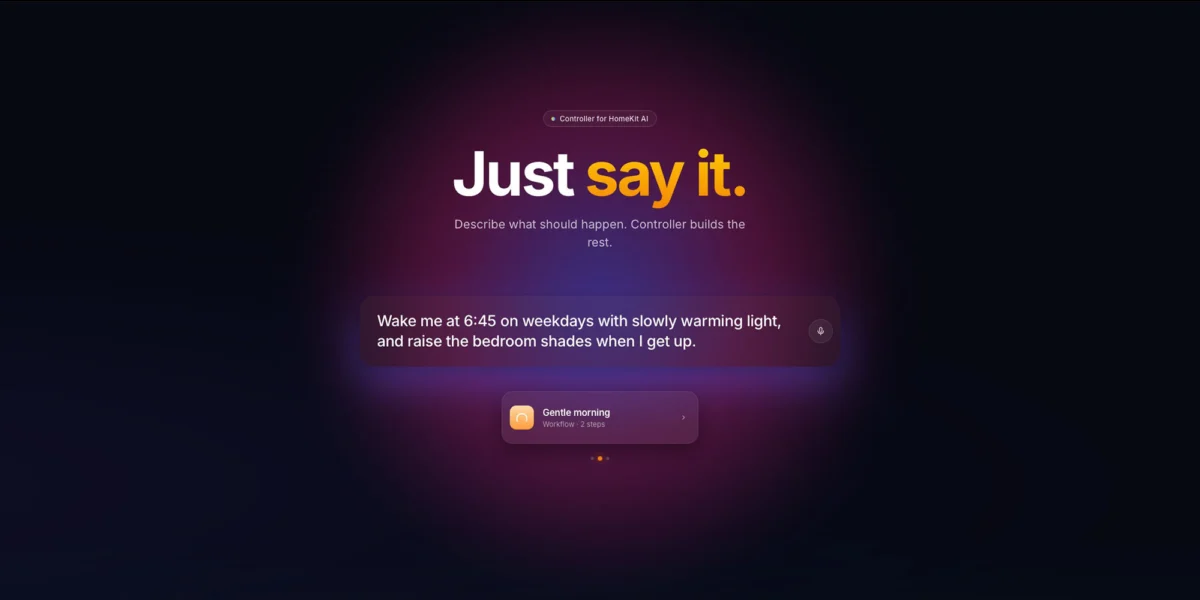
The Controller for HomeKit application, a prominent third-party utility designed to bridge the gap between Apple’s native Home app capabilities and the complex needs of advanced smart home enthusiasts, has officially integrated generative artificial intelligence into its automation suite. The new functionality, branded under the slogan “Just say it,” seeks to eliminate the steep learning curve traditionally associated with configuring intricate HomeKit scenes, triggers, and workflows by allowing users to employ natural language processing to dictate their desired home environment settings.
This update marks a significant shift in how users interact with the Apple smart home ecosystem. Historically, HomeKit users have been required to manually navigate a series of conditional menus, selecting specific devices, setting triggers based on time or location, and defining complex states to achieve sophisticated home automation. With this latest update, the application acts as an intermediary, interpreting descriptive prompts and automatically mapping those requests to the technical architecture of HomeKit’s underlying framework.
The Evolution of HomeKit Automation
To understand the significance of this development, one must examine the trajectory of Apple’s smart home platform. Since the inception of HomeKit in 2014, the ecosystem has matured from a basic remote-control interface into a robust, privacy-focused automation engine. However, as the number of supported device categories—ranging from smart lighting and climate control to advanced security systems and motorized window treatments—has expanded, the complexity of managing these devices has grown exponentially.
For years, the “Home” app provided by Apple has maintained a focus on simplicity and accessibility. While effective for basic operations, it often falls short for power users who desire granular control, such as multi-layered automations involving time-based offsets, state-dependent conditions, or cross-device coordination. Controller for HomeKit carved out its niche by providing a more powerful interface, and the introduction of AI-driven configuration is the next logical step in this evolution, aimed at democratizing high-level smart home management.
Technical Mechanics: From Natural Language to Logic Flows
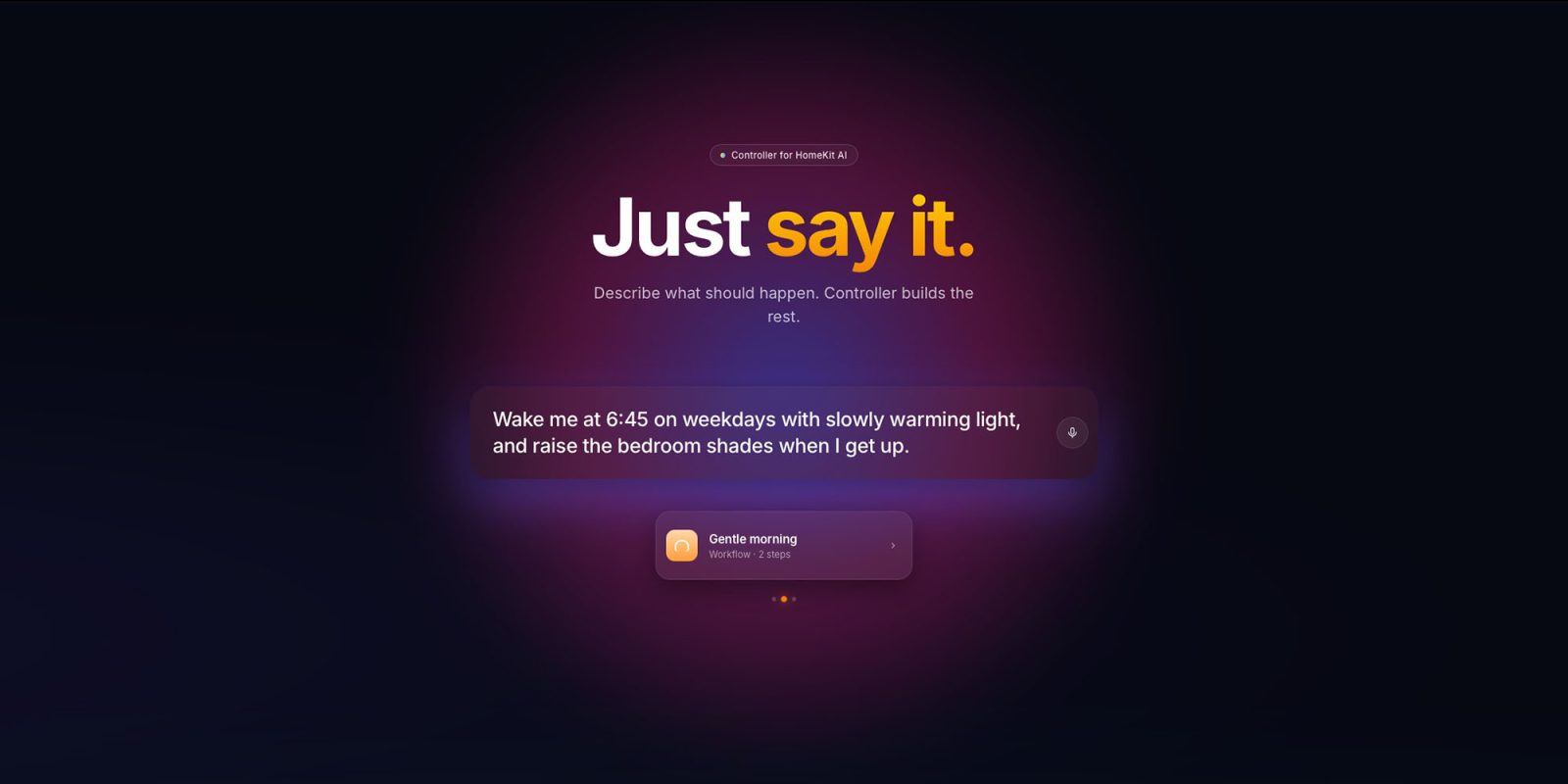
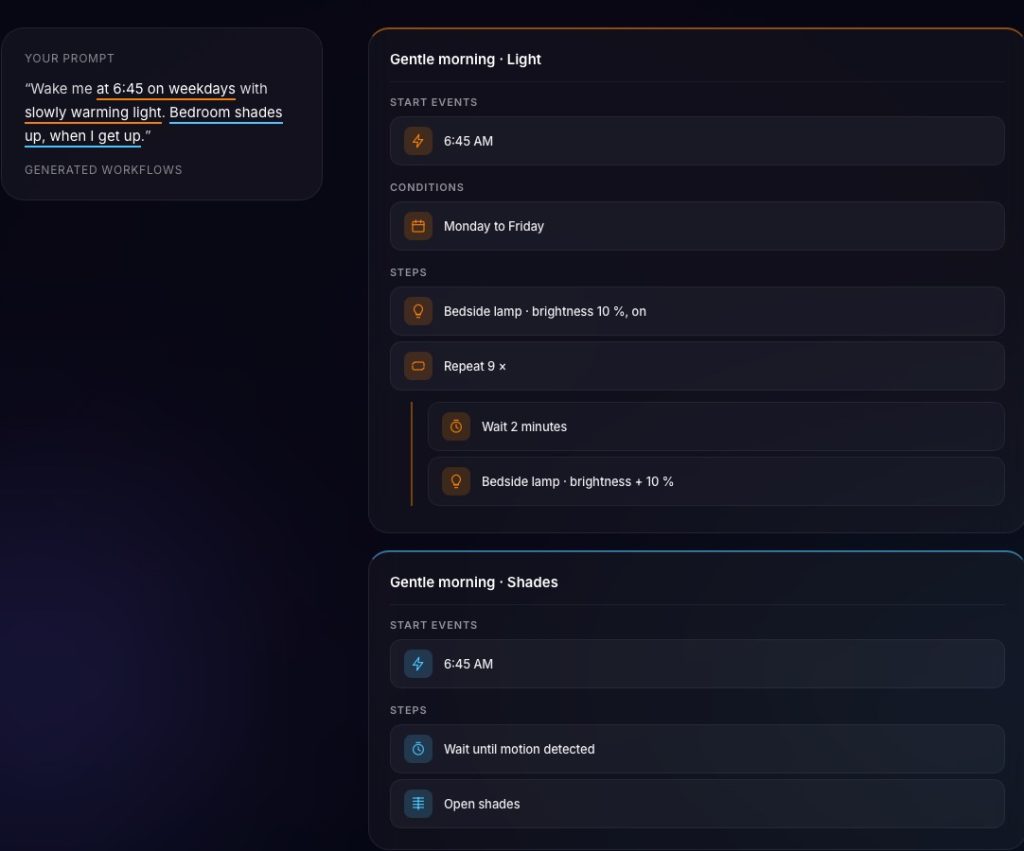
The implementation of the “Just say it” feature utilizes Large Language Model (LLM) technology to parse human intent. When a user enters a request, such as “Wake me at 6:45 on weekdays with slowly warming light, and raise the bedroom shades when I get up,” the AI backend decomposes this sentence into distinct logic components.
The app identifies the following parameters:
- Temporal Trigger: 6:45 AM, recurring on weekdays.
- Action Sequence A: Gradual light intensity increase (a complex lighting scene).
- Action Sequence B: Motorized shade adjustment (triggering upon a secondary event or time).
Once parsed, the software communicates with the Apple HomeKit framework to construct the necessary scenes and automation routines. This process removes the need for the user to manually select individual device entities from a list, toggle states, or define the intricate logic gates that prevent conflicting commands. By automating the backend configuration, the developer has effectively turned a ten-minute technical configuration task into a ten-second verbal or textual prompt.
Chronology of Development and Release
The integration of artificial intelligence into home automation software is part of a broader industry trend toward "ambient computing." Throughout 2025 and 2026, major players in the smart home sector have been pivoting toward predictive and generative interfaces.
- Q1 2026: Initial beta testing begins for the AI integration, focusing on parsing simple commands for lighting and climate control.
- April 2026: The developer refines the LLM integration to handle complex conditional logic, such as “If someone comes home after midnight, turn only the hallway light to 15%.”
- June 2026: Public release of the feature across the Controller for HomeKit platform.
- Current Status: The feature is now available to all subscribers, with ongoing refinements to improve accuracy and support for a wider array of third-party Matter-enabled devices.
Industry Context and Market Implications
The smart home market is currently experiencing a transition toward the "Matter" standard, an industry-wide interoperability protocol. As devices become more unified, the software layer—the "brain" of the house—becomes the primary point of differentiation.
The decision to gate this feature behind a subscription model ($40 per year for Essentials; $80 for Plus) reflects the ongoing costs associated with maintaining an AI-powered backend. Unlike static software, an AI-driven service requires constant server-side processing, token consumption for LLM queries, and regular updates to ensure compatibility with Apple’s evolving iOS and HomeKit APIs.
Industry analysts suggest that this shift toward AI-assisted configuration could significantly lower the barrier to entry for users who find traditional smart home setups daunting. However, it also introduces a new dependency: the reliance on a third-party developer’s cloud services to manage local home automations. While Apple’s native HomeKit remains local-first, users of the Controller app must weigh the convenience of AI configuration against the privacy and uptime considerations of relying on an external service provider.
Performance Analysis and User Experience
Early testing indicates that the system is highly proficient at mapping natural language to specific HomeKit actions. In controlled environments, the software successfully interpreted complex, multi-variable requests with minimal latency. For example, when tasked with creating a "Movie Night" scenario, the AI correctly identified that the user wanted to dim specific living room lights to a precise percentage while simultaneously closing window treatments—a task that would otherwise require multiple steps in the native Home app.
The effectiveness of this feature is inherently tied to the user’s existing smart home setup. If a user’s smart home devices are not properly named or organized within rooms in the Home app, the AI may struggle to identify the correct hardware. Success relies on a clean, well-organized HomeKit database. The developer has noted that the app is most effective when the user provides descriptive, clear commands, though the underlying models are becoming increasingly adept at handling colloquial phrasing.
Broader Impact on the Smart Home Ecosystem
The arrival of AI-driven automation represents a paradigm shift for the Internet of Things (IoT). For over a decade, the industry has struggled with the "fragmentation problem"—the difficulty of getting devices from different manufacturers to communicate effectively without significant technical overhead.

By automating the construction of these automations, Controller for HomeKit is not just simplifying the user interface; it is effectively providing a layer of "intelligence" that sits above the hardware. This has several implications:
- Reduction in "Automation Fatigue": Many users purchase smart home devices but fail to utilize their full potential due to the difficulty of setup. AI-driven interfaces encourage users to utilize more of their devices’ capabilities.
- Standardization of Logic: As AI handles the configuration, there is a potential for a more standardized approach to how automations are structured, potentially reducing bugs and system conflicts.
- Increased Value of Third-Party Apps: As Apple’s own tools remain relatively conservative in their feature set, third-party developers like those behind Controller for HomeKit are becoming the primary drivers of innovation in the space.
Looking Ahead
As the technology matures, it is expected that the next phase of development will move from reactive automation—where the AI builds what you ask for—to proactive automation, where the AI suggests improvements based on usage patterns. For instance, the system might eventually suggest: "You often dim the lights at 8 PM when the TV turns on. Would you like me to create an automation for that?"
For now, the “Just say it” feature provides a substantial utility for current users. While it is a paid addition, the time saved in configuring complex scenes and the reduction in technical friction may prove to be a worthwhile investment for those deeply embedded in the Apple ecosystem. As the industry continues to integrate AI into every facet of the user experience, applications like Controller for HomeKit will likely serve as a blueprint for how future smart homes will be managed: through natural conversation rather than manual configuration.
Prospective users are encouraged to utilize the provided seven-day trial to evaluate how the AI interprets their specific device library. As with all automation software, users should verify the generated routines within the native Home app to ensure they align with their preferences and privacy requirements. The future of the smart home, it seems, is not just in the devices we install, but in the intelligence we use to govern them.