
The outdoor apparel industry is built on a paradox: it sells products designed to protect the natural environment while simultaneously relying on manufacturing processes that heavily degrade it. For decades, one of the most glaring yet overlooked contradictions has hung in plain sight on the retail racks of outdoor gear shops worldwide. It is a problem defined not by bright, toxic neon colors or complex multi-colored prints, but by the most ubiquitous, dependable color in human fashion: black.
Walk down the fleece aisle of any well-stocked outfitter, and the scope of this systemic oversight becomes apparent. Dozens of versions of black garments hang side by side. To the casual shopper, they appear identical. Yet, upon closer inspection under direct, bright light, subtle variations emerge. One fleece leans fractionally toward a cool blue undertone, another toward a warm charcoal, and a third carries a deep, absolute darkness. These panels are all black, constructed from the exact same synthetic materials, manufactured in the same production season, and often sourced from the same global suppliers. Crucially, however, they are not the same color.
Behind these imperceptible variations lies a massive, resource-intensive web of redundant industrial processes. Every shade variation represents a distinct dye batch, a separate chemical formulation, an individual minimum order requirement, and an independent environmental footprint. Recognizing the absurdity of this hidden inefficiency, heritage outdoor brand Haglöfs, in partnership with textile innovator Polartec, has launched a collaborative initiative aimed at fundamentally rethinking how the industry approaches the world’s most popular neutral color.
The Synthetic Chemistry of Black: Understanding the Dye Dilemma
To fully grasp the scale of the issue, it is necessary to examine the industrial mechanics of textile dyeing, particularly for synthetic materials. The modern outdoor industry relies heavily on synthetic mid-layers crafted from polyester fleece, a material prized for its warmth-to-weight ratio, durability, and moisture-wicking properties. However, polyester possesses a hydrophobic chemical structure, meaning it naturally repels water and resists traditional water-based dyes used easily on natural fibers like cotton and wool.

Dyeing polyester requires an entirely different class of chemistry known as disperse dyes. These colorants are applied under intense conditions, typically requiring high-pressure vessels and water heated to temperatures of 130 degrees Celsius or higher. This thermal energy forces the dye molecules to penetrate the tight polymer matrix of the synthetic fiber.
Among all colors in the textile spectrum, black demands the most intensive application of resources. Achieving a deep, uniform, light-fast black requires layering multiple disperse dye molecules in precise ratios. This entails more complex chemical mixtures, extended fixation cycles, higher temperatures, and massive volumes of water.
According to global textile manufacturing data, the textile sector is responsible for roughly 20 percent of worldwide industrial water pollution, with wet processing—specifically dyeing and finishing—accounting for the lion’s share. Depending on the efficiency of the facility and the depth of the shade, producing a single kilogram of dyed polyester can consume anywhere from 30 to 150 liters of water. Because black sits at the absolute peak of color saturation demands, it consistently occupies the most resource-intensive end of that consumption scale.
The systemic flaw in the outdoor sector is that hundreds of competing brands independently commission their own proprietary shades of black. They repeat the same energy-intensive, water-heavy cycle over and over again, yielding finished products that are functionally indistinguishable to the end consumer.
The Economics of Minimum Order Quantities and Institutional Inertia
The persistence of this redundant dyeing is driven largely by manufacturing logistics and minimum order quantities (MOQs). Dye houses operate on economies of scale. To run a cost-effective dye cycle, facilities require a minimum volume of raw fabric—often several hundred kilograms per batch.
When a mid-sized outdoor brand designs a seasonal collection, its product teams specify exact color standards, frequently locking them into proprietary color codes. If a brand’s projected sales volume for a specific black fleece jacket does not meet the industrial MOQ for a custom dye run, they must either negotiate costly surcharges for smaller batches or accept standard stock runs that fail to match their exact internal design specifications.
This creates a fragmented market dynamic where dozens of separate outdoor labels commission independent laboratory dips, run separate recipe developments, conduct isolated quality control approvals, and pay separate environmental tolls for shades of black that differ only on a spectrophotometer. The waste is not generated by a single malicious corporate decision, but rather by the collective aggregation of hundreds of rational, isolated business choices that produce an irrational macroeconomic and ecological outcome.
For years, this inefficiency remained an open secret within supply chain circles. Institutional inertia kept the machinery running. The apparel industry, much like other heavy manufacturing sectors, operates on established habits. Changing a foundational supply chain variable requires alignment across multiple tiers of manufacturing, from yarn spinners and fabric knitters to brand designers and retail buyers.
The Black Capsule Project: A Provocative Public Argument
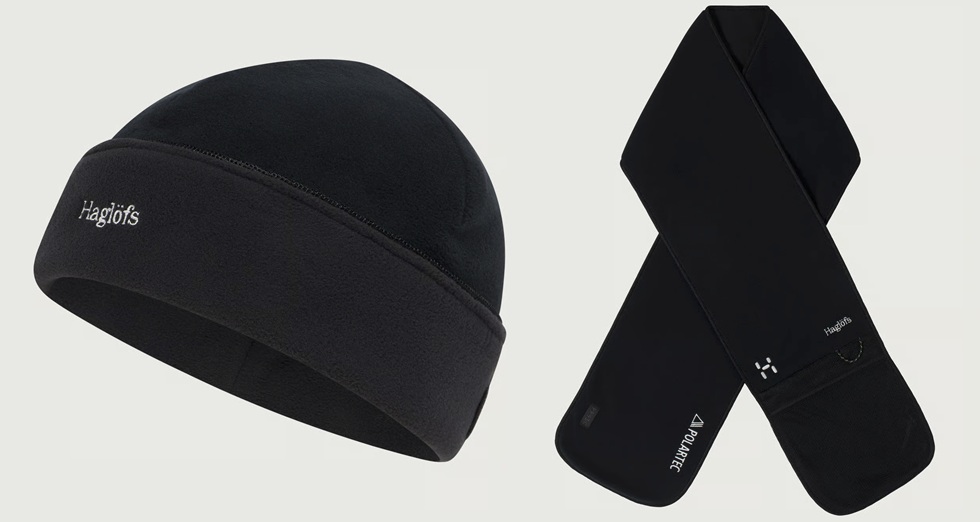
Before attempting to implement a permanent industrial fix, Haglöfs chose to make a striking public statement. The brand introduced the Black Capsule collection, a limited-run project consisting of a technical tee, a beanie, a scarf, and a pair of pants.
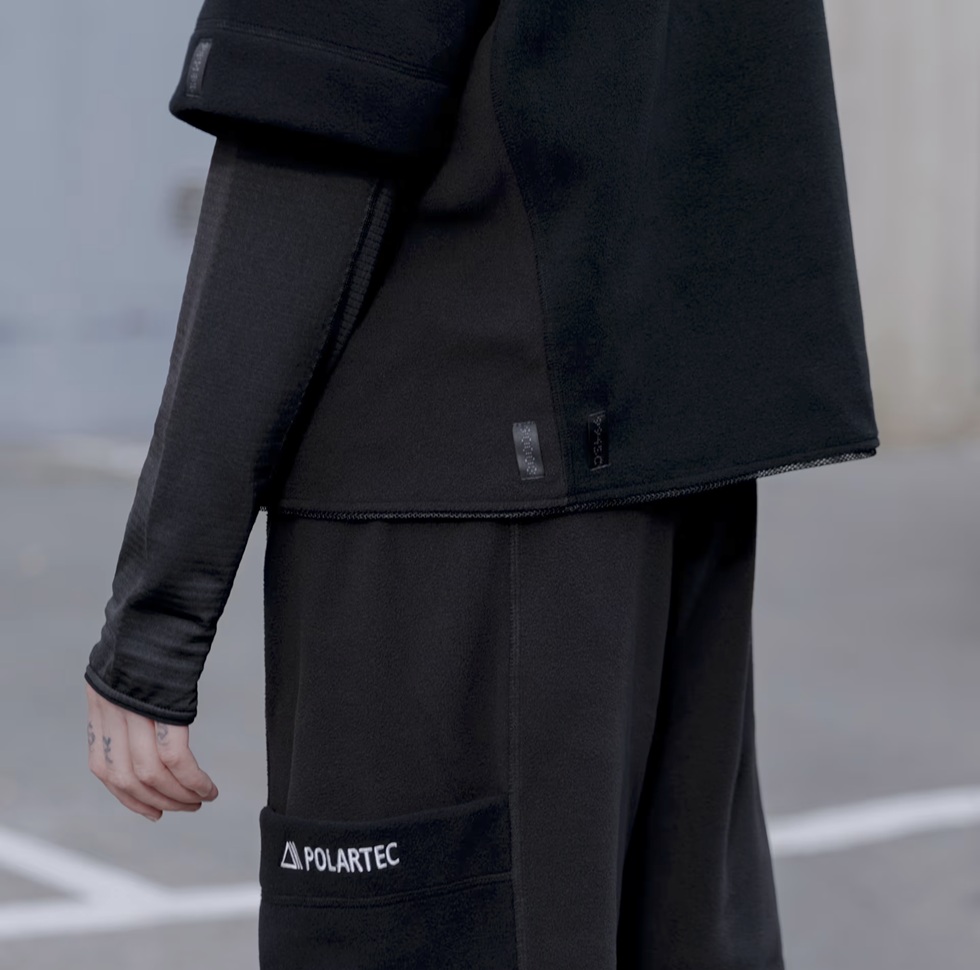
What distinguished the Black Capsule was its construction. Each garment was assembled from leftover scraps of black Polartec fleece sourced from multiple different historical dye variations, stitched deliberately into a single, cohesive item. To underscore the message, every individual pattern piece on the garments featured a prominent woven label stamped with its original color batch number.
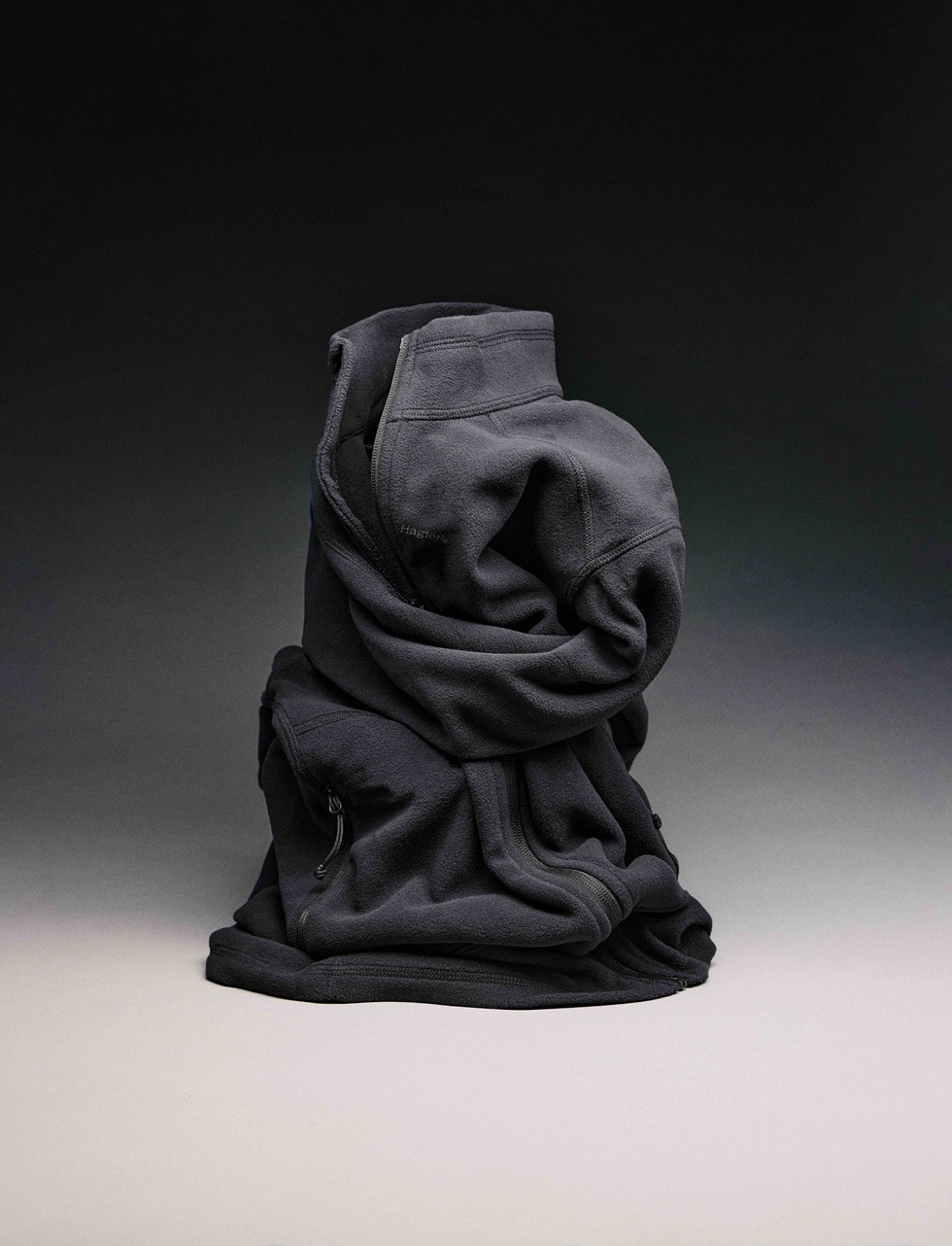
The labels served as a visual audit, making the invisible visible. They demonstrated to consumers and industry peers alike just how many separate dye runs had been executed to produce subtle, unnecessary variations of a single color within a single seasonal production cycle. The collection served as a bridge from abstract supply chain critique to tangible, physical proof.
Introducing Standard Issue Black: A Universal Industry Standard
Following the release of the Black Capsule, Haglöfs and Polartec formalized their solution: Standard Issue Black. The initiative is conceptually straightforward yet radical in its cooperative scope. The two companies established a single, highly optimized, universally accessible shade of black. Polartec integrated this specific color into its standard, large-scale production runs, making it openly available to the entire outdoor apparel market without proprietary lock-ins, licensing fees, or competitive restrictions.
By consolidating what would otherwise be fragmented, small-to-medium dye batches into massive, continuous production runs, the initiative unlocks substantial efficiency gains. According to internal production assessments provided by Haglöfs, transitioning to a consolidated standard black yields a projected reduction of over 50 percent in water consumption and at least a 20 percent decrease in thermal energy usage compared to traditional fragmented piece-dyeing methods. While these figures represent manufacturer-supplied estimates rather than independently audited lifecycle assessments, the underlying chemistry and industrial engineering principles of batch consolidation are well-established.
The rollout of Standard Issue Black moves from conceptual demonstration to commercial reality with Haglöfs’ Fall/Winter 2026 collection. Rather than reserving the standard exclusively for niche sustainability capsules or premium limited-edition lines, the brand has integrated the initiative directly into its highest-volume commercial volume drivers.
The primary vehicle for this implementation is the Buteo Mid II Jacket, one of the brand’s best-selling mid-layer styles. Eva Weiss, Head of Design and R&D at Haglöfs, emphasized the strategic importance of choosing a volume bestseller for the rollout. Implementing a sustainable standard in a low-volume novelty item serves merely as a marketing exercise; embedding it into a mass-market bestseller forces real, scalable supply chain transformation.

Overcoming the Creativity Objection in Apparel Design
A common critique raised by apparel designers when discussing material standardization is the fear of aesthetic homogenization. The immediate concern is that if multiple competing brands adopt the exact same shade of black, outdoor collections will lose their distinct brand identity and visual diversity.
Industry veterans, however, argue that this concern misunderstands where true differentiation occurs in technical apparel. Black has rarely been the primary vehicle for brand distinction in the outdoor sector. Differentiation is achieved through specialized ergonomic cuts, innovative garment construction techniques, proprietary hardware, functional pocket placements, technical fabric specifications, branding accents, and secondary seasonal colorways. Black serves as the neutral, reliable canvas upon which technical performance features are built.
Weiss addressed this design anxiety directly during the launch discussions, noting that standardization does not stifle creativity. Instead, by establishing a reliable, pre-optimized framework for foundational elements, design teams are liberated to focus their creative energy on structural innovation, performance enhancements, and stylistic details that genuinely add value for the consumer.
Industry parallels support this perspective. Decades ago, the outdoor and broader apparel industries largely standardized around a small pool of fastener and closure systems, most notably YKK zippers. Today, the presence of an industry-standard zipper on a high-end technical shell is entirely unremarkable. Few critics argue that the widespread adoption of standardized zippers has diminished creative expression in outerwear design. Standard Issue Black applies this exact pragmatic logic to textile coloration.
Industry Implications and the Path Forward
Despite the clear economic and environmental advantages of Standard Issue Black, widespread adoption across the broader outdoor industry remains an open question. The apparel sector has a documented history of introducing well-intentioned sustainability initiatives that garner industry praise but ultimately fail to achieve cross-brand adoption due to competitive silos and supply chain inertia.
Furthermore, the persistent challenge of the "green premium"—the historical gap between consumer sustainability values and actual purchasing behavior—has stalled numerous environmental innovations. Standard Issue Black sidesteps this hurdle because its economic structure is neutral to positive; it reduces production complexity and manufacturing costs rather than adding surcharges to the end consumer.
The primary barrier to universal adoption is not financial or technical, but institutional. Shifting established manufacturing routines requires brands to relinquish proprietary color control in favor of cooperative resource sharing. Similar systemic shifts are currently underway in other corners of the textile and manufacturing worlds, such as efforts to streamline synthetic recycling streams, eliminate per- and polyfluoroalkyl substances (PFAS), and optimize mono-material garment construction.
Whether competing outdoor brands will look past legacy branding strategies to adopt a unified standard remains to be seen. However, as initiatives like Haglöfs and Polartec’s Standard Issue Black transition from conceptual art projects into commercial volume drivers like the Buteo Mid II, the industry is being forced to confront an uncomfortable truth: when it comes to saving water and energy, fifty shades of black are simply no longer defensible.