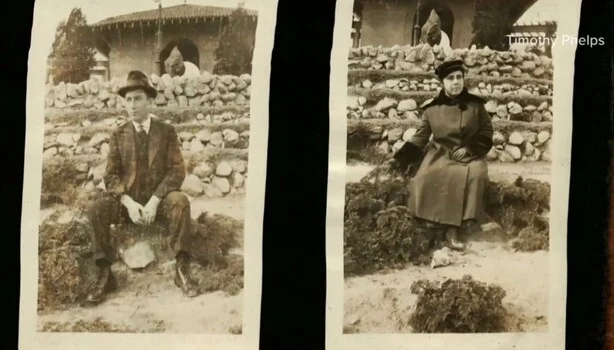
Dusty attics and cluttered garages frequently harbor forgotten relics of the past, but few discoveries carry the historical weight of a weathered photo album recently brought to light in Texas. Unearthed during the clearing of a friend’s late father’s garage, the modest album contains a series of handwritten labels identifying America’s most notorious Depression-era outlaws: Clyde Barrow and Bonnie Parker. For Timothy Phelps, a dedicated researcher who has spent more than fifteen years meticulously examining the lives and crimes of the Barrow Gang, holding these photographs represents a thrilling potential breakthrough. Yet, as Phelps has quickly learned, the journey from finding a compelling piece of historical memorabilia to achieving formal academic and institutional validation is fraught with skepticism, technical hurdles, and the stubborn demand for an unbroken chain of custody.
The discovery has reignited public fascination with the legendary duo, whose violent and glamorous two-year crime spree across the American Southwest permanently etched their names into the folklore of the Great Depression. While the album itself sat closed on a shelf for roughly a year after Phelps first encountered it, his subsequent examination revealed a series of intimate, unpolished snapshots that appear to depict the outlaws in settings never before documented by historians. Among the pages are frames featuring buildings marked with period-specific signage, including a distinct "hotel" marker that Phelps has spent years attempting to cross-reference with historical maps, local archives, and documented travel routes of the Barrow Gang.
The Road to Discovery and the Burden of Proof
Phelps’ meticulous investigation involved holding the newly discovered prints directly against authenticated, archival photographs of Bonnie Parker and Clyde Barrow. By scrutinizing posture, clothing styles, and facial structures, he sought to build a circumstantial case that the people captured on the film rolls were indeed the active members of the infamous criminal syndicate. However, translating personal conviction into accepted historical fact proved to be an uphill battle. When Phelps approached established museums, historical societies, and academic institutions, he was met with institutional reluctance, flat rejections, and, in some instances, outright hostility.
According to Phelps, many museum curators and historians declined to authenticate the materials, citing a lack of verifiable background information. The core obstacle facing the collection is a critical absence of provenance—the documented, verifiable history of ownership that traces an artifact from its creation to the present day. Rumors and vague recollections suggesting the album may have originated from an abandoned desert shack in California do little to satisfy rigorous archival standards. Without a clear paper trail documenting how the album moved from the hands of the outlaws or their immediate associates into the garage in Texas, mainstream institutions remain deeply hesitant to officially recognize the photographs as genuine historical artifacts of the Barrow Gang.
Anatomy Versus Archives: The Forensic Perspective
While traditional historians and museum administrators have largely dismissed the collection due to its murky origins, forensic science offers a different lens through which to evaluate the imagery. In his efforts to find credible validation, Phelps consulted prominent figures in forensic analysis, yielding mixed professional responses. Mark Hall-Patton, a well-known retired administrator for the Clark County Museum System in Nevada and a recognized expert frequently featured on historical programs, examined the physical album, the print quality, and the ink used in the handwritten captions. Hall-Patton concluded that the physical materials, paper stock, and handwriting styles were entirely consistent with the 1930s period. Nevertheless, he stopped short of making a definitive identification of the individuals depicted, maintaining that facial features alone in historical snapshots do not provide sufficient evidentiary weight without supporting documentation.
Taking a more assertive stance, renowned Houston forensic artist Lois Gibson—who holds a Guinness World Record for the number of suspect and historical identifications achieved through her artistic and analytical work—applied rigorous comparative methodologies to the portraits. Gibson utilized digital transparency overlays, superimposing the facial features from the newly discovered prints directly over verified, authenticated photographs of Bonnie Parker and Clyde Barrow.
According to Gibson, the structural alignment is striking. She noted that while soft tissue—such as weight fluctuations and aging—can alter the appearance of a human face over time, the underlying skeletal structure remains constant. By analyzing the contours, proportions, and geometry of the facial bones, Gibson stated with professional confidence that the anatomical markers of the man and woman in the album match those of Barrow and Parker. "That is the same facial bones in both of those men," Gibson affirmed regarding the male subject, asserting a similar conclusion for the female subject.
The Science of Facial Comparison and Historical Precedent
Despite the compelling nature of forensic superimposition, modern investigative standards treat such techniques as only one component of a comprehensive analytical framework. Guidelines established by the Facial Identification Scientific Working Group (FISWG), an initiative launched by the FBI in 2009 to standardize image analysis in law enforcement and forensic contexts, emphasize that facial superimposition must always be corroborated by a meticulous, feature-by-feature comparative analysis. Furthermore, the FISWG guidelines explicitly dictate that superimposition is valid only when comparing images captured from identical viewpoints, as camera angles, focal lengths, and shooting distances can drastically distort facial rendering and perspective.
The historical record demonstrates that authentic photographs of Bonnie and Clyde often relied on serendipitous preservation rather than controlled provenance. The most famous images of the outlaws—such as the iconic photograph of Bonnie Parker posing defiantly with a cigar clenched in her teeth and a revolver gripped in her hand—survived purely by chance. In April 1933, following a violent shootout with law enforcement at a suspected hideout in Joplin, Missouri, the fleeing gang abandoned a camera containing several undeveloped rolls of film. Police recovered the equipment, had the film processed at the local newspaper, the Joplin Globe, and distributed the frames across the national newswire, instantly cementing the romanticized outlaw imagery in the public consciousness.
Family archives have similarly served as vital repositories for authentic visual history. In September 2025, RR Auction facilitated the sale of an extensive collection containing approximately 600 photographs originating from the personal collection of Nell Barrow, Clyde Barrow’s older sister. Fetching $23,750 at auction, the archive included between 50 and 60 rare photographs of Bonnie and Clyde, several of which had originally been published in the 1934 biographical account co-authored by Nell Barrow and Bonnie’s mother, Emma Parker. These documented collections underscore the vast difference between an archive supported by a direct familial paper trail and an orphaned album discovered by chance in a residential garage.
Broader Implications for Outlaw History and Archival Authentication
The ongoing debate surrounding Timothy Phelps’ newly discovered album highlights a persistent tension within historical research: the friction between empirical forensic science and strict archival methodology. As historians and archivists prioritize provenance and verifiable chains of custody to protect the integrity of historical collections, independent researchers and forensic specialists increasingly turn to scientific analysis—including anatomical comparison, material dating, and environmental forensics—to unlock the secrets of unprovenanced artifacts.
For researchers studying the Great Depression and the era of motorized outlaws, the potential existence of unpublished photographs carries immense value. Beyond the faces of Barrow and Parker, the background details within the album’s frames—such as period architecture, vintage automobiles, local storefronts, and regional landscapes—may ultimately provide the definitive key to validation. If historians can successfully date and locate the physical settings captured in the background of the prints, the resulting contextual evidence could bypass the absence of a traditional paper trail, offering an independent verification method that relies on verifiable geography rather than subjective visual interpretation.
Until such physical locations are conclusively identified and accepted by the broader academic community, the album remains a tantalizing enigma—a bridge between documented history and unexplored folklore. Whether future technological advancements and rigorous archival detective work will officially elevate these images into the canon of officially recognized Barrow Gang documentation remains to be seen. In the interim, the battered photo album sits as a compelling testament to the enduring public obsession with America’s most infamous outlaw couple, proving that even nearly a century after their violent deaths in a Louisiana ambush, Bonnie Parker and Clyde Barrow retain an unmatched capacity to captivate, mystify, and challenge the boundaries of historical inquiry.