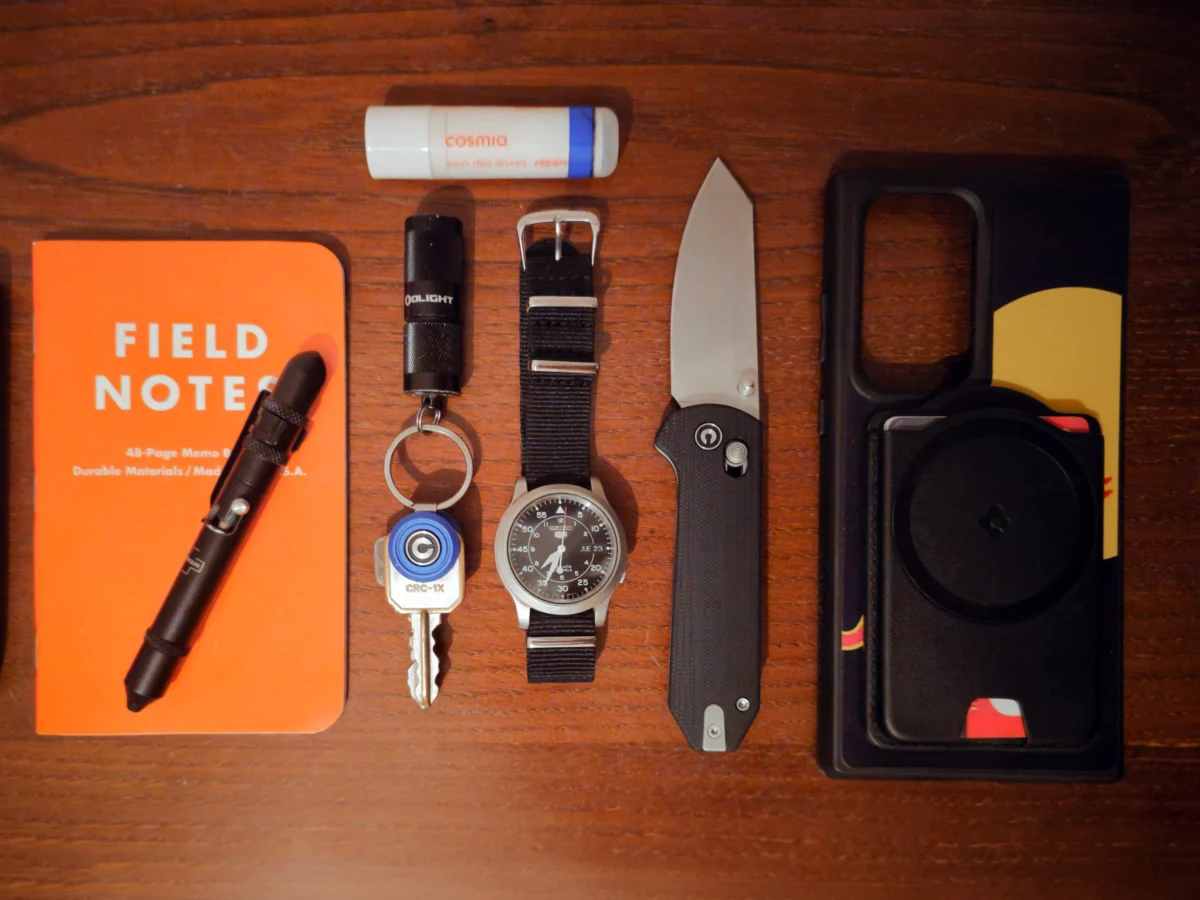
The concept of Everyday Carry (EDC) has evolved from a niche hobby into a sophisticated philosophy of personal preparedness and professional efficiency, as demonstrated by Ruben, an Aeronautical Automation Operator based in Portugal. In high-stakes technical environments such as aeronautical automation, the selection of personal tools is rarely accidental; it is an exercise in balancing weight, utility, and reliability. Ruben’s current loadout represents a shift toward "high-value minimalism," a trend where users prioritize high-performance gear that remains unobtrusive during complex technical operations. By analyzing the components of this specific carry, one gains insight into the broader intersection of professional requirements and the modern consumer market for EDC gear.
The Professional Context: Tools for Aeronautical Automation
Aeronautical automation is a field defined by precision and the management of complex systems. Operators in this sector are responsible for the oversight of automated flight systems, air traffic control interfaces, and ground-based navigation technologies. In such an environment, the tools carried on one’s person must serve two purposes: they must facilitate quick problem-solving and they must not interfere with the movement or the safety protocols of a high-tech workspace.
Ruben’s choice of gear reflects a disciplined approach to these requirements. The reliance on compact, multi-functional items—such as a keychain flashlight and a mini bolt-action pen—suggests a need for tools that are available for immediate use without adding significant bulk to a professional uniform. In the aeronautical sector, where space can be at a premium and safety regulations are stringent, the "less is more" philosophy is not just an aesthetic choice but a functional mandate.
Central Components: The CIVIVI Yonder and Field Notes
At the heart of Ruben’s current rotation is the CIVIVI Yonder, a pocket knife that has garnered significant attention within the industry. Designed by Zac Whitmore, an alumnus of Blade HQ, the Yonder recently secured the "Best Buy of the Year" award at Blade Show 2024. This accolade is significant; Blade Show is the world’s largest knife show, and the "Best Buy" category recognizes products that offer the highest ratio of build quality to price.
The CIVIVI Yonder features a crossbar lock mechanism, which provides a high degree of safety and ambidextrous operation—a critical feature for professionals who may need to deploy a tool with either hand while managing other equipment. Its design is described as "no-nonsense," focusing on ergonomics and a clean blade geometry that excels at the utilitarian tasks common in a technical workshop or an office setting. The inclusion of this specific tool highlights a growing trend among professionals to seek out award-winning engineering that does not require the massive financial investment typically associated with "custom" or "boutique" gear.
Complementing the hardware is the addition of Field Notes. Despite the ubiquity of digital devices in aeronautical automation, the resurgence of analog note-taking remains a hallmark of the EDC community. For an operator, the ability to quickly jot down a system code, a coordinate, or a maintenance reminder without navigating a digital interface is invaluable. Field Notes has successfully positioned itself as the standard for this practice, offering a slim profile that fits easily into a pocket alongside a smartphone.
Consolidating the "Pocket Footprint"
A key element of Ruben’s setup is the consolidation of daily essentials to minimize "pocket noise." This is achieved through the use of a magnetic wallet and an ultra-compact key organizer.
- Magnetic Wallet Integration: By utilizing a magnetic wallet that attaches directly to a smartphone, the user eliminates the need for a traditional, bulky billfold. In a professional setting where movement is frequent, reducing the number of independent items in one’s pockets decreases the likelihood of loss and improves comfort.
- Key Organization: Traditional keychains are often loud and cumbersome. The move toward compact key organizers—which stack keys in a silent, Swiss Army-style chassis—reflects a desire for organizational discipline. For an aeronautical professional, the elimination of jingling keys is a minor but meaningful improvement in professional decorum and focus.
- The Bolt-Action Pen: The choice of a mini bolt-action pen is a nod to both durability and tactile satisfaction. Bolt-action mechanisms are favored in EDC circles because they lack the plastic clicking components of standard pens that are prone to breaking. They are also less likely to accidentally deploy in a pocket, preventing ink stains on professional attire.
The Off-Duty Transition: Aesthetic and Functional Shifts
Ruben’s approach to EDC includes a clear distinction between "on-the-job" and "off-the-go" configurations. When not performing his duties as an automation operator, he suggests a transition to gear that leans more toward classic aesthetics while maintaining high performance. This involves swapping the CIVIVI Yonder for a Kizer Feist and replacing his work watch with a Casio Edifice featuring a "Tiffany" blue dial.
The Kizer Feist, designed by Justin Lundquist, is a front-flipper knife known for its sleek, "gentleman’s carry" profile. It represents a more refined aesthetic that fits well in social or formal environments. Meanwhile, the Casio Edifice EFB-108D-1AV (or similar variants) has become a cult favorite among horology enthusiasts. The "Tiffany" dial—a vibrant turquoise hue—references the iconic color associated with high-end luxury watches like the Patek Philippe Nautilus. By choosing a Casio Edifice with this dial, Ruben aligns with a market trend that values "attainable luxury"—high-quality sapphire crystal and reliable quartz movements paired with high-fashion colorways.
Market Trends and the Growth of EDC Culture
The data surrounding the EDC market suggests that Ruben’s kit is part of a global surge in consumer interest. The global EDC market, which includes knives, multi-tools, flashlights, and high-end stationery, is projected to continue its steady growth through 2030. Analysts attribute this to several factors:
- The "Prosumer" Movement: More individuals are seeking professional-grade tools for everyday tasks, driven by a desire for longevity and "buy it for life" (BIFL) sustainability.
- Social Media Influence: Platforms like Instagram have allowed users to share "pocket dumps," fostering a community where design, color coordination, and utility are analyzed in great detail.
- Technological Advancement in Materials: The accessibility of high-end materials like Nitro-V steel (often used by CIVIVI) and aerospace-grade aluminum has lowered the entry price for high-performance gear.
In Portugal, as in much of Europe, the EDC community is growing, though it often faces stricter legal regulations regarding the carry of pocket knives compared to the United States. Ruben’s selection of the CIVIVI Yonder and Kizer Feist—both relatively modest in size and non-threatening in appearance—reflects a savvy navigation of these social and legal norms.
Implications for Professional Efficiency
The enrichment of one’s daily carry is more than a pursuit of gadgets; it is an investment in personal infrastructure. For an Aeronautical Automation Operator, the implications of a well-curated EDC are manifold:
- Reduced Cognitive Load: Knowing exactly where every tool is located and having confidence in their reliability allows a professional to focus entirely on the task at hand.
- Preparedness: A keychain flashlight or a reliable blade can turn a potential workplace delay (such as a power flicker or a jammed package) into a minor, easily solved inconvenience.
- Professional Identity: The care taken in selecting tools often mirrors the care taken in one’s professional output. A streamlined, high-quality kit suggests a person who values order, precision, and efficiency.
Conclusion
Ruben’s EDC profile serves as a case study in the modern application of tool selection within a specialized technical field. By balancing the award-winning utility of the CIVIVI Yonder with the timeless practicality of Field Notes and the aesthetic flair of a Tiffany-dial Casio, he demonstrates that "Everyday Carry" is a highly personal yet deeply functional endeavor. As the EDC market continues to innovate, the focus remains on the synergy between the user and their tools—a relationship that is particularly vital in the demanding world of aeronautical automation. Through strategic minimalism, professionals can ensure they are always equipped for the challenges of the job while remaining unencumbered by the weight of the unnecessary.