
Lockheed Martin, a global aerospace, arms, defense, information security, and technology corporation, has announced the unveiling of its groundbreaking counter-drone system, the Morfius X-Rotor. This innovative platform is engineered to address the escalating threat posed by hostile drone swarms, capable of neutralizing an impressive fifty enemy drones in a single mission. The Morfius X-Rotor represents a significant leap forward in defensive capabilities, leveraging high-power microwave (HPM) technology to disable targets non-kinetically, thereby minimizing collateral damage and boasting a "significantly low cost per kill."
The Dawn of a New Counter-UAS Paradigm
Introduced on July 20, 2026, the Morfius X-Rotor is described as a ground-launched, one-to-many drone-kill system designed for rapid deployment and reuse. Its primary function is to ascend into contested airspace and engage large enemy drone formations, effectively disrupting their operational capabilities. Unlike traditional kinetic interceptors that rely on physical impact or explosives, the Morfius X-Rotor employs a directed energy weapon in the form of high-power microwaves. This method works by overwhelming the electronic systems of incoming drones, causing them to malfunction and cease operation without creating dangerous debris fields or requiring explosive payloads. This non-kinetic approach is crucial for operations in sensitive environments where minimizing collateral damage is paramount.
The introduction of the Morfius X-Rotor comes at a critical juncture in modern warfare. The proliferation of unmanned aerial systems (UAS), particularly in the form of coordinated swarms, has become one of the most pressing challenges for military forces worldwide. Recent conflicts, notably the ongoing hostilities in Eastern Europe and the Middle East, have underscored the vulnerability of conventional military assets to these relatively inexpensive yet highly effective threats. Swarms of hostile drones can overwhelm traditional air defense systems designed for larger, faster targets, posing risks to personnel, infrastructure, and high-value military equipment. The U.S. defense tech company explicitly states that these drone swarms are fast becoming the biggest threat to allied forces on today’s battlefields, directly motivating the creation of the Morfius X-Rotor.
Technological Prowess and Operational Advantages
The Morfius X-Rotor stands out due to several key technological and operational features. Lockheed Martin asserts that it is "the only ground-launched, field-reusable airborne HPM system capable of delivering more than 50 drone kills per flight using any command and control system and no dependence on fire control radars." This claim highlights several distinct advantages:
- Ground-Launched and Field-Reusable: The ability to launch from ground platforms enhances operational flexibility and rapid deployment in various tactical scenarios. Its reusability means that after a mission, the drone can be recovered, recharged, and redeployed, significantly reducing the logistical footprint and overall operational costs compared to single-use interceptors.
- Airborne HPM System: Integrating HPM capabilities into an airborne platform allows the system to achieve optimal positioning for engaging multiple targets simultaneously and effectively, covering a wider area than ground-based HPM systems might.
- High Kill Rate (50+ drones per flight): This capability directly addresses the swarm threat. Engaging multiple targets with a single platform is far more efficient and cost-effective than attempting to counter each drone individually, which can quickly deplete expensive kinetic interceptor inventories.
- Independence from Fire Control Radars: This is a crucial feature, particularly in contested environments characterized by heavy electronic warfare (EW). By not relying on dedicated fire control radars for target acquisition and engagement, the Morfius X-Rotor enhances its survivability and effectiveness against adversaries employing jamming or electronic countermeasures. This independence likely suggests advanced on-board sensors and autonomous targeting capabilities, making it resilient to sophisticated electronic attacks.
A video shared on social media provided an initial glimpse of the Morfius X-Rotor in action, depicting a trio of the systems launched into the sky. The footage showcased a target acquisition HUD (Heads-Up Display) followed by several microwave blasts, visually demonstrating the system’s intended operation. While the company has not confirmed whether the video contains live-action test footage or is a rendered animation, it effectively illustrates the concept and potential impact of the technology.
Strategic Alignment and Development History
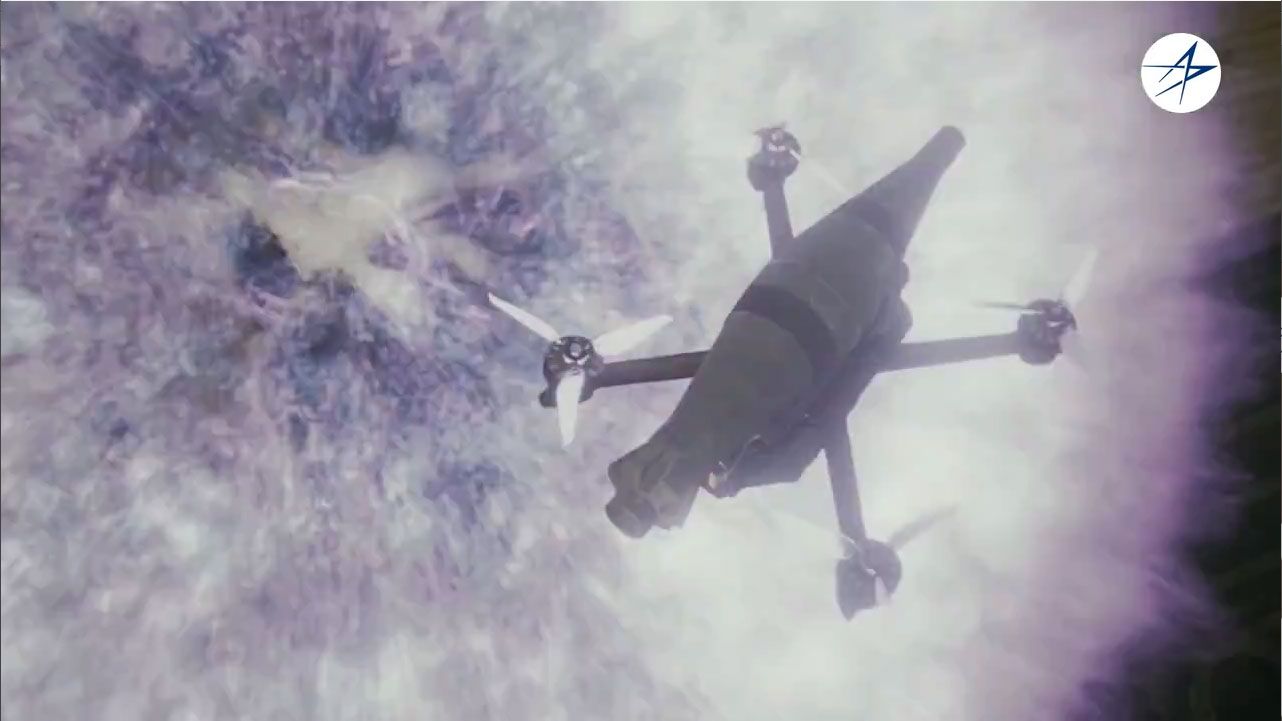
The development of the Morfius X-Rotor aligns perfectly with broader strategic objectives, specifically fitting into the U.S. Department of War’s 2025-2028 Rapid Response Counter-UAS Roadmap. This roadmap underscores the urgency and priority placed on developing and fielding effective solutions to counter evolving drone threats, emphasizing speed, adaptability, and cost-efficiency. The Morfius X-Rotor, with its rapid deployment, reusability, and low cost per kill, directly addresses these strategic imperatives.
Lockheed Martin further emphasizes the system’s reliability by stating that it is built on a "proven platform of Morfius variants which have been flying since 2017." This long development timeline suggests a mature technology, refined through years of research and testing. Recent field tests, conducted across several U.S. states, validate the system’s capabilities and readiness for operational deployment. A Lockheed Vice President commented on the video demo, stating it represents "a new benchmark for counter-drone capability – delivering a high kill rate while keeping the cost per kill low." This statement encapsulates the core value proposition of the Morfius X-Rotor: superior performance combined with economic viability.
The Expanding Landscape of High-Power Microwave Technology
High-Power Microwave (HPM) technology is rapidly emerging as a preferred method for counter-UAS applications due to its non-kinetic nature and ability to engage multiple targets simultaneously. The principle behind HPM weapons involves directing intense bursts of electromagnetic energy at electronic systems, disrupting or destroying sensitive components. This effect can range from temporary disabling to permanent damage, depending on the power and duration of the microwave exposure.
The Morfius X-Rotor is not an isolated development in the HPM field. Other defense contractors and nations are also investing heavily in similar technologies. For instance, the Epirus Leonidas system, a ground vehicle-based HPM solution, has demonstrated remarkable effectiveness. During a live-fire trial in Indiana last year, the Leonidas system "neutralized 61-of-61 drones" in a single engagement, showcasing the immense potential of this technology. Such successes highlight the growing confidence in HPM as a viable and highly effective countermeasure against drone threats.
Globally, the race for HPM superiority is intense. China, for example, has reportedly developed an incredibly powerful 20-gigawatt microwave weapon, dubbed the TPG1000C. Described by state media as "Starlink’s worst nightmare," this portable 5-ton device is touted as capable of delivering full-minute destructive bursts, potentially disrupting satellite communication networks. This indicates a broader strategic interest in HPM technology beyond just counter-drone applications, extending to electronic warfare and anti-satellite capabilities. The development of such systems by major global powers underscores the strategic importance and potential impact of directed energy weapons on future conflicts.
Implications and Future Outlook
The unveiling of the Morfius X-Rotor carries significant implications for military strategy, force protection, and the future of aerial combat.
- Enhanced Force Protection: For military units, especially those operating in forward positions or critical infrastructure, the Morfius X-Rotor offers a robust defense against drone threats that were previously difficult and costly to counter. Its ability to rapidly neutralize swarms can prevent intelligence gathering, harassment, and destructive attacks, thereby enhancing troop safety and operational continuity.
- Economic Advantage: The "low cost per kill" is a game-changer. In an era where adversaries can deploy vast numbers of inexpensive drones, conventional missile-based air defenses often prove economically unsustainable. A single interceptor missile can cost hundreds of thousands or even millions of dollars, while the target drone might cost only a few thousand. HPM systems like Morfius X-Rotor offer a far more sustainable economic model for defense against massed drone attacks.
- Adaptation to Asymmetric Warfare: The Morfius X-Rotor represents an adaptation to the realities of asymmetric warfare, where non-state actors or smaller nations can leverage off-the-shelf drone technology to challenge technologically superior militaries. By providing an effective and affordable counter, systems like Morfius X-Rotor help restore a technological advantage.
- Evolution of Air Defense Doctrine: The deployment of such systems will likely influence the evolution of air defense doctrine. Future strategies may increasingly integrate layered defenses combining traditional kinetic systems with non-kinetic HPM, laser, and electronic jamming capabilities to provide comprehensive protection against a diverse range of aerial threats.
- Ethical Considerations: As with any advanced military technology, the deployment of HPM systems raises ethical considerations, particularly regarding their potential use and impact in civilian areas. However, the non-kinetic nature of HPM, which disables rather than destroys, generally leads to less collateral damage than explosive-based weapons, potentially offering a more humane option for neutralizing threats.
While the immediate focus is on military applications, the underlying technology of high-power microwaves could also find future applications in civilian security contexts, such as protecting airports, critical infrastructure, or large public gatherings from unauthorized drone intrusions. The continued development and refinement of systems like the Morfius X-Rotor will be crucial in shaping the defensive capabilities against the increasingly sophisticated and pervasive threat of unmanned aerial systems in the coming decade. The future of counter-drone warfare appears to be increasingly directed by energy.